A chart shows that the Baltic Dry Index rose for the sixth consecutive trading day, with freight rates for all vessel types strengthening in tandem.
2026-11-11 23:24:28
The latest data shows that the Baltic Dry Index (BDI) reached 2959 points on November 11, 2026, a new high since October 8, 2026, up 3.39% month-on-month, the largest increase since November 4, 2026, and marking the sixth consecutive day of increase (including zero growth). Looking at the short-term charts, the recent 11 BDI data points show: 9 positive increases, 2 negative increases, and 0 zero increases. Specifically, the Panamax Freight Index (BPI) reached 2103 points, up 1.35% from the previous value; the Capesize Freight Index (BCI) reached 4700 points, up 5.45%; and the Supramax Freight Index (BSI) reached 1810 points, up 0.22%. For detailed 720-day and 10-year trend charts of the Baltic Dry Index and its three sub-indices, please refer to the charts specially prepared by FX678. 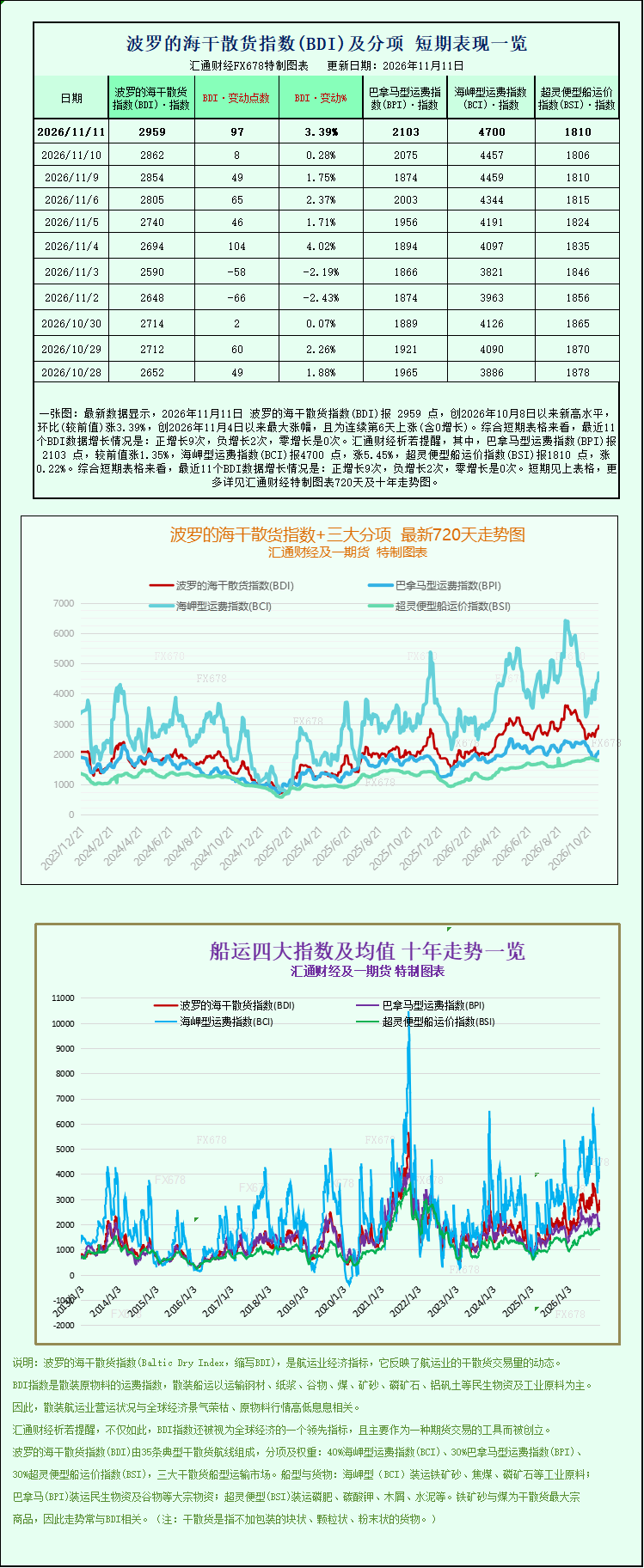 The Baltic Dry Index (BDI), the core shipping freight index of the Baltic Exchange that tracks global dry bulk commodity freight rates, recorded its sixth consecutive day of gains on Wednesday. Freight rates across all major vessel types rose, driving a continued recovery in the overall market index and further restoring the dry bulk shipping market's prosperity. The Baltic Dry Index, which comprehensively reflects the charter rates for Capesize, Panamax, and Supramax vessels, rose 97 points, or 3.4%, to close at 2959 points, a new high since October 8th. This sustained rebound in the index has broken the previous period of weak market fluctuations, reflecting marginal changes in the global dry bulk shipping demand and the supply-demand relationship of shipping capacity. Looking at the performance of different vessel types, the largest Capesize vessels were the core driver of the index's rise, with a significantly higher increase than other vessel types. The Capesize index rose 243 points, or 5.5%, to close at 4700, the highest level since October 5th. Capesize vessels primarily carry 150,000-ton bulk cargoes, mainly iron ore and thermal coal, and are the main vessel type for transporting upstream raw materials in the global steel industry chain. Corresponding to the Capesize daily earnings index (.BATCA), daily charter rates rose by $2208 to $39125 per day. The significant strengthening of Capesize freight rates is due to two main factors: firstly, increased cargo releases on Pacific and Atlantic routes, with a recovery in demand for iron ore transport from Australia and Brazil to the Far East; secondly, a tightening of available capacity on some routes in the short term, with some vessels reducing effective supply due to maintenance and port congestion, supporting higher shipowner quotes. It is worth noting that the trends in the iron ore spot and futures markets diverged somewhat from shipping freight rates. Iron ore futures prices fell slightly on Wednesday, mainly due to downward pressure from expectations in the domestic steel industry. Market expectations are that core steel-producing regions in my country, such as Hebei, will implement production restrictions and control measures. Coupled with persistently weak profit margins for steel mills and sluggish profit recovery, downstream purchasing intentions are becoming more cautious, resulting in insufficient follow-up buying in the spot market. This means that the current strength in iron ore sea freight rates is not entirely driven by strong new demand for raw material restocking. Short-term shipping capacity and the concentrated release of cargoes in stages are more crucial drivers. Whether freight rates can maintain their strength will depend on continued monitoring of domestic crude steel production and steel mill raw material procurement. The Panamax index rose 28 points, or 1.4%, to close at 2103 points, a high since October 23. Panamax vessels have a deadweight tonnage range of 60,000 to 70,000 tons and mainly transport coal, grain, and other commodities. Their routes cover Atlantic grain exports and Asia-Pacific coal trade, combining energy and agricultural product transportation attributes. The daily earnings index for Panamax vessels (.BPWT) rose $251 to $18,923 per day. The market for this vessel type has steadily increased, benefiting from stable grain export shipments from the Gulf of America and the Black Sea region, while coal seaborne demand driven by restocking of thermal power plants in some Asian countries has also provided support. Compared to the significant fluctuations in Capesize vessels, Panamax vessels have shown a more moderate trend with smaller fluctuations, reflecting the resilience of agricultural trade demand. The small vessel sector also saw a bottoming signal: the Supramax index rose slightly by 4 points, an increase of 0.2%, closing at 1810 points, ending an 11-day consecutive decline. Supramax vessels have shallow drafts, high maneuverability, and diversified routes, covering small-volume bulk cargo trade such as ore, building materials, fertilizers, and grains, and are more affected by regional short-haul trade. The previous consecutive days of weakness were mainly due to insufficient regional cargo, ample supply of small and medium-sized vessels, and intense market competition; this slight increase indicates that the pessimistic sentiment in the small and medium-sized vessel market has eased somewhat, but the increase is weak, indicating that the fundamental improvement of small vessels is limited and has not yet formed a trend reversal, with the recovery being weaker than that of large vessels. Overall, the current six-day rise in the Baltic Dry Index (BDI) exhibits a clear structural characteristic: large vessels are leading the gains, medium-sized vessels are steadily recovering, and small vessels have just stopped falling and begun to rebound. Behind this divergence among vessel types lies the difference in demand for different cargo types. Ocean shipping of bulk raw materials such as iron ore and long-term contract coal has recovered first, while demand for regional general bulk cargo has recovered more slowly. From the supply side, the recent pace of global dry bulk vessel deliveries has been stable, with no large influx of new ships into the market in the short term. This, coupled with some vessels entering maintenance cycles and capacity losses due to congestion at major ports, has led to a temporary tight supply and demand, pushing up charter rates. However, considerable uncertainty remains in the market. The implementation pace of domestic steel production restrictions and the recovery of steel mill profits will directly affect medium- and long-term iron ore procurement and shipments. With the Northern Hemisphere approaching winter, the export window for grain from North America and Europe is temporary; once the peak grain shipping season passes, demand for Panamax vessels will be under pressure. Simultaneously, fluctuations in international commodity prices and changes in the industrial climate of major economies will also impact dry bulk cargo volumes. The current rebound in freight rates is more of a temporary correction and is still some distance from a major market rally driven by strong demand. Shipping market participants are closely monitoring subsequent order changes. If Far East iron ore restocking remains insufficient, high freight rates for Capesize vessels will be difficult to sustain in the long term; if South American grain exports exceed expectations, Panamax vessel rates are likely to continue to be supported. Supramax vessels, on the other hand, need to wait for more active regional bulk cargo trade before they can open up upward potential. In summary, the continuous rise in the Baltic Dry Index signals a marginal improvement in the shipping market, but the fundamentals are clearly diverging, and the possibility of continued market volatility remains high.
- Risk Warning and Disclaimer
- The market involves risk, and trading may not be suitable for all investors. This article is for reference only and does not constitute personal investment advice, nor does it take into account certain users’ specific investment objectives, financial situation, or other needs. Any investment decisions made based on this information are at your own risk.