Gold challenges expectations of a hawkish rate hike by the Federal Reserve.
2026-11-12 00:22:28
Despite stronger-than-expected US inflation data pushing the market to fully price in three Fed rate hikes by June next year, gold still rebounded. This recovery suggests investors may be beginning to question the increasingly hawkish policy outlook and are instead focusing on the possibility that inflation could decline in the coming months if the recent sharp drop in energy prices continues. If this happens, expectations for further monetary tightening would weaken, and upward pressure on US Treasury yields and the dollar could ease.  Gold is currently in a tug-of-war between bulls and bears: short-term traders are inclined to be bearish due to weak technicals; long-term investors continue to view gold as an important asset diversification tool to hedge against economic, fiscal, and geopolitical uncertainties. Despite short-term headwinds, buying data from central banks and ETFs suggests that the underlying investment logic for gold remains intact. Following the release of the US October Consumer Price Index (CPI), gold prices plunged nearly 3% on Tuesday, dipping to $4,000. The data showed that overall US inflation rose 0.4% month-on-month, and core inflation rose 0.3% month-on-month, both exceeding market expectations. Shortly before the data release, Federal Reserve Governor Waller expressed support for a 25 basis point rate hike in December, while not ruling out the possibility of a 50 basis point hike. Traders further bet on a tighter Fed policy, causing US Treasury yields to surge; after a stock market correction, some long US Treasury positions were liquidated, further exacerbating the sell-off in US Treasuries. The two-year US Treasury yield is particularly sensitive to expectations of Federal Reserve policy. Affected by the stock market sell-off, the yield fell to a two-month low of 4.44% last week before rebounding sharply, rising to 4.76% on Tuesday before Veterans Day. The US Treasury market is closed today due to the holiday. The short-term technical outlook remains bearish. Although gold prices have rebounded, the technical pattern remains under pressure. Following the US midterm elections, the market saw a large-scale short covering; now, Commodity Trading Advisors (CTAs) and other trend-driven trading strategies are again receiving bearish signals. Short-, medium-, and long-term moving averages are all trending downwards, and there are no signs of crossover or reversal. This means that unless gold prices decisively break through key resistance levels, algorithmic trading institutions are likely to continue selling on rallies. Gold prices failed to hold above $4155 and subsequently fell back to $4000, which remains a key support level. If this psychological level is broken, gold prices may weaken again, potentially testing the lows below $3900 reached at the end of October. Initial resistance levels are the recent high of $4,150 and $4,225. The 200-day moving average is also significantly higher than the current gold price; for a sustained rebound, market momentum must show a substantial improvement. Hedge funds and commodity trading advisory funds have been net sellers of precious metals for several consecutive weeks. As of the week ending November 3, net long positions in silver shrank to only 2,700 contracts, the lowest level since February 2024; net long positions in gold fell to a five-month low of 104,000 contracts; and platinum, along with palladium, turned net short for the first time since May 2025. The current core contradiction is that short-term gold prices are increasingly dominated by trend-driven trading institutions; however, the strongest underlying buying comes from investors with a very long-term perspective. Central banks and ETF investors support long-term demand . The latest data from the World Gold Council (WGC) highlights the resilience of underlying demand for gold. In the third quarter, central banks worldwide purchased a total of approximately 321 tons of gold, a 42% year-on-year increase; the total purchases for the first nine months reached 675 tons. China remains the primary gold buyer, with the People's Bank of China increasing its holdings by 63 tons in the third quarter and another 25.8 tons in October, marking 24 consecutive months of gold purchases. Central banks' continued gold purchases are driven by strategic considerations: diversifying reserves, reducing dependence on the US dollar, and hedging against potential impacts from geopolitical risks and sanctions. A recent survey by the World Gold Council shows that 89% of central banks expect global official gold reserves to continue increasing in the coming year, and 45% plan to increase their national gold reserves. ETF investors also demonstrated resilience. In the third quarter, physical gold ETFs saw inflows of 211 tons, reaching a record high of $31 billion. Even with declining gold prices, October still saw inflows of 19 tons (equivalent to $2.7 billion). Global gold ETF holdings thus climbed to a record high of 4,275 tons, reflecting institutional investors' continued allocation to gold to diversify portfolio risks and mitigate fiscal and financial uncertainties. However, gold demand is not universally positive: High gold prices suppressed price-sensitive buyers, leading to a 19% year-on-year decline in global retail demand for gold bars and coins in the third quarter, and a 17% year-on-year decrease in gold jewelry consumption. Why does the long-term investment logic for gold still hold true? Multiple structural factors continue to support the long-term prospects of gold. High government fiscal deficits and increasing sovereign debt burdens have heightened market concerns about fiscal sustainability; simultaneously, geopolitical shifts and the potential use of financial assets as a tool of sanctions are prompting foreign exchange reserve management institutions worldwide to diversify their asset allocation. For institutional investors, gold does not carry the credit risk of issuers or counterparties. In an environment where inflationary shocks have broken the traditional negative correlation between stocks and government bonds as safe havens, gold can achieve portfolio diversification. These factors do not guarantee that gold prices will necessarily rise, but they explain why strategic investors are still willing to continue increasing their gold holdings even if short-term fundamentals and technicals deteriorate. What factors can change the short-term outlook?
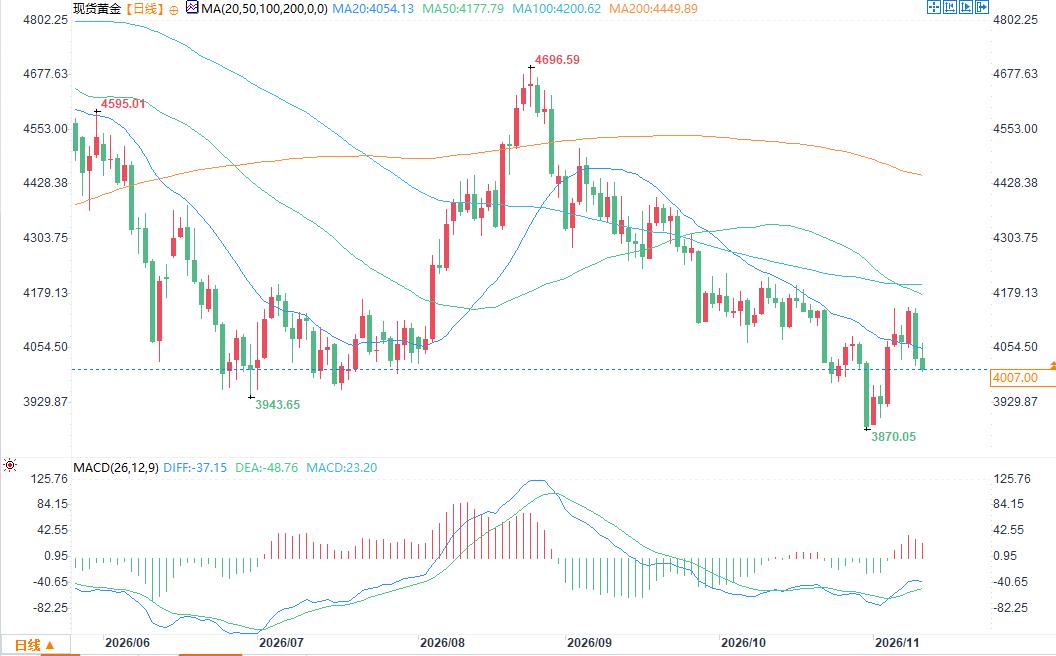 (Spot gold daily chart source: FX678) The biggest variable remains the Federal Reserve. Stubborn inflation coupled with further interest rate hikes will maintain the strength of US Treasury yields and the US dollar; while continued selling by commodity trading advisors and slowing ETF inflows will amplify downward pressure on gold prices. However, if the recent decline in oil prices continues, it could reverse this situation: lower oil prices will alleviate inflationary pressures, and traders may lower their expectations for the first three rate hikes by June next year. A key contradiction exists in the timing: the US November CPI data will not be released until December 10th, one day after the Fed's next policy meeting. Even if inflation cools, the data will not be enough to prevent a December rate hike, but it may prompt the market to lower its expectations for further monetary tightening in early 2027. The impact of the Middle East peace agreement is mixed: on the one hand, lower energy prices will suppress inflation and weaken expectations of rate hikes; on the other hand, the easing of geopolitical tensions will also diminish some of the safe-haven premium for gold. In short, gold is in a contradictory situation: the short-term technical outlook is bearish, but the long-term investment logic is positive. As long as US Treasury yields remain high and momentum indicators trend downwards, the possibility of further declines in gold prices cannot be ruled out. However, continued gold purchases by central banks and resilient ETF inflows, coupled with fiscal and geopolitical uncertainties, mean that each round of gold price declines will attract strategic investors to buy on dips. The key question is: before a shift in interest rate expectations triggers a sustained rebound, can these long-term investors absorb the selling pressure from algorithmic trading institutions?
Gold is currently in a tug-of-war between bulls and bears: short-term traders are inclined to be bearish due to weak technicals; long-term investors continue to view gold as an important asset diversification tool to hedge against economic, fiscal, and geopolitical uncertainties. Despite short-term headwinds, buying data from central banks and ETFs suggests that the underlying investment logic for gold remains intact. Following the release of the US October Consumer Price Index (CPI), gold prices plunged nearly 3% on Tuesday, dipping to $4,000. The data showed that overall US inflation rose 0.4% month-on-month, and core inflation rose 0.3% month-on-month, both exceeding market expectations. Shortly before the data release, Federal Reserve Governor Waller expressed support for a 25 basis point rate hike in December, while not ruling out the possibility of a 50 basis point hike. Traders further bet on a tighter Fed policy, causing US Treasury yields to surge; after a stock market correction, some long US Treasury positions were liquidated, further exacerbating the sell-off in US Treasuries. The two-year US Treasury yield is particularly sensitive to expectations of Federal Reserve policy. Affected by the stock market sell-off, the yield fell to a two-month low of 4.44% last week before rebounding sharply, rising to 4.76% on Tuesday before Veterans Day. The US Treasury market is closed today due to the holiday. The short-term technical outlook remains bearish. Although gold prices have rebounded, the technical pattern remains under pressure. Following the US midterm elections, the market saw a large-scale short covering; now, Commodity Trading Advisors (CTAs) and other trend-driven trading strategies are again receiving bearish signals. Short-, medium-, and long-term moving averages are all trending downwards, and there are no signs of crossover or reversal. This means that unless gold prices decisively break through key resistance levels, algorithmic trading institutions are likely to continue selling on rallies. Gold prices failed to hold above $4155 and subsequently fell back to $4000, which remains a key support level. If this psychological level is broken, gold prices may weaken again, potentially testing the lows below $3900 reached at the end of October. Initial resistance levels are the recent high of $4,150 and $4,225. The 200-day moving average is also significantly higher than the current gold price; for a sustained rebound, market momentum must show a substantial improvement. Hedge funds and commodity trading advisory funds have been net sellers of precious metals for several consecutive weeks. As of the week ending November 3, net long positions in silver shrank to only 2,700 contracts, the lowest level since February 2024; net long positions in gold fell to a five-month low of 104,000 contracts; and platinum, along with palladium, turned net short for the first time since May 2025. The current core contradiction is that short-term gold prices are increasingly dominated by trend-driven trading institutions; however, the strongest underlying buying comes from investors with a very long-term perspective. Central banks and ETF investors support long-term demand . The latest data from the World Gold Council (WGC) highlights the resilience of underlying demand for gold. In the third quarter, central banks worldwide purchased a total of approximately 321 tons of gold, a 42% year-on-year increase; the total purchases for the first nine months reached 675 tons. China remains the primary gold buyer, with the People's Bank of China increasing its holdings by 63 tons in the third quarter and another 25.8 tons in October, marking 24 consecutive months of gold purchases. Central banks' continued gold purchases are driven by strategic considerations: diversifying reserves, reducing dependence on the US dollar, and hedging against potential impacts from geopolitical risks and sanctions. A recent survey by the World Gold Council shows that 89% of central banks expect global official gold reserves to continue increasing in the coming year, and 45% plan to increase their national gold reserves. ETF investors also demonstrated resilience. In the third quarter, physical gold ETFs saw inflows of 211 tons, reaching a record high of $31 billion. Even with declining gold prices, October still saw inflows of 19 tons (equivalent to $2.7 billion). Global gold ETF holdings thus climbed to a record high of 4,275 tons, reflecting institutional investors' continued allocation to gold to diversify portfolio risks and mitigate fiscal and financial uncertainties. However, gold demand is not universally positive: High gold prices suppressed price-sensitive buyers, leading to a 19% year-on-year decline in global retail demand for gold bars and coins in the third quarter, and a 17% year-on-year decrease in gold jewelry consumption. Why does the long-term investment logic for gold still hold true? Multiple structural factors continue to support the long-term prospects of gold. High government fiscal deficits and increasing sovereign debt burdens have heightened market concerns about fiscal sustainability; simultaneously, geopolitical shifts and the potential use of financial assets as a tool of sanctions are prompting foreign exchange reserve management institutions worldwide to diversify their asset allocation. For institutional investors, gold does not carry the credit risk of issuers or counterparties. In an environment where inflationary shocks have broken the traditional negative correlation between stocks and government bonds as safe havens, gold can achieve portfolio diversification. These factors do not guarantee that gold prices will necessarily rise, but they explain why strategic investors are still willing to continue increasing their gold holdings even if short-term fundamentals and technicals deteriorate. What factors can change the short-term outlook? (Spot gold daily chart source: FX678) The biggest variable remains the Federal Reserve. Stubborn inflation coupled with further interest rate hikes will maintain the strength of US Treasury yields and the US dollar; while continued selling by commodity trading advisors and slowing ETF inflows will amplify downward pressure on gold prices. However, if the recent decline in oil prices continues, it could reverse this situation: lower oil prices will alleviate inflationary pressures, and traders may lower their expectations for the first three rate hikes by June next year. A key contradiction exists in the timing: the US November CPI data will not be released until December 10th, one day after the Fed's next policy meeting. Even if inflation cools, the data will not be enough to prevent a December rate hike, but it may prompt the market to lower its expectations for further monetary tightening in early 2027. The impact of the Middle East peace agreement is mixed: on the one hand, lower energy prices will suppress inflation and weaken expectations of rate hikes; on the other hand, the easing of geopolitical tensions will also diminish some of the safe-haven premium for gold. In short, gold is in a contradictory situation: the short-term technical outlook is bearish, but the long-term investment logic is positive. As long as US Treasury yields remain high and momentum indicators trend downwards, the possibility of further declines in gold prices cannot be ruled out. However, continued gold purchases by central banks and resilient ETF inflows, coupled with fiscal and geopolitical uncertainties, mean that each round of gold price declines will attract strategic investors to buy on dips. The key question is: before a shift in interest rate expectations triggers a sustained rebound, can these long-term investors absorb the selling pressure from algorithmic trading institutions?
- Risk Warning and Disclaimer
- The market involves risk, and trading may not be suitable for all investors. This article is for reference only and does not constitute personal investment advice, nor does it take into account certain users’ specific investment objectives, financial situation, or other needs. Any investment decisions made based on this information are at your own risk.