Gold Trading Alert: With inflation soaring, the dollar breaking down, and interest rate hikes a certainty, gold prices continue to fall, breaching the $4,000 mark. Is a "bear storm" coming?
2026-11-12 08:00:28
Spot gold continued its downward trend on Wednesday (November 11th), falling nearly 3% after a sharp drop on Tuesday, closing down 1.1% at $3987.69 per ounce. It had briefly touched a high of $4066.87 before quickly retreating. December U.S. gold futures also closed down 0.7% at $4000.50 per ounce. Driven by stronger-than-expected U.S. October CPI and hawkish comments from the Federal Reserve, the dollar index hit a one-and-a-half-year high, raising the probability of a December rate hike to 100%, and even increasing the probability of a 50 basis point rate hike. This put significant downward pressure on gold prices. Rising oil prices also exacerbated inflation concerns, supporting expectations of a Fed rate hike. In early Asian trading on Thursday (November 12th), spot gold continued its weakness, hitting a low of $3978.06 per ounce by 07:55, a one-week low. 
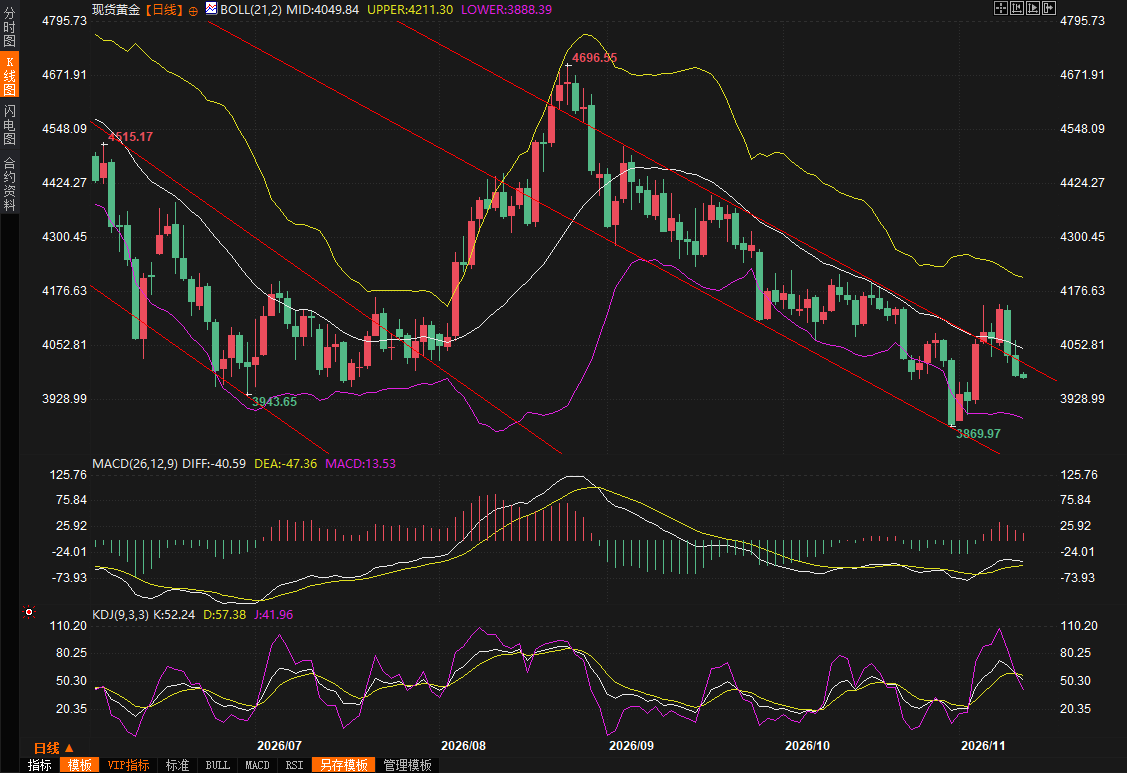 (Spot gold daily chart, source: EasyTrade) At 07:55 Beijing time, spot gold is currently trading at $3980.96 per ounce.
I. Inflation data exceeds expectations: a Fed rate hike in December is almost a certainty.
The immediate trigger for this round of gold price declines was the release of the US October Consumer Price Index (CPI) on Tuesday. Data showed that the October CPI rose 0.4% month-on-month, higher than economists' previous forecast of 0.3%. This marks the third consecutive month that US inflation data has exceeded expectations, completely dispelling market hopes that the Federal Reserve might pause interest rate hikes. StoneX senior market strategist Bob Haberkorn bluntly stated, "The CPI data was slightly higher than expected, and the market interprets this as indicating that the Fed should raise interest rates at its December meeting." What unsettled gold bulls even more were the hawkish statements from Fed officials before and after the data release. Fed Governor Waller clearly stated before the data release that if the core inflation rate in October was 0.3%, he would consider raising interest rates by half a percentage point at the December meeting. Dallas Fed President Logan also expressed deep concern about high inflation and hinted at support for a significant interest rate hike. According to the CME Group's FedWatch tool, traders' pricing in the probability of a Fed rate hike of at least 25 basis points in December has surged from about 70% a month ago to 100%, while the probability of a significant 50 basis point hike has risen from zero before the CPI data release to 12.9%. Some institutions have also quickly adjusted their expectations: Goldman Sachs now predicts rate hikes in December and March, with three more hikes expected by 2027, while Deutsche Bank predicts consecutive rate hikes in December, January, and March. For gold, rising interest rates mean an increased opportunity cost of holding non-interest-bearing assets, which is the core logic behind the downward pressure on gold prices.II. The US dollar index hits a one-and-a-half-year high: Gold's "natural enemies" strengthen across the board.
The dollar strengthened across the board, echoing the inflation data. On Wednesday, the dollar index, which measures the strength of the dollar against a basket of six major currencies, rose 0.64% to close at 102.90, reaching a high of 102.95 during the session, its highest level since April 2025. Elias Haddad, global head of market strategy at Brown Brothers Harriman & Co., interpreted this as follows: "The dollar's overall strength is mainly due to the strong October CPI data, which pushed market expectations for the federal funds rate towards a hawkish stance, and recent comments from Fed officials have further exacerbated this trend." The dollar's strength puts downward pressure on gold on two levels. First, gold is priced in dollars, and a stronger dollar directly increases the purchasing cost for non-dollar holders, suppressing physical demand. Second, while both the dollar and gold are safe-haven assets, the dollar also offers interest income during a rate hike cycle, making funds more inclined to flow into dollar assets rather than gold. It is worth noting that, except for the Australian dollar and the Norwegian krone, most developed market currencies have weakened against the dollar so far this year, with the widening interest rate differential continuing to boost the dollar. Some analysts also attribute the dollar's strength this year to safe-haven flows triggered by the US-Israel war on Iran—a geopolitical factor that has supported gold but has been offset by the dollar's strength.III. The Double-Edged Sword of Geopolitics: Rising Oil Prices Exacerbate Inflation, and Safe-Haven Demand is Suppressed by Interest Rates
Geopolitical tensions played a complex role in this round of gold price fluctuations. On Wednesday, the head of Iran's security services stated that Iran would not allow any enriched nuclear material to leave the country, sparking market concerns about supply and pushing oil prices up by about 1% from a two-month low hit in the previous trading day. Brent crude futures closed up 1.39% at $92.76, while U.S. crude rose 0.57% to $86.53. The rise in oil prices further exacerbated inflation concerns, which in turn strengthened expectations of a Federal Reserve interest rate hike, forming a transmission chain of "geopolitical tension → rising oil prices → rising inflation expectations → strengthened interest rate hike expectations → pressure on gold prices." The details of the situation in Iran warrant further examination. Mohsen Rezaei, Secretary of Iran's National Security Council, stated firmly in a televised address: "Any new U.S. attack will be responded to with strikes against U.S. remote bases." He also revealed that Tehran had informed Moscow that Iran's enriched nuclear material would be kept for domestic use. The International Atomic Energy Agency estimates that by June 2025, when Israel and the United States attack Iran's nuclear facilities, Iran will possess 440.9 kilograms of 60% enriched uranium, far exceeding civilian needs. Meanwhile, US Vice President Vance is becoming the chief negotiator with Iran, considering face-to-face talks with senior Iranian security officials to end the war. This "fighting while negotiating" stalemate means that geopolitical risk premiums are unlikely to completely subside, but in a market environment dominated by expectations of Fed rate hikes, safe-haven buying of gold is clearly overwhelmed by the suppressive force of rising interest rates. The Russia-Ukraine situation presents a similar logic. Two days of peace talks in Abu Dhabi made limited progress, with both sides agreeing to a large-scale release of prisoners of war, but differences remain on core issues such as territorial disputes. US envoy Kushner admitted that there is a lack of mutual trust between the two sides, and the territorial issue will be the most difficult to resolve. Although the peace talks have released some signs of easing tensions, attacks on the front lines continue, and Russian forces control about one-fifth of Ukraine's territory. The ongoing geopolitical conflict should have provided safe-haven support for gold, but this support has proven insufficient under the dual pressure of a stronger dollar and expectations of interest rate hikes.IV. Central Bank Gold Purchases and Physical Demand: Gold's "Hidden Weapon"
Despite a multitude of short-term negative factors, the market is not without its buffers. StoneX's Haberkorn, amidst the pessimistic atmosphere, points out a key fact: China, as the world's largest gold consumer, and other central banks are still actively purchasing gold. This trend has formed a structural force over the past few years—global central banks have continuously increased their gold holdings as they diversify their foreign exchange reserves, providing solid bottom support for gold prices. Central bank gold purchases are often unaffected by short-term price fluctuations; their strategic allocation nature means that even if gold prices correct, official buying will continue. Furthermore, as the world's two largest gold consumer markets, China and India often experience a seasonal rebound in physical demand when gold prices correct. While current high gold prices have somewhat dampened jewelry consumption, investment demand for gold bars may actually be stimulated when prices fall. This pattern of "official support + private buying on dips" limits the potential for further significant declines in gold prices after breaking below the $4,000 mark. Haberkorn's observation actually suggests an important judgment: the current market's bearish force mainly stems from speculative pricing in interest rate hike expectations, while strategic buying has not yet ceased.V. Technical Analysis and Market Outlook: The Battle for the $4,000 Level
From a technical perspective, after a nearly 3% plunge on Tuesday, spot gold prices rebounded to $4066.87 during Wednesday's session, but subsequently fell back to close at $3987.69, indicating that the $4,000 mark has become a key battleground between bulls and bears. Gold futures barely closed above $4000.50, but the weakness in spot gold suggests that short-term downward pressure has not yet been fully released. If gold prices effectively break below the support area around $3950, they may further test the $3800 level; conversely, if central bank buying and physical demand provide strong support below $4000, gold prices are expected to see a corrective rebound after the interest rate hike. Looking ahead, the core contradiction facing gold is that the Fed's interest rate hike expectations have been fully priced in, with a 25 basis point rate hike in December almost a certainty, and even the probability of a 50 basis point hike is increasing. This means that short-term negative factors may have been largely priced in—when all traders expect a rate hike, the impact of the rate hike itself on the market is actually weakened. The real variable lies in the sustainability of the interest rate hike path: Goldman Sachs and Deutsche Bank's forecasts of a further rate hike in March 2027 suggest that this tightening cycle may be longer than the market anticipates. However, changes in the political landscape after the US midterm elections, the progress of US-Iran negotiations, and the direction of the Russia-Ukraine peace talks could all alter market expectations regarding the path of inflation and interest rates at any time. For gold, the short-term downward pressure is unlikely to reverse, but given the structural support from central bank gold purchases and the fact that geopolitical risk premiums have not yet fully subsided, a deep decline is less probable. A more likely scenario is a period of consolidation, bottoming out, and revaluation after the rate hikes are implemented. (Spot gold daily chart, source: EasyTrade) At 07:55 Beijing time, spot gold is currently trading at $3980.96 per ounce.
- Risk Warning and Disclaimer
- The market involves risk, and trading may not be suitable for all investors. This article is for reference only and does not constitute personal investment advice, nor does it take into account certain users’ specific investment objectives, financial situation, or other needs. Any investment decisions made based on this information are at your own risk.