UBS: Despite strong US October CPI, support for a 50 basis point rate hike by the Fed in December is limited.
2026-11-12 08:16:28
On Thursday (November 12) during Asian trading hours, the US dollar index touched 102.95, a new high since mid-April 2005, and is currently trading around 102.80. On Tuesday, a stronger-than-expected US inflation report raised an unusual question for the Federal Reserve: should the next rate hike be double the magnitude? UBS believes the answer remains no. However, the bank stated that the October data reinforced the case for at least two more 25-basis-point hikes and increased the risk that they will come sooner. Overall consumer prices rose 0.4% in October, higher than the expected 0.3%; core prices, excluding food and energy, rose 0.3%, higher than the expected 0.2%. Price increases were broad-based, covering food, housing, entertainment, healthcare, electricity, airfares, and delivery services. The 10-year US Treasury yield jumped 11 basis points to nearly 5%, and the S&P 500 fell 0.4% on Tuesday. 
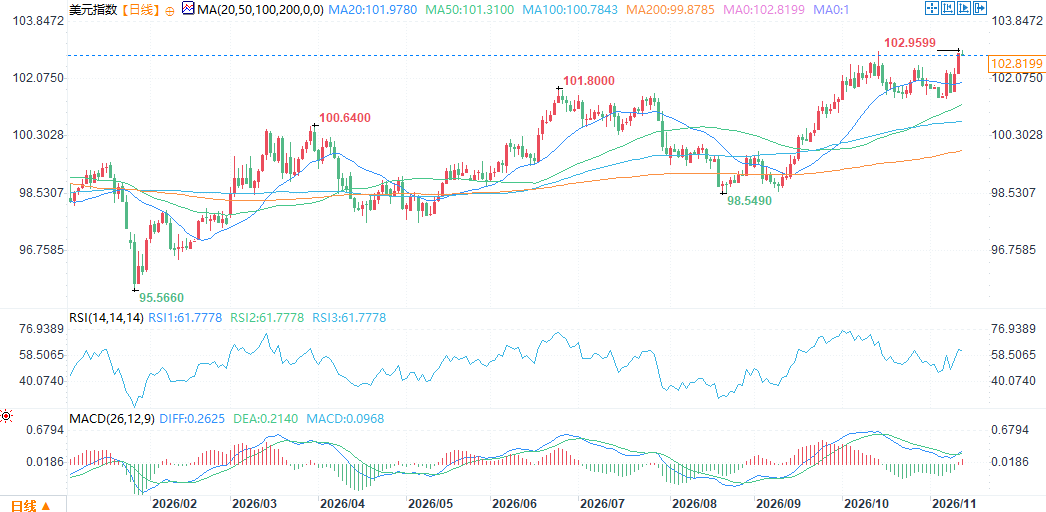 (US Dollar Index Daily Chart, Source: FX678) At 8:13 Beijing time, the US Dollar Index was at 102.82.
The 50 basis points come from Waller's "conditional" statement and Logan's "at least twice".
The idea of a 50-basis-point rate hike came from Federal Reserve Governor Waller. Before the data release, he stated that a core reading of 0.3% or higher might justify considering a 50-basis-point hike in December. Additionally, Dallas Fed President Logan indicated she favored at least two more 25-basis-point hikes and hinted that the Fed might act faster this winter. Federal funds futures are currently pricing in a tightening of about 28 basis points in December, implying a full 25-basis-point hike, and a smaller probability of a larger one. The discussion on a 50-basis-point hike was ignited by Waller's "conditional" remarks, but Logan's "at least two 25-basis-point hikes" is a closer representation of consensus—the difference lies in "one big step" versus "multiple small steps," and the market's priced-in 28-basis-point figure points towards the latter.UBS's assessment: The FOMC's support for a 50 basis point rate is limited; the benchmark remains 25 basis points above the December and March rates.
UBS argues that the interest rate-setting committee has limited interest in a 50-basis-point move. The bank states that such a large rate hike could signal that policy is far below its proper level and make the tightening cycle appear endless. Its baseline scenario remains a 25-basis-point increase each in December and March. The issue with 50 basis points is not just the "magnitude," but also the "signal"—a large step could be interpreted by the market as the Fed admitting it is lagging behind the curve, thus creating uncertainty about the end of tightening; while two smaller steps retain the "data-dependent" narrative, making the policy path more controllable.Data details: Three-month annualized core inflation rose to approximately 3.75%, with tariff-sensitive goods and IT hardware remaining strong.
The details behind the overall figures explain the concerns. Monthly core inflation edged down to 0.30% from 0.33%, but the three-month annualized rate rose to approximately 3.75% from less than 2% in August. Excluding a 1.2% drop in used car prices, core commodity prices rose by about 0.4%. Tariff-sensitive items such as toys, furniture and bedding, and home appliances each rose by more than 1%, while IT hardware prices rose by 0.4%. UBS points out that these categories have a larger weighting in the Fed's preferred PCE indicator; heading into 2027, commodity deinflation no longer appears to be a reliable theme. Housing inflation slowed to 0.30% from 0.39%, but remained sticky; energy rose another 0.7%, although its contribution to the overall figure has weakened. The slight decline in monthly core inflation masks the acceleration in the three-month annualized rate and the strength of commodity prices—this is precisely the basis for UBS's view that "commodity deinflation is no longer reliable," and its reason for predicting that interest rate hikes will continue until March.Market Implications: The December debate shifted its focus, providing support for yields and the US dollar.
Following two consecutive disappointing reports, the December debate is now about the scale of action, not whether to act at all. For markets, the 28 basis point pricing in federal funds futures indicates a December rate hike is already priced in, while 50 basis points represents a tail risk—any headline from a Fed official could trigger a repricing of that tail. The 10-year yield near 5% is supporting the dollar, including against the yen—the USD/JPY interest rate differential remains a key driver against the yen, given the Bank of Japan's own expectations of a December rate hike. Higher real yields are a headwind for gold, which has traded more in line with rate hike expectations than as a safe-haven asset this year. For equities, the combination of strong inflation and rising long-term yields adds pressure to already overvalued tech stocks burdened by the Nvidia leadership shakeup.Why is the US dollar index lacking downward momentum?
UBS maintaining its benchmark of 25 basis points each in December and March implies that the tightening cycle is being extended, not shortened. For the US dollar index, a slower but longer rate hike path provides more sustained support than a single, large-scale rate hike. Data details reinforce this logic. Three-month annualized core inflation rose to approximately 3.75%, and prices for tariff-sensitive goods and IT hardware remained firm, indicating that inflation stickiness is not a one-month phenomenon; this makes it difficult to easily reduce expectations of another rate hike in March. The 10-year yield approaching 5% provides yield-level support for the dollar and also reduces the market's pricing space for a Fed shift to easing. The current high level of the US dollar index above 102 is a result of this combination: a December rate hike is fully priced in, 50 basis points is a tail risk rather than a benchmark, and the expectation of a "longer path" lacks a catalyst for a dollar downside. Unless inflation data shows a substantial cooling or financial conditions deteriorate, forcing the Fed to reassess, the support for the US dollar index is unlikely to be shaken by a single debate over the magnitude of the rate hike.in conclusion
October's overall CPI rose 0.4% and core CPI rose 0.3%, both exceeding expectations. The widespread price increases have made a December rate hike almost certain, shifting the debate to the magnitude of the increase. Before the data release, Waller stated that a core rate of 0.3% or higher would warrant a 50 basis point increase, while Logan favored at least two more 25 basis point increases. Federal funds futures are pricing in a tightening of approximately 28 basis points in December, implying a single, full rate hike, with a much smaller probability. UBS believes the FOMC's support for a 50 basis point increase is limited—a large step would be interpreted as policy falling far short of its potential, with an endless tightening cycle—the baseline scenario remains a 25 basis point increase each in December and March. Data details support this assessment: three-month annualized core inflation rose to approximately 3.75%, with tariff-sensitive goods and IT hardware prices remaining firm, making commodity deinflation unreliable. A 50 basis point increase is a tail risk; any official headline could trigger repricing. Yields near 5% support the dollar and the USD/JPY interest rate differential, creating headwinds for gold and adding pressure on highly valued tech stocks. (US Dollar Index Daily Chart, Source: FX678) At 8:13 Beijing time, the US Dollar Index was at 102.82.
- Risk Warning and Disclaimer
- The market involves risk, and trading may not be suitable for all investors. This article is for reference only and does not constitute personal investment advice, nor does it take into account certain users’ specific investment objectives, financial situation, or other needs. Any investment decisions made based on this information are at your own risk.