Crude oil trading alert: The stalemate in US-Iran negotiations, coupled with OPEC+ production increases, has led to a five-day losing streak for WTI crude oil; be wary of a downward breakout.
2026-11-12 09:48:28
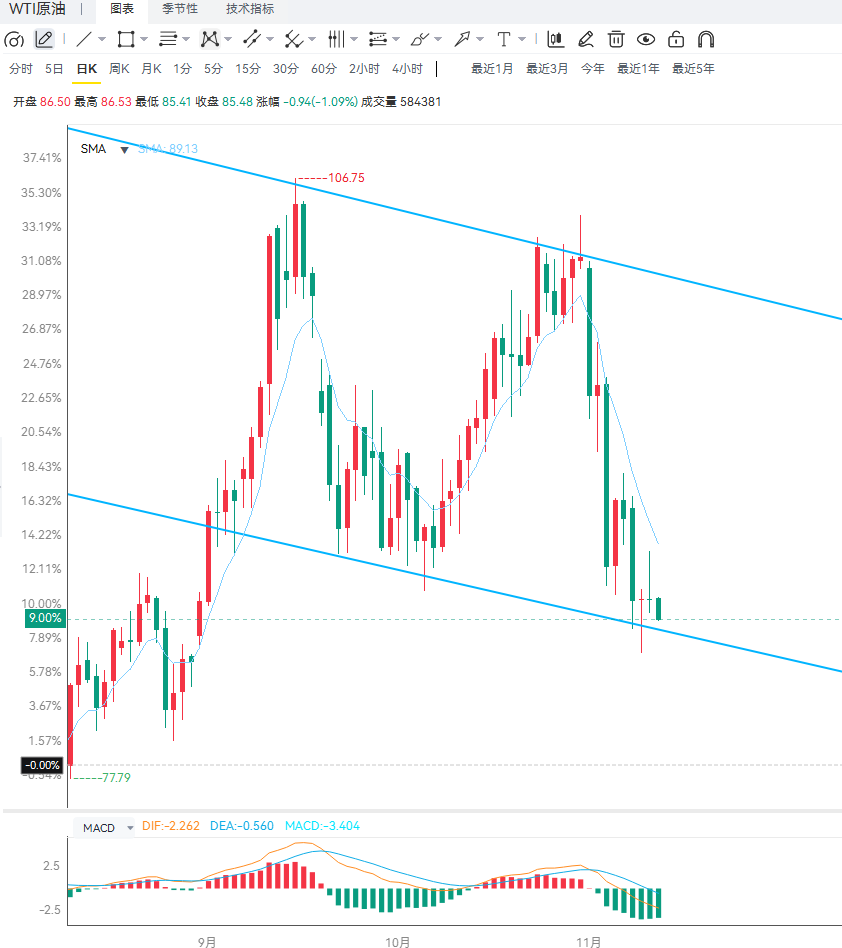
WTI crude oil prices fell for the fifth consecutive trading day in Asian trading on Thursday, trading around $85.70 per barrel . This level is a step down from $86.20 on November 11 and is approaching the previously confirmed key support level of $84 . Crude oil prices fell as negotiations between the US and Iran stalled, although both sides are currently avoiding further escalation. Washington insists that the nuclear issue must be part of any initial negotiations aimed at ending the conflict, but a senior Iranian security official rejected this key condition, stating that Tehran would not allow a single gram of its enriched nuclear material to leave the country. Iran also reiterated that the US must lift sanctions and end the maritime blockade before the Strait of Hormuz can be reopened.  OPEC+, including allies such as the Organization of the Petroleum Exporting Countries (OPEC) and Russia, saw a surge in crude oil production in October. According to OPEC's monthly report released Wednesday, the alliance produced 41.23 million barrels per day in October, an increase of approximately 2.04 million barrels per day from September, primarily driven by a sharp rise in Saudi Arabian production. This actual increase in supply was a substantial factor suppressing oil prices this week, offering more certainty than expectations of a "de-escalation in negotiations," and together with the fact that "Middle East shipping has nearly returned to pre-war levels," it constitutes a double easing of supply. Rabobank analysts warned that the geopolitical backdrop surrounding oil remains highly volatile, noting that "assuming this had occurred over the weekend—other reports suggested the US was just moments away from launching an attack—it means we could see more fighting by mid-to-late November, when a third US aircraft carrier would enter the region." They called this potential timeline, along with the buildup of US military assets, "a disturbing report," and emphasized that the market cannot rule out the risk of renewed tensions between the US and Iran. From a technical perspective, the daily MACD remains in a downtrend, with prices declining for five consecutive days and continuously making new lows, indicating the bearish structure is intact. The area around $88 remains a daily resistance level; failure to break above this level will maintain the bearish bias. Intraday resistance is around $87.50 . On the downside , $84 is a previously confirmed key low, currently relatively close at $85.70. This is the most important level to watch in this decline: a break below this level would open up further downside potential. On the 4-hour chart, after five consecutive days of decline, the MACD divergence has not yet turned into a valid reversal. The existence of divergence suggests a possible technical rebound after short-term overselling, but until the daily structure changes, the rebound remains corrective. If prices find support above $84 and rebound, the first target will be the intraday resistance at $87.50, with stronger resistance at $88.00. If $84 is effectively broken, the daily structure will open up further downside potential, requiring reference to previous swing lows and psychological levels rather than relying on indicator support.
 The editor summarizes that WTI is currently facing a triple pressure: the deadlock in negotiations makes it difficult to realize the benefits of diplomatic easing; OPEC+'s October production increase of 2.04 million barrels per day provides a definite supply boost; and Middle East transportation has almost recovered to pre-conflict levels. In contrast, the only support for the bulls is the unrealized risk of a potential resurgence of conflict in mid-to-late November, as highlighted by Rabobank. $84 is the watershed for this round of decline; a break below this level opens up further downside potential; failure to recover to $88 maintains the bearish structure . In the medium term, if negotiations continue to stall and OPEC+ maintains increased production, the probability of oil prices falling below $84 and extending to lower psychological levels is high; if the US-Iran conflict reignites in mid-to-late November, or OPEC+ adjusts its production policy, oil prices are expected to stabilize above $84 and rebound to test $87.50-$88.00. Key attention should be paid to the substantive progress of US-Iran negotiations, OPEC+'s subsequent production policy, and geopolitical dynamics.
OPEC+, including allies such as the Organization of the Petroleum Exporting Countries (OPEC) and Russia, saw a surge in crude oil production in October. According to OPEC's monthly report released Wednesday, the alliance produced 41.23 million barrels per day in October, an increase of approximately 2.04 million barrels per day from September, primarily driven by a sharp rise in Saudi Arabian production. This actual increase in supply was a substantial factor suppressing oil prices this week, offering more certainty than expectations of a "de-escalation in negotiations," and together with the fact that "Middle East shipping has nearly returned to pre-war levels," it constitutes a double easing of supply. Rabobank analysts warned that the geopolitical backdrop surrounding oil remains highly volatile, noting that "assuming this had occurred over the weekend—other reports suggested the US was just moments away from launching an attack—it means we could see more fighting by mid-to-late November, when a third US aircraft carrier would enter the region." They called this potential timeline, along with the buildup of US military assets, "a disturbing report," and emphasized that the market cannot rule out the risk of renewed tensions between the US and Iran. From a technical perspective, the daily MACD remains in a downtrend, with prices declining for five consecutive days and continuously making new lows, indicating the bearish structure is intact. The area around $88 remains a daily resistance level; failure to break above this level will maintain the bearish bias. Intraday resistance is around $87.50 . On the downside , $84 is a previously confirmed key low, currently relatively close at $85.70. This is the most important level to watch in this decline: a break below this level would open up further downside potential. On the 4-hour chart, after five consecutive days of decline, the MACD divergence has not yet turned into a valid reversal. The existence of divergence suggests a possible technical rebound after short-term overselling, but until the daily structure changes, the rebound remains corrective. If prices find support above $84 and rebound, the first target will be the intraday resistance at $87.50, with stronger resistance at $88.00. If $84 is effectively broken, the daily structure will open up further downside potential, requiring reference to previous swing lows and psychological levels rather than relying on indicator support. The editor summarizes that WTI is currently facing a triple pressure: the deadlock in negotiations makes it difficult to realize the benefits of diplomatic easing; OPEC+'s October production increase of 2.04 million barrels per day provides a definite supply boost; and Middle East transportation has almost recovered to pre-conflict levels. In contrast, the only support for the bulls is the unrealized risk of a potential resurgence of conflict in mid-to-late November, as highlighted by Rabobank. $84 is the watershed for this round of decline; a break below this level opens up further downside potential; failure to recover to $88 maintains the bearish structure . In the medium term, if negotiations continue to stall and OPEC+ maintains increased production, the probability of oil prices falling below $84 and extending to lower psychological levels is high; if the US-Iran conflict reignites in mid-to-late November, or OPEC+ adjusts its production policy, oil prices are expected to stabilize above $84 and rebound to test $87.50-$88.00. Key attention should be paid to the substantive progress of US-Iran negotiations, OPEC+'s subsequent production policy, and geopolitical dynamics.
- Risk Warning and Disclaimer
- The market involves risk, and trading may not be suitable for all investors. This article is for reference only and does not constitute personal investment advice, nor does it take into account certain users’ specific investment objectives, financial situation, or other needs. Any investment decisions made based on this information are at your own risk.