Spot gold fell below $4,000, with TD Securities predicting a pullback to $3,900.
2026-11-12 09:56:29
Gold prices fluctuated slightly lower during Asian trading hours on Thursday (November 12), currently trading around $3,980 per ounce. After a nearly 3% plunge on Tuesday, spot gold fell another 1.1% on Wednesday (November 11), closing at $3,987.69 per ounce; it briefly touched a high of $4,066.87 before quickly retreating. According to TD Securities, with rising US interest rates and a stronger dollar continuing to suppress investment demand, gold may test support around $3,900 per ounce. Bart Melek, head of commodity strategy at the bank, stated in a report released on Tuesday that there is still room for further pressure on gold before the long-term bullish logic returns. Gold prices fell below $4,000 on Wednesday. This extended a two-day decline – a higher-than-expected US October inflation report solidified bets on a December rate hike by the Federal Reserve. Higher interest rates increase the opportunity cost of holding non-yielding gold; a stronger dollar makes it more expensive for buyers using other currencies. 
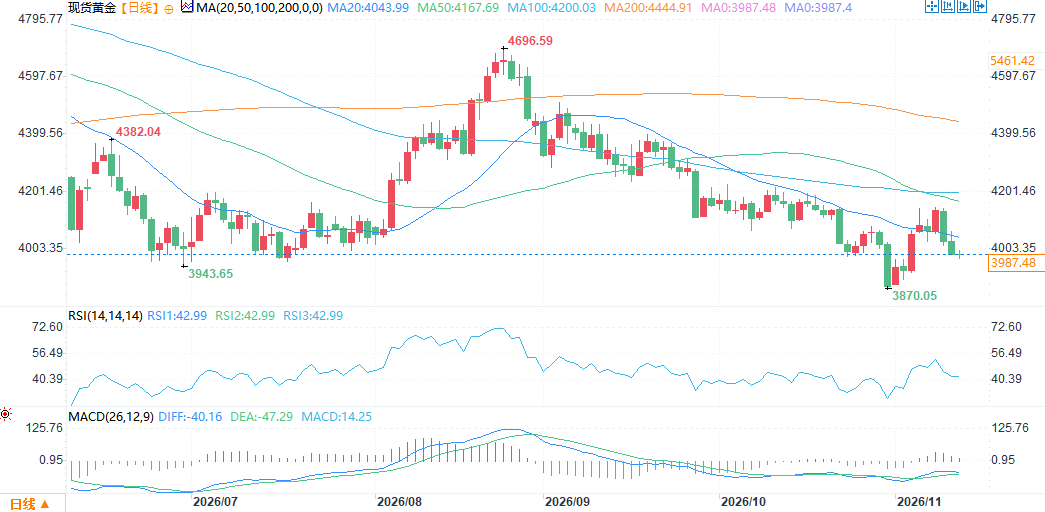 (Spot gold daily chart, source: EasyTrade) At 9:55 Beijing time, spot gold was trading at $3981.26 per ounce.
The shift in judgment: The condition that "unless interest rates are raised earlier, the market will not break 3900" in July has been reversed.
This report marks a significant shift in TD Securities' thinking since mid-year. In early July, Melek argued that a drop below $3,900 was unlikely as long as the possibility of an earlier Fed rate hike was not on the table. This condition no longer holds. With the Fed on its rate hike path and futures fully pricing in December action, what TD Securities once considered a safe floor has now become a level it expects to be tested. Just at the end of October, the bank described gold as trapped in a range of $3,900 to $4,250. The $3,900 level has changed from a "safe floor" to a "support to be tested," and this change was triggered by the establishment of the Fed's rate hike path—the shift in judgment is not based on gold's own supply and demand, but on the repricing of the interest rate environment.Gold's Behavior Pattern: Following Interest Rate Expectations Rather Than Safe-Haven Demand; October's Worst Month Since 2008
Gold's recent performance reinforces this view. During the Iranian conflict, it did not rise as a safe-haven asset, but rather traded primarily in line with interest rate expectations—oil-driven inflation fueled bets on a Fed tightening. Gold prices fell to a one-year low and recorded their worst October since 2008 as investors sold gold to cover losses during a tech-led stock market sell-off. This year, gold's pricing strategy has been driven by the "oil price → inflation → interest rate hike" chain, rather than traditional geopolitical safe-haven demand—as long as this chain remains intact, gold's rebound will be constrained by interest rate hike expectations, while declines will be limited by central bank buying and the psychological level of $4,000.Our long-term view remains unchanged: gold prices are expected to rise above $5,300 by 2027.
TD Securities has not abandoned its long-term view. Melek previously stated that once the conflict and the oil price-driven inflation it fuels begin to subside, and long-term support holds, gold prices could rise to record highs above $5,300 per ounce by 2027. Short-term pullbacks and long-term bullish sentiment are not contradictory—the former reflects the suppression of investment demand by the interest rate hike cycle, while the latter reflects the support from central bank gold purchases and policy shifts after inflation subsides; their time dimensions differ, and short-term pressure is part of the long-term bullish path.Key price levels: $3940 to $4000 is a key area, and $3900 is a watershed.
Analysts have marked the $3,940 to $4,000 area as a key near-term zone, with some noting that central bank gold purchases tend to accelerate when gold prices trade below $4,000. A decisive break below $3,900 would indicate that the interest rate narrative still prevails; holding this level would keep TD Securities' recovery scenario intact. The $3,940 to $4,000 range serves as a near-term buffer (where central bank gold purchases intervene), while $3,900 is a watershed for determining whether the interest rate narrative or the recovery scenario is dominant—a break below this level indicates that the interest rate logic is dominant, while holding above it suggests that the long-term bullish logic remains intact.in conclusion
TD Securities expects gold to test support near $3,900 as rising US interest rates and a stronger dollar dampen investment demand. Gold prices fell below $4,000 on Wednesday, extending a two-day decline, as strong October CPI data reinforced bets on a December rate hike. The bank had stated in July that it wouldn't break $3,900 unless the Fed raised rates earlier than expected; this condition has now reversed—$3,900 has gone from a "safe floor" to a "support level to be tested." Gold's behavior this year has followed interest rate expectations rather than safe-haven demand; October was its worst month since 2008 as investors sold gold to cover losses during the stock market sell-off. However, the bank hasn't abandoned its long-term view: once oil-driven inflation subsides, gold prices could rise above $5,300 by 2027. The $3,940-$4,000 range is a key area where central bank gold purchases accelerate; $3,900 is a watershed—a break below this level would give the interest rate narrative the upper hand, while holding above it would maintain a healthy recovery scenario. (Spot gold daily chart, source: EasyTrade) At 9:55 Beijing time, spot gold was trading at $3981.26 per ounce.
- Risk Warning and Disclaimer
- The market involves risk, and trading may not be suitable for all investors. This article is for reference only and does not constitute personal investment advice, nor does it take into account certain users’ specific investment objectives, financial situation, or other needs. Any investment decisions made based on this information are at your own risk.