USD/JPY nears 160: Japan warns of excessive exchange rate volatility, risk of intervention returns to the forefront.
2026-11-12 08:52:28
The US dollar edged slightly lower against the Japanese yen during Asian trading hours on Thursday (November 12), currently trading around 159.55. Japan intensified its verbal defense of the yen on Thursday. Vice Minister of Finance for International Affairs, Kamimura, stated that the exchange rate fluctuations of the past few days had been too rapid. This statement came as the US dollar rose near 160 against the yen—a level that has twice this year triggered actual intervention by Japanese authorities. 
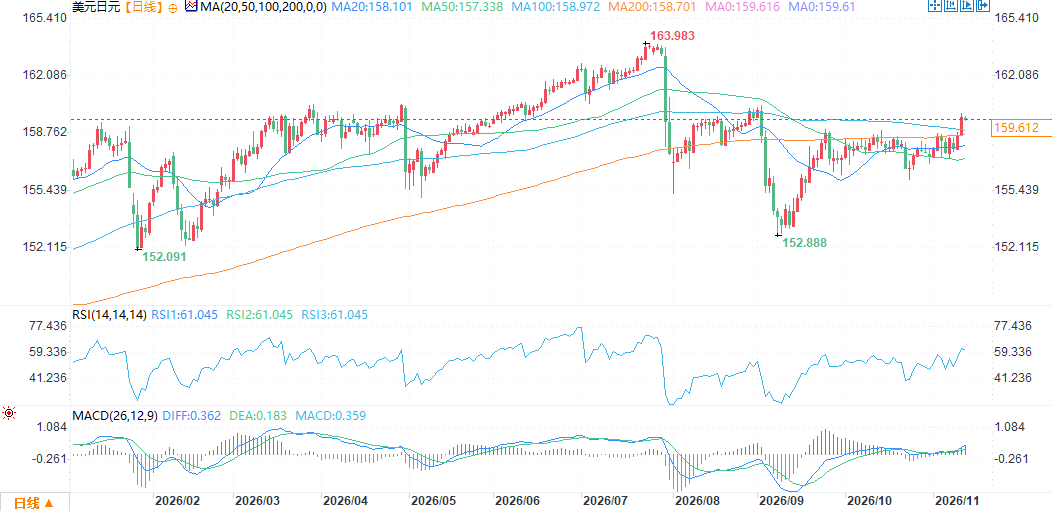 (USD/JPY daily chart, source: EasyForex) At 8:48 Beijing time, USD/JPY was trading at 159.59/60.
Warning sequence: From "too fast" to "decisive action," intervention has been triggered twice in 2026.
Kamimura, who is in charge of Japan's exchange rate policy, delivered a speech. His focus on the "speed" of fluctuations is the standard first step in Tokyo's warning sequence. Officials typically begin by describing the fluctuations as "too fast" or "excessive," then escalate to "concerned with a strong sense of urgency," and finally promise "decisive action." In 2026, such wording appeared twice before actual intervention. This record lends weight to the warnings. Japan implemented its largest-ever yen intervention around the Golden Week holiday in late April and early May, when the dollar broke through 160; in late July, the dollar rose above that level again, and Tokyo intervened again; in early August, Japan and the US confirmed that the operation was coordinated, marking the first coordinated yen purchase since the 1998 Asian financial crisis. 160 is not only a psychological threshold but also a policy red line with a history of actual intervention—each escalation of the warning corresponds to a signal that is historically closer to action.The root cause of the yen's downward pressure: the US-Japan interest rate differential and a 5% yield.
The yen's latest decline was driven by interest rate differentials. This week's stronger-than-expected US inflation report reinforced expectations of a December rate hike by the Federal Reserve and pushed the 10-year Treasury yield close to 5%. This outweighed strong domestic data in Japan—Japan's October producer price index rose 7.1% year-on-year, higher than expected, and the Bank of Japan is widely expected to raise its policy rate by 1.25% in December. The implication of this combination is that while Japanese data and rate hike expectations should have supported the yen, US yields and rate hike expectations were stronger—the widening interest rate differential outweighed improvements in domestic fundamentals, which is why the USD/JPY pair is approaching 160.The effective boundaries of intervention: Interest rate spreads remain dominant, and warnings can only slow down, not reverse, the situation.
For traders, the key question in the near term is whether officials will escalate their rhetoric. If USD/JPY decisively breaks through 160 and the rhetoric shifts to “decisive action,” the risk of another intervention will rise sharply. Previously, verbal warnings tended to slow rather than reverse trends, especially given the continued rise in US yields. Japan’s 2026 record means that the area around 160 now carries real two-way risk, which should make traders less willing to chase new highs, even if the trend remains upward. The risk of intervention around 160 limits the upside for USD/JPY and makes long positions more two-way; however, the bigger driver remains the USD/JPY interest rate differential—the Fed’s rate hike path and yields near 5% support the dollar, limiting how far a warning alone could push the exchange rate down.A weak yen and the Bank of Japan: Import prices rose nearly 25% year-on-year, increasing pressure at the December meeting.
A weak yen has directly exacerbated Japan's inflation problem. Yen-denominated import prices rose nearly 25% year-on-year, led by oil prices; therefore, further yen weakness will push up costs for businesses and households. The weak yen directly impacts the Bank of Japan's policy considerations through imported inflation—this, combined with the unexpectedly high wholesale inflation in Japan, reinforces the necessity of a December interest rate hike; in other words, the exchange rate is not only a result of monetary policy but is also becoming an input variable.in conclusion
Japanese Vice Minister Kamimura warned of excessively rapid exchange rate volatility in recent days, with the USD/JPY pair rebounding to near 160—a level that has already triggered intervention twice this year, including the largest-ever intervention in late April/early May and the joint US-Japan operation at the end of July. The root cause of the yen's pressure is the US-Japan interest rate differential: stronger-than-expected US CPI data reinforces expectations of a December rate hike, and the 10-year yield near 5% has outweighed support from Japan's higher-than-expected 7.1% producer price index and the anticipated December rate hike. The 160 level carries real two-way risk, limiting the upside potential of the USD/JPY pair; however, the interest rate differential remains dominant, and verbal warnings can only slow, not reverse, the trend—unless the wording escalates to "decisive action" or there are signs of US support, the risk of intervention is more about limiting upside than driving downside. A weak yen, through a nearly 25% year-on-year increase in import prices, directly pushes up Japanese inflation, which, combined with higher-than-expected wholesale inflation, puts further pressure on the Bank of Japan's December meeting—the exchange rate is shifting from being a result of monetary policy to becoming its input variable. (USD/JPY daily chart, source: EasyForex) At 8:48 Beijing time, USD/JPY was trading at 159.59/60.
- Risk Warning and Disclaimer
- The market involves risk, and trading may not be suitable for all investors. This article is for reference only and does not constitute personal investment advice, nor does it take into account certain users’ specific investment objectives, financial situation, or other needs. Any investment decisions made based on this information are at your own risk.