Stubborn inflation is weighing on gold prices, which have fallen below the $4,000 mark. Be wary of a potential acceleration in the downward trend.
2026-11-12 10:24:28
Gold fell to around $3,985 in early Asian trading on Thursday. The precious metal continued its downward trend as persistent inflation forced the Federal Reserve to maintain its tightening policy. This marks the second consecutive day of decline after falling from $4,125 to $4,050 yesterday, and has broken below the previously observed 50% Fibonacci retracement level of $4,008 .  The U.S. Bureau of Labor Statistics reported Tuesday that the Consumer Price Index (CPI) rose 0.4% month-over-month in October, following a 0.6% increase in September. This figure was higher than the expected 0.3%, reinforcing market expectations of a Federal Reserve rate hike next month. "The CPI was slightly higher than expected, and the market is interpreting it as a need for higher rates at the December meeting," said Bob Habercohn, senior market strategist at StoneX. Bets on a 50-basis-point rate hike in December began to accumulate after Fed Governor Christopher Waller stated that an overheated CPI would support more aggressive action. Higher interest rates typically put downward pressure on precious metals by making interest-bearing assets more attractive. According to the CME FedWatch tool, a 25-basis-point rate hike has been fully priced in, while the probability of a 50-basis-point hike has risen from 0% before the data release to 12.7% . Traders will look for further clues from Friday's U.S. October Producer Price Index (PPI) data; a report showing a bullish result could put downward pressure on gold in the short term. Deutsche Bank analysts noted that while "credit markets on both sides of the Atlantic were actually quite stable," a broader "risk-averse sentiment in equities led to gold's best week since August, with a gain of 5.06% (down 0.42% on Friday)." They added that "this, along with the risk-averse sentiment stemming from the AI sell-off, helped to push down global sovereign bond yields." Even so, Deutsche Bank noted that "the 10-year US Treasury yield rose 1 basis point to 4.87% , while Brent crude fell by about 1% at the time of writing," highlighting the complex cross-asset context entering the latest trading session. Fed's Goolsby delivered a significantly more hawkish signal, with his FXS speech tracker rating at 8/10 , significantly above the historical average of 6.8/10, highlighting rising concerns about persistent price pressures. He emphasized that the latest CPI was "near troubling," that services inflation "has not declined," and stated that "we have a real inflation problem on our hands," indicating that even with the labor market described as robust and stable, his unease with underlying inflation dynamics is deepening. Its repeated mention of addressing persistent inflation and the risk of expectations becoming unanchored reinforces its stance of maintaining policy tightening and remaining open to further action. This context typically supports the US dollar and is unfavorable to lower-yielding currencies. The FXS Fed Sentiment Index rose 1.69 points to 145.61 , keeping the policy tone firmly hawkish, well above the 100 neutral line. Technically, gold remains under significant downward pressure on the daily chart, with the price below the 20-day Bollinger Band middle line and the 100-day simple moving average , both reinforcing the recent bearish tone. The price is compressed in the lower half of the Bollinger Bands, and the 14-day Relative Strength Index (RSI) is at 43 , remaining below the midline, suggesting moderate bearish momentum but not yet oversold. On the upside, initial resistance is at the Bollinger Band middle line around 4055 , followed by the 100-day simple moving average at 4200 and the Bollinger Band upper line around 4215 . On the downside, the next significant support level appears at the lower Bollinger Band, currently near 3895. If the decline continues, sellers may take profits here. Looking at the trading range, yesterday's price touched the lower edge of the 4050-4200 range at 4050, and today it broke through that level, officially breaching the lower boundary – meaning the previous assessment of a "4050-4200 range-bound movement" is no longer valid, and the daily chart has entered a downtrend. Based on yesterday's 1-hour Fibonacci levels, the price has broken below the 50% retracement (4008), and the next key level is the 61.8% retracement ( 3975 ). Currently, 3985 is above this level, which is the most crucial defense line in the short term. If 3975 is breached, the next support levels are 3929 and 3870. On the 4-hour chart, the price has fallen for two consecutive days and is compressed at low levels, indicating that the momentum still has a tendency to decline further. However, the RSI 43 has not yet entered the oversold zone, which means that there may still be room for further decline, and it has not yet reached the inevitable point of a technical rebound.
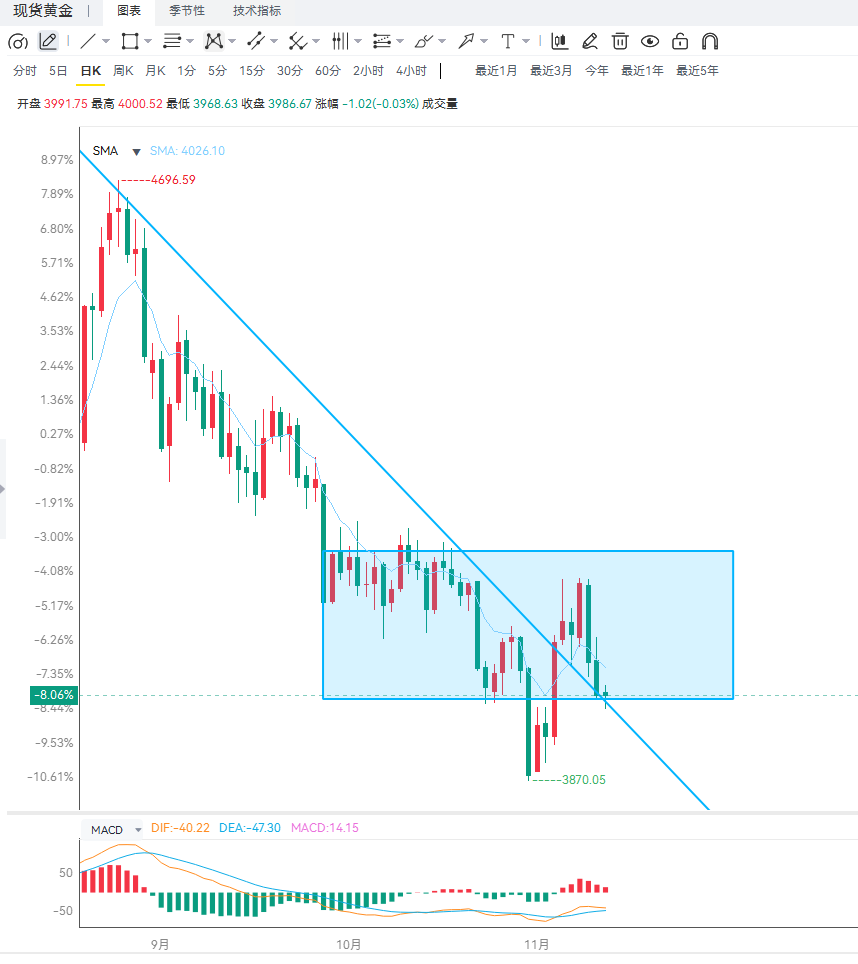 Editor's Summary: The core pressure on gold has escalated from "expected December rate hike" to " potentially larger rate hike" —25 basis points have already been fully priced in, and the probability of a 50 basis point hike has risen from 0% to 12.7%. This has deprived gold prices of any buffer after the negative news has been fully priced in, as evidenced by the two consecutive days of decline. 3975 (61.8% retracement) is currently the most crucial short-term support level; once breached, the lower Bollinger Band at 3895 will be the next target. Meanwhile, the middle Bollinger Band at 4055 has become the ceiling for any rebound. In the medium term, if Friday's PPI is also relatively high, and the probability of a 50 basis point hike continues to rise, the probability of gold prices breaking below 3975 and testing 3895 or even 3870 is relatively high. If the PPI softens, or if setbacks in US-Iran diplomacy lead to a resurgence of safe-haven demand, then gold prices are expected to stabilize and rebound between 3975 and 4055. Key events to watch include Friday's US October PPI data, the further evolution of the 50 basis point probability, whether the 10-year US Treasury yield can break through 4.87% and continue to rise, and the progress of US-Iran negotiations.
The U.S. Bureau of Labor Statistics reported Tuesday that the Consumer Price Index (CPI) rose 0.4% month-over-month in October, following a 0.6% increase in September. This figure was higher than the expected 0.3%, reinforcing market expectations of a Federal Reserve rate hike next month. "The CPI was slightly higher than expected, and the market is interpreting it as a need for higher rates at the December meeting," said Bob Habercohn, senior market strategist at StoneX. Bets on a 50-basis-point rate hike in December began to accumulate after Fed Governor Christopher Waller stated that an overheated CPI would support more aggressive action. Higher interest rates typically put downward pressure on precious metals by making interest-bearing assets more attractive. According to the CME FedWatch tool, a 25-basis-point rate hike has been fully priced in, while the probability of a 50-basis-point hike has risen from 0% before the data release to 12.7% . Traders will look for further clues from Friday's U.S. October Producer Price Index (PPI) data; a report showing a bullish result could put downward pressure on gold in the short term. Deutsche Bank analysts noted that while "credit markets on both sides of the Atlantic were actually quite stable," a broader "risk-averse sentiment in equities led to gold's best week since August, with a gain of 5.06% (down 0.42% on Friday)." They added that "this, along with the risk-averse sentiment stemming from the AI sell-off, helped to push down global sovereign bond yields." Even so, Deutsche Bank noted that "the 10-year US Treasury yield rose 1 basis point to 4.87% , while Brent crude fell by about 1% at the time of writing," highlighting the complex cross-asset context entering the latest trading session. Fed's Goolsby delivered a significantly more hawkish signal, with his FXS speech tracker rating at 8/10 , significantly above the historical average of 6.8/10, highlighting rising concerns about persistent price pressures. He emphasized that the latest CPI was "near troubling," that services inflation "has not declined," and stated that "we have a real inflation problem on our hands," indicating that even with the labor market described as robust and stable, his unease with underlying inflation dynamics is deepening. Its repeated mention of addressing persistent inflation and the risk of expectations becoming unanchored reinforces its stance of maintaining policy tightening and remaining open to further action. This context typically supports the US dollar and is unfavorable to lower-yielding currencies. The FXS Fed Sentiment Index rose 1.69 points to 145.61 , keeping the policy tone firmly hawkish, well above the 100 neutral line. Technically, gold remains under significant downward pressure on the daily chart, with the price below the 20-day Bollinger Band middle line and the 100-day simple moving average , both reinforcing the recent bearish tone. The price is compressed in the lower half of the Bollinger Bands, and the 14-day Relative Strength Index (RSI) is at 43 , remaining below the midline, suggesting moderate bearish momentum but not yet oversold. On the upside, initial resistance is at the Bollinger Band middle line around 4055 , followed by the 100-day simple moving average at 4200 and the Bollinger Band upper line around 4215 . On the downside, the next significant support level appears at the lower Bollinger Band, currently near 3895. If the decline continues, sellers may take profits here. Looking at the trading range, yesterday's price touched the lower edge of the 4050-4200 range at 4050, and today it broke through that level, officially breaching the lower boundary – meaning the previous assessment of a "4050-4200 range-bound movement" is no longer valid, and the daily chart has entered a downtrend. Based on yesterday's 1-hour Fibonacci levels, the price has broken below the 50% retracement (4008), and the next key level is the 61.8% retracement ( 3975 ). Currently, 3985 is above this level, which is the most crucial defense line in the short term. If 3975 is breached, the next support levels are 3929 and 3870. On the 4-hour chart, the price has fallen for two consecutive days and is compressed at low levels, indicating that the momentum still has a tendency to decline further. However, the RSI 43 has not yet entered the oversold zone, which means that there may still be room for further decline, and it has not yet reached the inevitable point of a technical rebound. Editor's Summary: The core pressure on gold has escalated from "expected December rate hike" to " potentially larger rate hike" —25 basis points have already been fully priced in, and the probability of a 50 basis point hike has risen from 0% to 12.7%. This has deprived gold prices of any buffer after the negative news has been fully priced in, as evidenced by the two consecutive days of decline. 3975 (61.8% retracement) is currently the most crucial short-term support level; once breached, the lower Bollinger Band at 3895 will be the next target. Meanwhile, the middle Bollinger Band at 4055 has become the ceiling for any rebound. In the medium term, if Friday's PPI is also relatively high, and the probability of a 50 basis point hike continues to rise, the probability of gold prices breaking below 3975 and testing 3895 or even 3870 is relatively high. If the PPI softens, or if setbacks in US-Iran diplomacy lead to a resurgence of safe-haven demand, then gold prices are expected to stabilize and rebound between 3975 and 4055. Key events to watch include Friday's US October PPI data, the further evolution of the 50 basis point probability, whether the 10-year US Treasury yield can break through 4.87% and continue to rise, and the progress of US-Iran negotiations.
- Risk Warning and Disclaimer
- The market involves risk, and trading may not be suitable for all investors. This article is for reference only and does not constitute personal investment advice, nor does it take into account certain users’ specific investment objectives, financial situation, or other needs. Any investment decisions made based on this information are at your own risk.