A chart shows that the Baltic Dry Index (BDI) has strengthened for the seventh consecutive trading day, with freight rates across all vessel types rising, driving the market upward.
2026-11-13 00:48:28
The latest data shows that the Baltic Dry Index (BDI) reached 3020 points on November 12, 2026, a new high since October 5, 2026, up 2.06% month-on-month, marking the 7th consecutive day of increase (including zero growth). Looking at the short-term charts, the recent 11 BDI data points show: 9 positive increases, 2 negative increases, and 0 zero increases. Specifically, the Panamax Freight Index (BPI) was 2117 points, up 0.67% from the previous value; the Capesize Freight Index (BCI) was 4836 points, up 2.89%; and the Supramax Freight Index (BSI) was 1831 points, up 1.16%. For detailed 720-day and 10-year trend charts of the Baltic Dry Index and its three main sub-indices, please refer to the charts specially created by FX678. 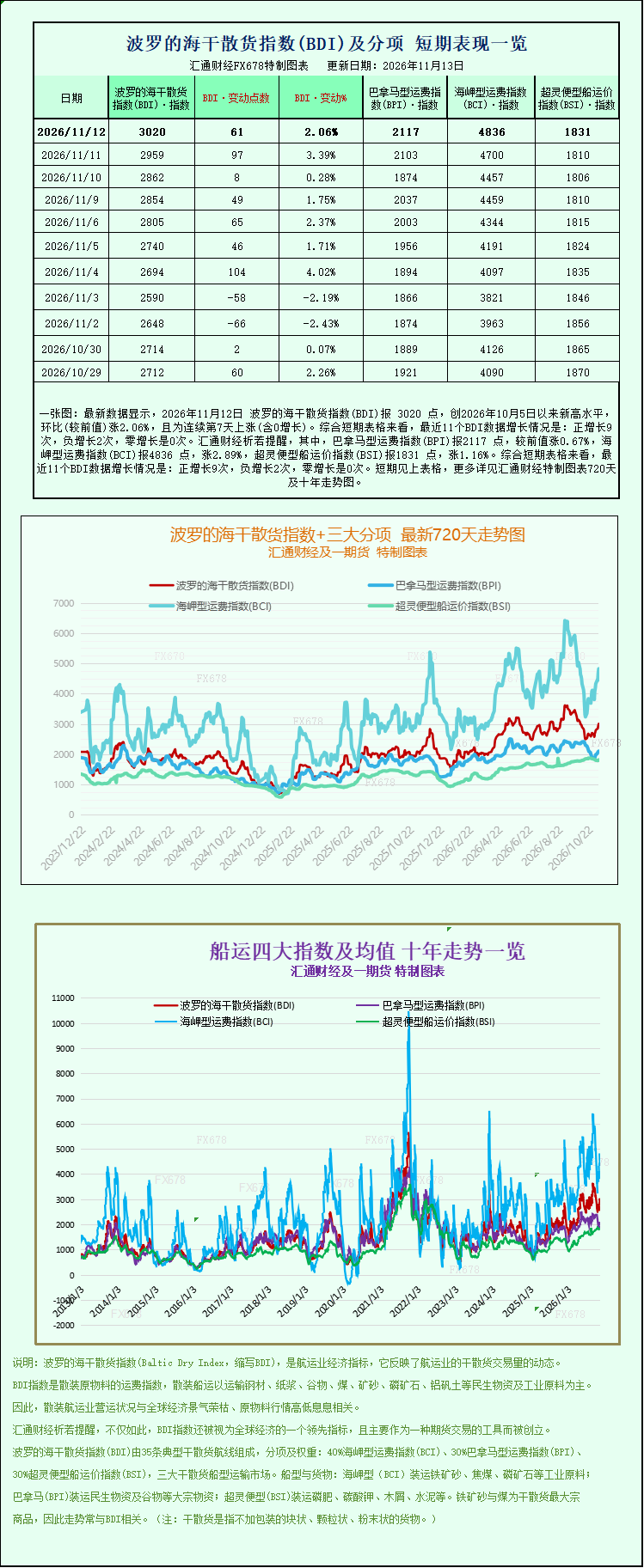 The Baltic Dry Index (BDI), the core shipping index of the Baltic Exchange that tracks global dry bulk commodity freight rates, rose again on Thursday, marking its seventh consecutive day of gains and reaching a new high in over a month. This surge was supported by simultaneous increases in freight rates across all major vessel types. The core Baltic Dry Index, which encompasses charter rates for Capesize, Panamax, and Supramax vessels, rose 61 points, or 2.1%, to close at 3020 points, its highest level since October 5th. Looking at different vessel types, the market showed a broad-based strengthening trend without segmented differentiation, reflecting broad-based demand support in the current dry bulk shipping market, rather than a short-lived surge driven by a single cargo type. Specifically, the Capesize index rose 136 points, or 2.9%, to close at 4836 points, a new high since October 2nd. Capesize vessels are the largest and most dominant vessel type in the dry bulk market, typically with a deadweight tonnage of around 150,000 tons. They primarily carry commodities such as iron ore and coal, serving as a barometer for raw material trading demand in the industrial sector. The average daily earnings for this vessel type rose by $1,232 to $40,357 per day. It's worth noting that while freight rates strengthened, iron ore futures prices weakened on Thursday. Weak spot trading at ports, coupled with continued downward pressure on prices from anticipated increased supply at the Simandou iron ore mine, put downward pressure on iron ore futures prices. This divergence between freight rates and cargo prices necessitates distinguishing the underlying drivers: iron ore futures pricing focuses more on medium- to long-term expectations of new supply and the purchasing pace of domestic steel mills, while short-term charter rates depend more on the current release of cargoes on shipping routes, vessel capacity scheduling, and port congestion. The pricing cycles of these two are not entirely synchronized. Even with weakening ore prices, the concentrated release of cargoes in the short term can still push up spot charter rates. The Panamax index rose 14 points, or 0.7%, to close at 2117, a new high since October 22. Panamax vessels, with a deadweight range of 60,000-70,000 tons, primarily transport coal and grain, and are the main vessel type connecting global energy trade and the transoceanic flow of agricultural products. The average daily charter yield for this type of vessel increased by $131 to $19,054 per day. Compared to Capesize vessels, the Panamax's increase this round was more moderate, indirectly indicating that the recovery in trade demand for grain and thermal coal is weaker than the short-term boost from iron ore shipments. The small vessel sector also followed the upward trend, with the Supramax index rising 21 points, or 1.2%, to close at 1831, a new high in more than a week. Supramax vessels have shallower drafts, greater route flexibility, and can call at more small and medium-sized ports. They also handle a wider variety of cargoes, including not only small batches of coal and grain, but also steel, cement clinker, and fertilizer. The strength of this sector indicates a simultaneous recovery in global regional and short-haul feeder bulk cargo trade, further broadening the scope of demand. The current seven-week rise in the Baltic Dry Index (BDI) represents a strong and sustained recovery following the correction in early October. Several underlying market drivers are at play. First, the pace of iron ore shipments in the Asia-Pacific region has accelerated, with concentrated shipping windows from Australia and Brazil. Steel mill restocking has led to a concentrated release of short-term cargo, directly boosting immediate demand for Capesize vessels. The Capesize vessel, with the highest weighting, is the core engine of this BDI rise. Second, with the arrival of autumn and winter in the Northern Hemisphere, the seasonal procurement window for coal for global thermal power plants has opened, leading to a steady increase in cargo on Atlantic and Pacific coal shipping routes, supporting Panamax vessel charter rates. Third, the supply pressure from the return of some shipping capacity and maintenance has eased temporarily, and there has been no significant increase in effective shipping capacity available in the short term. This has led to a marginal shift in supply and demand that is favorable to shipowners. However, we must also recognize the internal contradictions in the market, namely the divergence between iron ore futures and freight rates. The anticipated supply from the Simandou iron ore project continues to suppress iron ore prices in the medium to long term. Domestic steel mills, constrained by profit margins, have limited willingness to actively replenish their inventories significantly. This means that the demand for iron ore shipments is likely to be a temporary surge, unlikely to form a sustained high level of activity in the long term. Once the short-term concentrated shipping window ends and cargo volumes decline, Cape-class vessel charter rates will face downward pressure. Structurally, this is a general price increase across all vessel types. Compared to past market movements driven by a single vessel type, this signal is stronger, indicating that the recovery in dry bulk demand is not a short-term disturbance of a single cargo type, but rather a simultaneous marginal improvement across multiple categories, including industrial raw materials, energy, and agricultural products. However, it's crucial to distinguish between seasonal spikes and trend reversals: autumn and winter are traditionally peak seasons for dry bulk shipping, and this round of price increases largely reflects seasonal factors. The ability to absorb demand after the peak season is the biggest point to observe in subsequent market movements. On the risk front, firstly, the strength of China's manufacturing recovery and the continued purchasing intentions of steel mills will directly determine the forward futures prices of iron ore and coal; secondly, the pace of new ship deliveries, ship rerouting, and changes in port efficiency will continuously alter the supply side of shipping capacity. If demand for commodities weakens subsequently, and cargo volumes shrink rapidly, the currently high spot rates will quickly decline. For commodity trading, the Baltic Dry Index (BDI) is an important leading indicator. A sustained rise in dry bulk freight rates represents a marginal increase in global physical trade activity, indirectly affecting trading sentiment for coal, ore, and agricultural products; however, it's important to note that freight rates are a synchronous spot indicator and do not necessarily mean that commodity prices will rise in tandem. The recent divergence in iron ore prices is a typical example; in trading, a rise in the BDI cannot be simply equated with a rise in commodity prices. Key areas to monitor include: iron ore shipment data from Brazil and Australia, daily steel mill consumption and restocking pace, Atlantic coal cargoes, grain export orders, weekly charter rates for various vessel types, and the number of vessels waiting to anchor at ports. These factors will help determine whether this round of freight rate increases is a short-term seasonal spike or a trend recovery.
- Risk Warning and Disclaimer
- The market involves risk, and trading may not be suitable for all investors. This article is for reference only and does not constitute personal investment advice, nor does it take into account certain users’ specific investment objectives, financial situation, or other needs. Any investment decisions made based on this information are at your own risk.