The U.S. Treasury bought yen for the first time in 27 years, but the dollar/yen exchange rate hit 160.
2026-11-13 08:14:30
The USD/JPY pair traded in a narrow range during Asian trading hours on Friday (November 13), currently hovering around 159.90. Overnight, the pair touched 160.04, a new high since early September. The New York Fed stated on Thursday (November 12) that the U.S. Treasury bought yen in the third quarter, marking the first yen intervention since 1998, while the Fed itself did not intervene in the foreign exchange market. The New York Fed's quarterly foreign exchange operations report confirms that Washington acted in conjunction with Tokyo this summer to prevent a sharp decline in the yen. 
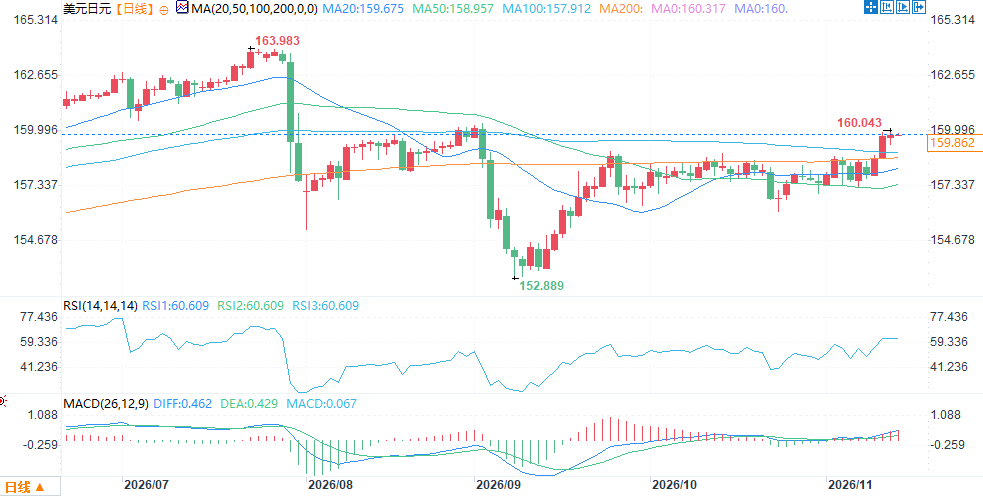 (USD/JPY daily chart, source: FX678) At 8:07 Beijing time, USD/JPY was trading at 159.84/85.
Operational details: ¥79 billion, paid in Euros; exchange rate checks conducted on behalf of the Ministry of Finance.
According to reports, the Federal Reserve Bank of New York purchased approximately 79 billion yen, worth about $500 million, in the spot market on July 31. It paid for the purchases in euros from the Treasury's Exchange Stabilization Fund, stating that the purchases were to counter what the Treasury perceived as disorderly fluctuations in the yen. There were reports on July 30 of checks on the USD/JPY exchange rate—an operation involving calls to dealers to inquire about prices, often interpreted by the market as a signal of impending intervention. The report states that the New York Fed conducted these checks solely on behalf of the Treasury, acting as its fiscal agent. The yen rose more than 2% that day. The US participation was not passive cooperation, but rather an active implementation using its own funds through the Exchange Stabilization Fund—transforming the speculation that "the US is a voluntary partner in yen support" from mere conjecture into a verifiable fact.The effects and regression of the coordinated intervention: from 164 to 155, then back to 160
Japan's Ministry of Finance intervened simultaneously, spending approximately 15 trillion yen in the quarter. The coordinated action was swiftly effective: between July 30 and August 3, the dollar fell against the yen from around 164 to around 155. Finance Minister Bessant stated in early August that the US would not hesitate to join further intervention and reiterated its call for the Bank of Japan to continue raising interest rates. However, the yen's recovery was short-lived. It has since fallen back to around 160, its weakest level since September. On Thursday, Japan's Deputy Finance Minister and top currency diplomat, Kamimura, warned that it was too early to forget the summer's intervention. While the coordinated intervention was effective in the short term, it failed to alter the medium-term trend driven by interest rate differentials—as long as the US-Japan interest rate differential does not narrow, the intervention can only delay, not reverse, the yen's decline.Institutional View: USD/JPY is expected to continue rising, but the risk of Japanese action is increasing.
Some analysts predict that the USD/JPY exchange rate will continue to rise, supported by the resilience of the US economy and strong AI investment maintaining high inflation, while also highlighting the risk of new actions by Japan. The fundamental interest rate differential logic still points to a stronger dollar, but the existence of intervention risks casts uncertainty on this assessment with the possibility of a "policy counterattack"—the tension between these two factors is the source of two-way risk around 160.Bank of Japan: December rate hike to 1.5% is another tool; US involvement increases resistance.
The Bank of Japan (BOJ) is another available tool. Some BOJ policymakers called for faster interest rate hikes in October, arguing that underlying inflation had reached the 2% target. Media surveys showed that most economists expected the bank to raise the policy rate to 1.5% in December, following hikes in June and September. Now that the US has clearly become a voluntary partner, any move back towards 160 or higher is likely to encounter stronger resistance from both governments. Intervention and interest rate hikes are two parallel lines of defense—the former affects the speed and magnitude of exchange rate movements, while the latter affects the fundamental interest rate differential. If the BOJ raises rates as expected in December, the interest rate differential will narrow by 25 basis points, combining with the intervention's effect; if the rate hike fails, the effectiveness of intervention will again face the test of its own strength.in conclusion
The New York Federal Reserve confirmed that the U.S. Treasury purchased approximately 79 billion yen (about $500 million) on July 31, marking its first yen intervention since 1998; the Fed did not intervene on its own in the third quarter. During the same period, the Japanese Ministry of Finance coordinated an intervention of approximately 15 trillion yen, causing the dollar to fall from around 164 to around 155 yen; the exchange rate check on July 30 was conducted on behalf of the Ministry of Finance, and the yen rose by more than 2% that day. In early August, Bessant stated that the U.S. would not hesitate to join further intervention and called on the Bank of Japan to continue raising interest rates. However, the yen's recovery was short-lived, falling back to around 160; Kamimura warned that the intervention this summer should not be forgotten, and institutions expect the dollar to continue rising against the yen, but the risk of Japanese intervention is increasing. The Bank of Japan's December rate hike to 1.5% is another tool—intervention and rate hikes operating in parallel: the former affects the speed and magnitude, while the latter affects the fundamental interest rate differential. The U.S. has clearly become a voluntary partner, and any move back towards 160 or higher is likely to encounter stronger resistance from both governments. (USD/JPY daily chart, source: FX678) At 8:07 Beijing time, USD/JPY was trading at 159.84/85.
- Risk Warning and Disclaimer
- The market involves risk, and trading may not be suitable for all investors. This article is for reference only and does not constitute personal investment advice, nor does it take into account certain users’ specific investment objectives, financial situation, or other needs. Any investment decisions made based on this information are at your own risk.