













Institutions: Short-term pressure on gold and silver does not change the long-term logic; their investment value remains worth noting.
2026-11-13 10:42:28
Kristy Akullian, Head of Investment Strategy for BlackRock Americas iShares, analyzed that although gold and silver are weak in the short term, both precious metals have solid demand support, providing differentiated allocation value for portfolios. After a surge at the beginning of 2026, gold and silver gradually declined, pressured by rising real yields, a stronger dollar, and profit-taking. However, most long-term structural positive factors have not disappeared, and the investment value of gold and silver remains noteworthy.

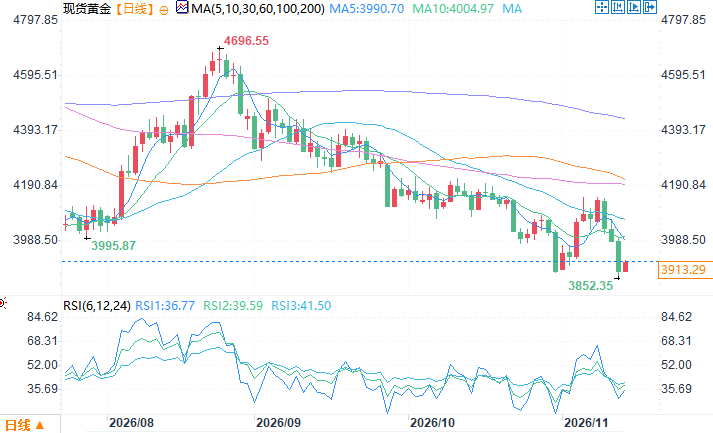 Spot gold daily chart source: FX678. At 10:36 AM Beijing time on November 13th, spot gold was trading at $3913.29 per ounce.
The market trended upwards and then downwards this year, with significant differences in the fundamentals of gold and silver.
In a research report released on Tuesday (November 10), Akulian reviewed that gold, after surging above $5,000 per ounce in early 2026, entered a correction phase, with a year-to-date decline of approximately 10%. However, its core functions of hedging against geopolitical and economic risks and diversifying asset portfolios have not failed. Silver performed well in 2025, but faces greater pressure this year, similarly encountering profit-taking and negative macroeconomic shocks. The biggest difference between silver and gold is that, in addition to its investment attributes, silver is deeply tied to industrial sectors such as photovoltaics, electrification, and AI infrastructure, with industrial demand forming a crucial foundation for its long-term demand. Silver's volatility is significantly higher than gold's; over the past two decades, its annualized volatility has reached up to twice that of gold, highlighting its more pronounced cyclical characteristics.Three long-term core drivers underpin the underlying value of precious metals
The first driving factor is the demand for value storage brought about by the global high debt structure. The US federal debt has exceeded 120% of GDP, and the annual fiscal deficit remains around 6% to 7% of GDP. The debt ratios of major developed economies such as Japan, the UK, France, and Canada have also exceeded 100%. Gold does not have the risk of a single sovereign issuer and naturally possesses value storage attributes in a high-debt environment. Silver is a more elastic commodity under this logic. Recently, the economic recovery has eased market concerns about the sustainability of US fiscal policy, the dollar has rebounded, and many trades betting on currency depreciation have been closed, putting short-term pressure on precious metal prices. The second driving factor comes from the demand for safe-haven assets. During periods of global policy shifts and geopolitical restructuring, funds will increase their allocation to safe-haven assets. Precious metals should not be simply understood as crisis hedging tools, but rather as portfolio stabilizers, showing low or even negative correlation with equity assets during stock market crashes. Since 2020, in months when the S&P 500 has fallen by more than 5%, gold has recorded an average return of 2%, while the US Treasury bond index has remained basically flat. This asymmetric return makes gold have a clear advantage in pullback markets. The third driver is the unique industrial demand for silver. Approximately 60% of silver consumption annually is in the industrial sector, with the electronics industry being the largest source, consuming about 445 million ounces of silver annually. The continued construction of new AI computing centers, rising electricity demand, and the advancement of electrification across society continue to generate incremental demand. Photovoltaics are the main driver of silver demand growth, with the proportion of silver used in industrial demand increasing from 11% in 2014 to nearly 29% in 2024.Central bank gold purchases remain a pillar of the gold market, with gold ETFs continuing to see net inflows.
Central bank gold purchases have reshaped the gold demand landscape. In 2025, gold surpassed US Treasury bonds to become the largest component of global reserves for the first time in thirty years. While the pace of purchases is unlikely to maintain the previous extremely high levels, it remains a significant support. A 2026 survey shows that 89% of central banks expect global gold reserves to continue growing, and 45% plan to increase their holdings. Many emerging economies have gold reserves accounting for less than 10% of their total reserves, indicating room for further increases. Gold ETFs continue to see net inflows, with global holdings expected to exceed 4,000 tons in 2025, managing over $650 billion.Gold and silver allocations are differentiated to suit different investment objectives.
Akulian stated that a balanced portfolio of gold and silver can provide both defensive capabilities and growth potential. Gold is suitable as a strategic core holding to hedge against downside risks in the stock market, acting as a ballast in environments where stock-bond linkages fail. Silver is more cyclical, exhibiting greater resilience during economic expansion and industrial upswings, but also carries higher downside risk; therefore, its allocation in a portfolio is typically lower than that of gold.Conclusion
Gold and silver prices fluctuated and adjusted under short-term pressure from real interest rates and a stronger dollar, but long-term factors such as central bank gold purchases, a high-debt environment, and industrial demand for silver remain solid. Gold serves as a primary tool for portfolio diversification and a safe haven, while silver benefits from industrial growth driven by new energy and AI infrastructure. Combining the two can help investors balance risk resistance and long-term return opportunities in their asset portfolios. Spot gold daily chart source: FX678. At 10:36 AM Beijing time on November 13th, spot gold was trading at $3913.29 per ounce.
- Risk Warning and Disclaimer
- The market involves risk, and trading may not be suitable for all investors. This article is for reference only and does not constitute personal investment advice, nor does it take into account certain users’ specific investment objectives, financial situation, or other needs. Any investment decisions made based on this information are at your own risk.

