













With direct exports from the Hormuz region at only 9 million barrels per day, Barclays sees upside risks to oil prices.
2026-11-13 10:28:29
On Friday (November 13) during Asian trading hours, US crude oil futures fluctuated lower, currently trading around $88.40. Barclays believes the oil market is overly relaxed about future risks, and even with the recent decline in crude oil prices, the near-term outlook remains bullish. In its latest energy report, the bank argued that a diplomatic breakthrough in US-Iran tensions remains a long way off, and traders are not prepared for the current stalemate to continue. 
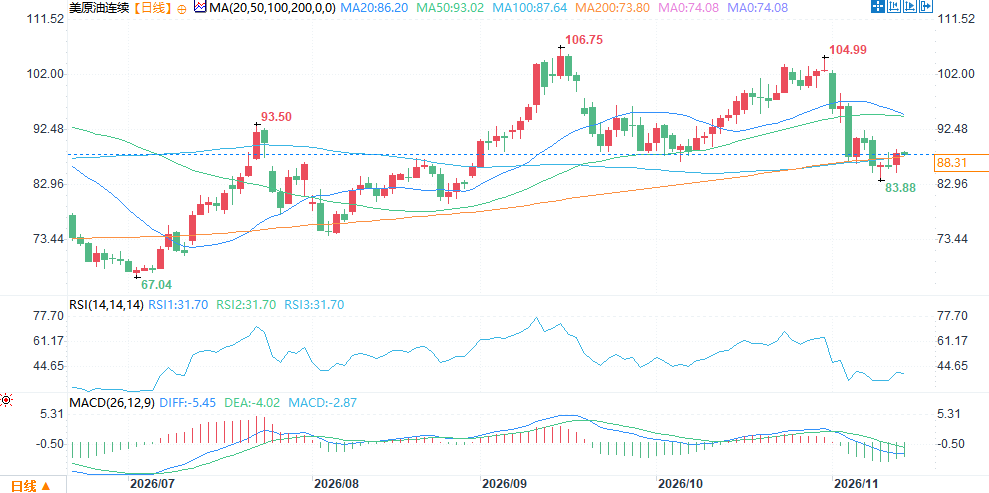 (US crude oil futures daily chart, source: FX678) At 10:21 Beijing time, US crude oil futures were trading at $88.46 per barrel.
The divergence between prices and data: Market pricing is "peaceful," but data points to "tight supply."
Barclays points out that since its last update a week ago, both near-month Brent crude and WTI crude futures have fallen by about 7%, but subsequent data have all pointed in the same direction. In the bank's view, diplomacy continues, but a deal seems unlikely. The price decline is pricing in "hopes for diplomatic progress," while the data reflects "the reality that supply has not yet recovered"—this gap is the basis for Barclays' view that the risks are skewed to the upside.Hormuz flow: Direct exports of 9 million barrels per day, still 23% lower even after accounting for rerouting.
The first pressure point is the Strait of Hormuz. Recent increases in attacks on shipping have slowed the recovery of Middle Eastern traffic. The bank stated that as of the week ending October 31, net direct exports through the strait averaged approximately 9 million barrels per day; ship-to-ship transshipment and pipelines bypassing the strait brought the total to nearly 18 million barrels per day, still about 23% lower than pre-war levels. In mid-October, despite the blockade of Iran, traffic briefly exceeded pre-war levels, but this was not sustained. The 30-day average shows that Middle Eastern traffic at the end of October was close to 19.5 million barrels per day, approximately 85% of pre-war levels. While "direct" traffic through the strait has only recovered to about half of pre-war levels, and bypass routes have filled some of the gap, an overall structural supply gap of about 15% remains—a gap that means any new disturbance could quickly translate into upward price movements.Inventory and Demand: Except for major Asian countries, foreign inventories are far below normal, and imports from China and India are rebounding.
Barclays' bigger concern is inventory. Inventories have stabilized but not been rebuilt. Global inventories remain well below their usual range, and most strategic reserve releases have now ended. The bank argues that this means that even if the current situation continues, there are upside risks, and the probability of a sharp price surge is higher than before. Two other indicators support this view: demand from price-sensitive buyers is recovering, with combined seaborne imports from major Asian countries and India rebounding to near last year's levels after a deep decline; and speculative positions in Brent and WTI crude remain light, leaving room for buyers to return. The "stabilization" rather than "rebuilding" of inventories means the market lacks a buffer; and the coexistence of recovering demand and light positions means that once a triggering factor appears, there is significant room for buying to return—both of which constitute the condition for "a rise without new shocks."The spread between US crude oil and Canadian heavy crude oil reflects logistics and production shutdowns, rather than a surge in supply.
Barclays also addressed the recent widening of the price spread between WTI and Canadian Heavy crude oil. The bank stated that the spread reflects transportation costs, refinery and upgrading unit shutdowns, and strategic reserve releases, rather than a surge in supply. The bank maintained its price forecast and reiterated its recommendation to go long on the Brent spread – betting that near-month contracts will outperform far-month contracts due to tight supply. Going long on the spread is essentially a bet on “tight near-term supply” – if Straits Exchange rate remains low and inventories cannot be rebuilt, near-month prices will be relatively stronger than far-month prices, maintaining a near-high, far-low curve.in conclusion
Barclays believes the risks to oil prices are skewed to the upside, a view that contradicts the recent price decline—Brent and WTI crude fell by about 7% in a week, but data points in the same direction: a US-Iran agreement remains elusive, direct exports from the Hormuz are only about 9 million barrels per day (still 23% lower after detours), the 30-day average is about 85% of pre-war levels, inventories outside major Asian countries are far below normal, most strategic reserve releases have ended, imports from China and India are rebounding, and speculative positions are light. The bank's core argument is that the oil market doesn't need new shocks to rise—as long as the stalemate continues, the supply gap and low inventory levels are enough to skew the risks to the upside, and light positioning means that short covering could be significant once a triggering factor emerges. The bank maintains its price forecast and recommendation to go long on the Brent-WTI spread, the latter being a bet on "tight near-term supply and a near-high, far-low curve." Rising oil prices will also keep inflation and central bank interest rate hike expectations high, adding pressure to interest rate-sensitive assets. (US crude oil futures daily chart, source: FX678) At 10:21 Beijing time, US crude oil futures were trading at $88.46 per barrel.
- Risk Warning and Disclaimer
- The market involves risk, and trading may not be suitable for all investors. This article is for reference only and does not constitute personal investment advice, nor does it take into account certain users’ specific investment objectives, financial situation, or other needs. Any investment decisions made based on this information are at your own risk.

