High deficits and refinancing pressures have caused a surge in volatility in US Treasury bonds, with long-term yields challenging historical highs.
2026-11-13 13:50:29
The CME Group Volatility Index (CVOL) measures the implied volatility of 30-day U.S. Treasury options. Data shows that volatility in the U.S. Treasury market surged in October, with the index approaching 140 at one point, reaching a new high since March. Driven by persistent inflation and a continuously expanding fiscal deficit, the structural trend of rising yields that began five years ago is accelerating. U.S. Treasuries were sold off in October, leading to a comprehensive reassessment of risk pricing for 10-year and 30-year bonds, and the debate surrounding the sustainability of U.S. fiscal policy continues to intensify.
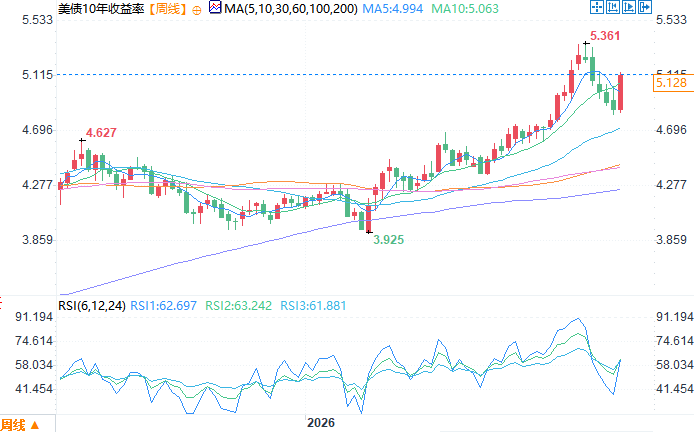 10-year US Treasury yield weekly chart. Source: EasyTrade. At 13:41 Beijing time on November 13th, the 10-year US Treasury yield was 5.128%.
Sticky inflation is forcing higher interest rates, and the market is clearly underestimating inflation risks.
RSM's chief economist, Brusuelas, stated that the US will continue to issue more Treasury bonds to support economic expansion and defense spending, keeping the fiscal deficit between 5% and 6%. This deficit, coupled with high inflation, will push yields further upward. RSM's model calculations show that even if interest rates rise to 5.5% or even 6%, inflation will not decline significantly, only leading to a moderate slowdown in the economy and employment. He believes the market has underestimated the resilience of inflation, and the Federal Reserve has underestimated the tightening力度 needed to stabilize prices. Not only the US, but also several G7 countries with high deficits are facing pressure on their bonds, with France's debt risk already triggering market concerns about a European debt crisis.Huge amounts of debt are maturing and need to be refinanced, leading to a sharp increase in interest expenses.
Steve Shaw, founder and president of BondSavvy, stated that net issuance of U.S. Treasury bonds will increase by over 40% this fiscal year, reaching approximately $1.2 trillion. Issuance is expected to remain high next year, pushing the total federal debt above $40 trillion. The real challenge lies in the refinancing wave. A large number of bonds with near-zero coupon rates were issued during the pandemic, and these will mature and be replaced in the next two years. Even if the Treasury prefers to issue 1-year, 2-year, and 5-year short-term bonds to control interest costs, overall interest expenses will still rise significantly after the replacement with higher-yield new bonds. In October, the yield on 10-year U.S. Treasury bonds reached 5.36%, the highest since 2002, while the 30-year yield exceeded 5.7%. Multiple rounds of Treasury bond auctions saw lower-than-expected subscriptions, and the large-scale repurchase operations in August failed to effectively boost demand. Some major overseas buyers of U.S. Treasury bonds have continued to reduce their holdings, reflecting overseas investors' concerns about high deficits, persistent inflation, and geopolitical uncertainties.Overseas buyers continue to reduce their holdings, and market disagreement arises regarding the timing of the US debt crisis.
Billionaire investor Ray Dalio believes the selling pressure on US Treasuries could worsen further. Major Asian countries are no longer willing to continue increasing their holdings of US Treasuries, and coupled with geopolitical and economic factors, Japan is also seeking to recoup its previously invested funds. Data shows that in July, Japan's holdings of US Treasuries decreased by $12.8 billion to $1.1 trillion; during the same period, holdings by major Asian countries fell to $618 billion, far below the peak of $1.3 trillion in 2013. Of course, the CME FedWatch tool shows the market continues to price in further interest rate hikes, and historically, high coupon rates during tightening cycles have attracted overseas funds to flow back in periodically. Bruzuelas points out that this inflow logic may weaken in the short term, and it is necessary to continuously monitor the subscription situation of subsequent Treasury bond auctions. Treasury Secretary Scott Bessent has already intervened to reassure the market, reversing the Treasury bond issuance curve through spending constraints and lowering long-term yields.The fiscal path has not collapsed, but its long-term trend is unsustainable.
Oliver Allen, senior U.S. economist at Pansen Macroeconomics, stated that the U.S. still has various tools to manage its debt, such as cutting spending, utilizing cash reserves, and prioritizing the issuance of short-term debt to lower interest costs. He believes the U.S. is not yet at a crisis tipping point, but is simply on an unsustainable development path. He mentioned that former Treasury Secretary Janet Yellen missed the opportunity to lock in long-term low interest rates during the pandemic, only replacing short-term Treasury bills and leaving behind the current long-term interest burden. Looking at a longer period of several decades, the cumulative effects of high deficits and interest burdens will gradually become apparent, but the U.S. still has time to adjust its fiscal policy. Market opinions are also divided. Ethan Heisler, editor of *Bond Industry Newsletter*, believes that U.S. Treasuries remain attractive due to the dollar's status as the global reserve currency. Allison Schrager, a senior fellow at the Manhattan Institute, suggests that increased supply of high-rated European bonds will divert funds, while if AI giants default, funds will flow back to U.S. Treasuries for safety. CME Group continues to enrich its derivatives offerings. In the third quarter, the average daily trading volume of U.S. Treasury futures and options increased by 25%. It will also launch the TreasuryLink product to help traders hedge yield curve risk.Conclusion
US Treasury bonds are currently under multiple pressures, including rising yields, increased volatility, and weakening overseas buying. The core issue stems from the combined effects of fiscal deficits, concentrated refinancing, and high inflation. While the US fiscal situation has not yet reached a crisis point, its long-term trajectory urgently needs adjustment. Subsequent Treasury bond auction results, overseas capital flows, and the Federal Reserve's policy statements will continue to dominate long-term bond yields and influence global asset pricing. 10-year US Treasury yield weekly chart. Source: EasyTrade. At 13:41 Beijing time on November 13th, the 10-year US Treasury yield was 5.128%.
- Risk Warning and Disclaimer
- The market involves risk, and trading may not be suitable for all investors. This article is for reference only and does not constitute personal investment advice, nor does it take into account certain users’ specific investment objectives, financial situation, or other needs. Any investment decisions made based on this information are at your own risk.