Wall Street is collectively bearish, retail investors are divided, and gold prices will face policy validation next week.
2026-11-14 11:20:29
Spot gold rose slightly on Friday, closing at $3,879.92 per ounce, but fell 4.69% for the week, hitting a one-year low of $3,852.33 per ounce this week, as rising oil prices triggered concerns about rising inflation and persistently high interest rates. The market is still repricing the Federal Reserve's policy path and inflation risks.  U.S. Treasury Secretary Bessant stated on Friday that the Federal Reserve should not raise interest rates due to the energy supply shock caused by the Iran war pushing up inflation. He believes the U.S. economic fundamentals are very strong, the data is noisy, and the Fed should focus on the future rather than looking in the rearview mirror. This stance leans towards avoiding overreacting to temporary energy shocks. Chicago Fed President Goolsby immediately disagreed, stating that price pressures have spread far beyond what rising oil prices can explain; inflation has spread to service sector inflation and healthcare, areas typically unaffected by oil prices, and demand for AI data center construction is also pushing up inflation. Goolsby did not explicitly support raising interest rates but stated that the Fed "does indeed need to take action to continue rebuilding its credibility." The core of their disagreement lies in whether current inflation is a temporary energy shock or has spread to broader demand and service sector pressures. For gold, if the market believes more in Goolsby's "spread theory," rising expectations of interest rate hikes will suppress gold prices; if it believes more in Bessant's "energy shock theory," the risk of policy overreaction decreases, which may provide support for gold prices.
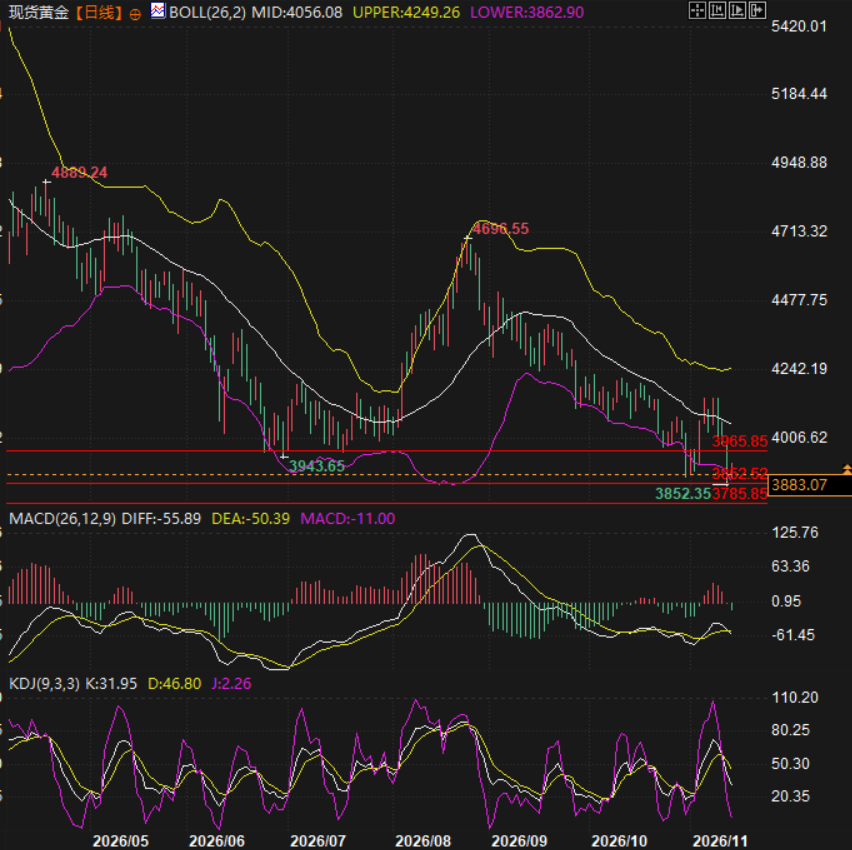 From a daily technical perspective, both the MACD and KDJ indicators show signs of a death cross, and the Bollinger Bands are trending downwards. Gold prices narrowly held the lower Bollinger Band support this week, and next week they may continue to test the lower Bollinger Band support around $3850/oz. If this level is broken, prices could fall to around $3785/oz, with the final support level next week around $3700/oz. On the upside, the key level to watch is whether the price can hold above $3900/oz. If it does, the next target is around $3965/oz.
U.S. Treasury Secretary Bessant stated on Friday that the Federal Reserve should not raise interest rates due to the energy supply shock caused by the Iran war pushing up inflation. He believes the U.S. economic fundamentals are very strong, the data is noisy, and the Fed should focus on the future rather than looking in the rearview mirror. This stance leans towards avoiding overreacting to temporary energy shocks. Chicago Fed President Goolsby immediately disagreed, stating that price pressures have spread far beyond what rising oil prices can explain; inflation has spread to service sector inflation and healthcare, areas typically unaffected by oil prices, and demand for AI data center construction is also pushing up inflation. Goolsby did not explicitly support raising interest rates but stated that the Fed "does indeed need to take action to continue rebuilding its credibility." The core of their disagreement lies in whether current inflation is a temporary energy shock or has spread to broader demand and service sector pressures. For gold, if the market believes more in Goolsby's "spread theory," rising expectations of interest rate hikes will suppress gold prices; if it believes more in Bessant's "energy shock theory," the risk of policy overreaction decreases, which may provide support for gold prices.investigation
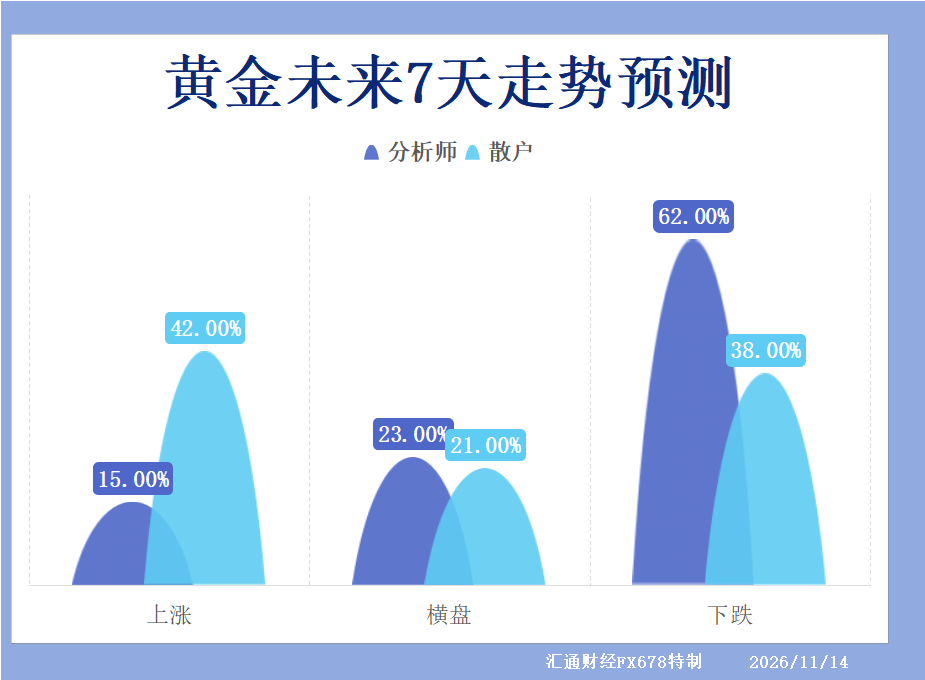
A survey shows that market sentiment turned significantly bearish after gold prices fell below $3,900/ounce. Of the 13 analysts surveyed, only 2 (15%) predicted a rise in gold prices in the coming week, 10 (62%) were bearish, and 3 (23%) expected sideways movement. Wall Street already had a bearish bias, which was further reinforced after gold prices fell below $3,800/ounce. Of the 160 retail investors surveyed, 67 (42%) were bullish, 60 (38%) were bearish, and 33 (21%) expected consolidation. The decline in bullish sentiment to a minority indicates that retail investor sentiment was also affected by the price breakdown. However, the proportion of bullish retail investors was still higher than that of analysts, reflecting market divergence: one side believes a rebound is expected, while the other believes that the dollar and yields will continue to suppress gold prices. The shift to bearish sentiment may amplify short-term volatility, but it is not an independent fundamental signal.Daily chart
From a daily technical perspective, both the MACD and KDJ indicators show signs of a death cross, and the Bollinger Bands are trending downwards. Gold prices narrowly held the lower Bollinger Band support this week, and next week they may continue to test the lower Bollinger Band support around $3850/oz. If this level is broken, prices could fall to around $3785/oz, with the final support level next week around $3700/oz. On the upside, the key level to watch is whether the price can hold above $3900/oz. If it does, the next target is around $3965/oz.Institutional Views
Bannockburn Global Forex Marc Chandler: Bearish, believes that strong US CPI has pushed up interest rates and interest rate expectations, impacting gold prices, and a significant low does not appear to have yet appeared. The next technical target is about $100 lower; if it breaks below the $3750 area, it may target $3500. StoneX Group Daniel Pavilonis: Short-term bearish, long-term bullish. He believes the chart is unfavorable, the dollar continues to strengthen, and the market is at a major turning point; he is currently fundamentally neutral on metals, "seeing no advantage," and tends to sell on rallies. He does not believe the possibility of a 50 basis point rate hike in December has been fully priced into gold prices; if there is an aggressive rate hike, gold prices may fall from the 100-week moving average to the 200-week moving average around $3200. He also stated that he remains bullish in the long term, but needs to experience a sharp correction first. Independent analyst Jesse Colombo: Bearish, watch for breakout risk. He believes gold is on the verge of a more significant breakout, mainly due to a stronger dollar and rising interest rates, with liquidation caused by the sell-off in tech stocks also having an impact. The $3900 level is a key support, but a confirmed break below it has not yet been achieved. A significant drop below this level could create a "vacuum" in the $3400-$3500 range, potentially resulting in a drop of at least $400. He emphasized that the dollar is like a "wrecking ball," with the dollar index breaking through 102 and 103, unwilling to declare a bottom before the dollar's rally peaks. FxPro's Alex Kupzikovich: Bearish. He believes that a stronger dollar and a 5% 10-year Treasury yield pose strong headwinds for gold, and the current decline is a restart of the previous downtrend pointing to $3300. However, if the Fed lowers market expectations for a 50 basis point rate hike in December, this could severely hinder this move. Adrian Day Asset Management: Short-term neutral, long-term bullish. He believes gold prices are caught between conflicting drivers and will be "flat" in the short term: long-term fundamentals are very bullish, but short-term factors are bearish. Before the end of the Iran war, gold faces headwinds from a stronger dollar, rising oil prices pushing up inflation expectations, and consequently, rising expectations of a Fed rate hike. CPM Group: Hold. They gave a "wait and see" recommendation on Friday, with an initial target range of $3800 to $4160 for November 13-27. They believe the decline in gold prices reflects a shift in financial market consensus: rising inflation expectations, higher US interest rates, lower future economic growth, and a still highly complex political situation. The lack of follow-through buying after gold rose approximately $160 over four days is one reason for the sharp drop below $4000; the decline mainly spilled over to silver, while platinum and palladium were relatively less affected. If support holds in the coming days, a rapid rebound is possible. Forex James Stanley: Bullish on a rebound. He believes spot gold prices will rise above $4000 again, but is "unsure if it can hold." This is a short-term rebound assessment, not a clear bullish trend.Next Week's Outlook
Next week is packed with data releases. Monday sees the release of the New York State manufacturing survey, followed by a speech from New York Fed President Williams. Tuesday brings US October retail sales and industrial production data, with speeches from Fed Chair Warsh, Richmond Fed President Barkin, St. Louis Fed President Musaleem, and Cleveland Fed President Hamak. Wednesday sees the release of US October construction data, again with a speech from New York Fed President Williams. Thursday sees the release of the Fed's monetary policy meeting minutes, with speeches from several Fed officials, including Williams, Kashkari, and Hamak, and the release of initial jobless claims. Friday sees the release of the University of Michigan Consumer Sentiment Index, and speeches from several Fed officials.- Risk Warning and Disclaimer
- The market involves risk, and trading may not be suitable for all investors. This article is for reference only and does not constitute personal investment advice, nor does it take into account certain users’ specific investment objectives, financial situation, or other needs. Any investment decisions made based on this information are at your own risk.