Growing divisions within the Federal Reserve have caused gold prices to tug at the crossroads between concerns about "inflation spread" and "energy shocks," resulting in a weekly drop of over 4%.
2026-11-14 08:34:30
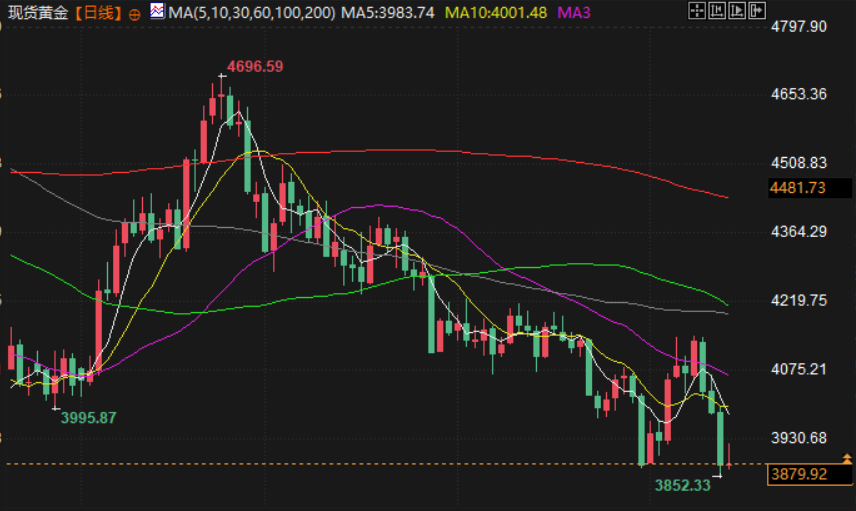
Spot gold rose slightly on Friday, closing at $3,879.92 per ounce, but fell 4.69% for the week, hitting a one-year low of $3,852.33 per ounce this week, as rising oil prices triggered concerns about rising inflation and persistently high interest rates. The market is still repricing the Federal Reserve's policy path and inflation risks.  US October PPI rose 0.3% month-on-month, lower than the 0.4% forecast in the survey. This reduced some of the market's bets on a larger rate hike, directly triggering a rebound in gold prices on Friday. As a non-interest-bearing asset, gold is particularly sensitive to interest rate expectations: when the market believes that the pace of rate hikes may be narrowing, the expected opportunity cost of holding gold decreases, leading to short-term buying. However, the data was not entirely positive. Core PPI rose 0.3% month-on-month, which independent analyst Tai Wong pointed out is still too high for policymakers; meanwhile, the bond market continued to be under pressure under the Fed's hawkish stance, limiting gold's ability to hold onto its initial gains after the PPI release. In other words, the lower-than-expected PPI data provided a window for a rebound, but core inflation stickiness and bond market pressures made it difficult for gold prices to sustain an upward trend. The pullback in gold prices after reaching a daily high reflects the market's repeated weighing between "slightly cooling inflation" and "still hawkish policy." The core contradiction for gold prices this week is not a single day's data, but rather the sharp weekly decline under the impact of a series of events. Gold prices fell 3% on Thursday, hitting a more than one-year low, amid concerns that rising oil prices would fuel further inflation and keep interest rates high. Earlier this week, higher-than-expected CPI data exacerbated the decline. The combined CPI and PPI data suggests that while overall inflationary pressures have shown marginal changes, there is no evidence sufficient for the Federal Reserve to shift towards easing. Rising oil prices could also transmit through transportation, production costs, and inflation expectations, raising concerns that the Fed might be forced to maintain high interest rates for longer. Gold's appeal diminishes in a rising interest rate environment because it does not generate interest, while rising bond yields increase the relative cost of holding gold. Wong added that with hawkish comments from Fed officials, gold prices are unlikely to return above $4,000. This indicates that the market remains cautious about the short-term recovery potential for gold prices. Internal Fed Disagreements Significant policy disagreements have emerged. US Treasury Secretary Bessant stated that the Fed should not raise interest rates due to the energy supply shock caused by the Iran war pushing up inflation, and believes that the US economic fundamentals are very strong, the data contains noise, and the Fed should focus on the future rather than looking in the rearview mirror. This stance leans towards avoiding overreacting to temporary energy shocks. Chicago Fed President Goolsby immediately disagreed, arguing that price pressures have spread far beyond what oil price increases can explain; inflation has spread to sectors typically unaffected by oil prices, such as services and healthcare, and demand from AI data center construction is also pushing up inflation. Goolsby did not explicitly support interest rate hikes but stated that the Fed "does indeed need to take action to continue rebuilding its credibility." The core of their disagreement lies in whether current inflation is a temporary energy shock or has spread to broader demand and services pressures. For gold, if the market believes Goolsby's "spread theory," rising expectations of interest rate hikes will suppress gold prices; if it believes Bessant's "energy shock theory," the risk of policy overreaction decreases, potentially providing support for gold prices. The Inflation Spread Debate A key issue raised by Goolsby is that tariff-induced inflation and oil price shocks should have subsided by now, but this has not been the case; services inflation is likely not from tariffs or oil prices and is one of the more troubling aspects of recent inflation reports. Related research also shows that the impact of rising oil prices on US inflation may not be limited to supply shocks: as the US is an energy exporter, rising global oil prices may also be transmitted to the overall economy through corporate profits and wage growth, creating inflationary pressures that the Federal Reserve cannot ignore. This means that even if the energy supply shock subsides in the future, core inflation stickiness may still support the rationale for raising interest rates. Recent stronger-than-expected employment and inflation data have further strengthened the Federal Reserve's rationale for continuing to raise interest rates. For gold, the more the inflation diffusion theory prevails, the more likely rising real interest rates and expectations of monetary policy tightening are to suppress gold prices; however, if energy shocks and geopolitical risks escalate, gold's safe-haven and inflation-hedging properties may provide phased support, creating a tug-of-war between bulls and bears. Interest Rate Hike Path Market focus has shifted to the December 8-9 meeting. Some officials have even begun discussing whether a 50 basis point rate hike is necessary. Goolsby stated that the upcoming inflation data will be key to determining whether the Federal Reserve needs to accelerate its pace of interest rate hikes. He emphasized that if we observe the breadth of inflation, signs of problems have been appearing for months, and in categories unaffected by oil prices and tariffs, progress in combating inflation remains stagnant, with some even heading in the wrong direction. Bessant criticized the Fed for potentially overreacting but stated he wouldn't tell the Fed what to do, only urging an open mind. For gold trading, the uncertainty of the policy path itself amplifies volatility: if discussions about a 50 basis point rate hike in December intensify, gold prices may retest lows; only if subsequent inflation data eases and officials become more cautious can gold prices gain a more solid foundation for a rebound. Currently, the market remains in a phase of data-dependent and official statement-driven speculation. Overall, the short-term outlook for gold prices is biased towards volatility and downward pressure. Negative factors include: a hawkish stance from the Federal Reserve, pressure on the bond market, still-high core PPI, higher-than-expected CPI, stronger-than-expected employment data, and the possibility of a larger rate hike being discussed in December, coupled with concerns about the AI industry triggered by Nvidia. These factors increase the opportunity cost of holding gold, limiting the momentum for gold prices to return above $4,000. Positive factors include: lower-than-expected overall PPI reducing bets on a larger rate hike, energy supply shocks and geopolitical uncertainties caused by the Iran war, gold's inflation-hedging and safe-haven properties, and the potential decrease in the risk of excessive rate hikes by the Federal Reserve if the energy shock proves to be temporary.
US October PPI rose 0.3% month-on-month, lower than the 0.4% forecast in the survey. This reduced some of the market's bets on a larger rate hike, directly triggering a rebound in gold prices on Friday. As a non-interest-bearing asset, gold is particularly sensitive to interest rate expectations: when the market believes that the pace of rate hikes may be narrowing, the expected opportunity cost of holding gold decreases, leading to short-term buying. However, the data was not entirely positive. Core PPI rose 0.3% month-on-month, which independent analyst Tai Wong pointed out is still too high for policymakers; meanwhile, the bond market continued to be under pressure under the Fed's hawkish stance, limiting gold's ability to hold onto its initial gains after the PPI release. In other words, the lower-than-expected PPI data provided a window for a rebound, but core inflation stickiness and bond market pressures made it difficult for gold prices to sustain an upward trend. The pullback in gold prices after reaching a daily high reflects the market's repeated weighing between "slightly cooling inflation" and "still hawkish policy." The core contradiction for gold prices this week is not a single day's data, but rather the sharp weekly decline under the impact of a series of events. Gold prices fell 3% on Thursday, hitting a more than one-year low, amid concerns that rising oil prices would fuel further inflation and keep interest rates high. Earlier this week, higher-than-expected CPI data exacerbated the decline. The combined CPI and PPI data suggests that while overall inflationary pressures have shown marginal changes, there is no evidence sufficient for the Federal Reserve to shift towards easing. Rising oil prices could also transmit through transportation, production costs, and inflation expectations, raising concerns that the Fed might be forced to maintain high interest rates for longer. Gold's appeal diminishes in a rising interest rate environment because it does not generate interest, while rising bond yields increase the relative cost of holding gold. Wong added that with hawkish comments from Fed officials, gold prices are unlikely to return above $4,000. This indicates that the market remains cautious about the short-term recovery potential for gold prices. Internal Fed Disagreements Significant policy disagreements have emerged. US Treasury Secretary Bessant stated that the Fed should not raise interest rates due to the energy supply shock caused by the Iran war pushing up inflation, and believes that the US economic fundamentals are very strong, the data contains noise, and the Fed should focus on the future rather than looking in the rearview mirror. This stance leans towards avoiding overreacting to temporary energy shocks. Chicago Fed President Goolsby immediately disagreed, arguing that price pressures have spread far beyond what oil price increases can explain; inflation has spread to sectors typically unaffected by oil prices, such as services and healthcare, and demand from AI data center construction is also pushing up inflation. Goolsby did not explicitly support interest rate hikes but stated that the Fed "does indeed need to take action to continue rebuilding its credibility." The core of their disagreement lies in whether current inflation is a temporary energy shock or has spread to broader demand and services pressures. For gold, if the market believes Goolsby's "spread theory," rising expectations of interest rate hikes will suppress gold prices; if it believes Bessant's "energy shock theory," the risk of policy overreaction decreases, potentially providing support for gold prices. The Inflation Spread Debate A key issue raised by Goolsby is that tariff-induced inflation and oil price shocks should have subsided by now, but this has not been the case; services inflation is likely not from tariffs or oil prices and is one of the more troubling aspects of recent inflation reports. Related research also shows that the impact of rising oil prices on US inflation may not be limited to supply shocks: as the US is an energy exporter, rising global oil prices may also be transmitted to the overall economy through corporate profits and wage growth, creating inflationary pressures that the Federal Reserve cannot ignore. This means that even if the energy supply shock subsides in the future, core inflation stickiness may still support the rationale for raising interest rates. Recent stronger-than-expected employment and inflation data have further strengthened the Federal Reserve's rationale for continuing to raise interest rates. For gold, the more the inflation diffusion theory prevails, the more likely rising real interest rates and expectations of monetary policy tightening are to suppress gold prices; however, if energy shocks and geopolitical risks escalate, gold's safe-haven and inflation-hedging properties may provide phased support, creating a tug-of-war between bulls and bears. Interest Rate Hike Path Market focus has shifted to the December 8-9 meeting. Some officials have even begun discussing whether a 50 basis point rate hike is necessary. Goolsby stated that the upcoming inflation data will be key to determining whether the Federal Reserve needs to accelerate its pace of interest rate hikes. He emphasized that if we observe the breadth of inflation, signs of problems have been appearing for months, and in categories unaffected by oil prices and tariffs, progress in combating inflation remains stagnant, with some even heading in the wrong direction. Bessant criticized the Fed for potentially overreacting but stated he wouldn't tell the Fed what to do, only urging an open mind. For gold trading, the uncertainty of the policy path itself amplifies volatility: if discussions about a 50 basis point rate hike in December intensify, gold prices may retest lows; only if subsequent inflation data eases and officials become more cautious can gold prices gain a more solid foundation for a rebound. Currently, the market remains in a phase of data-dependent and official statement-driven speculation. Overall, the short-term outlook for gold prices is biased towards volatility and downward pressure. Negative factors include: a hawkish stance from the Federal Reserve, pressure on the bond market, still-high core PPI, higher-than-expected CPI, stronger-than-expected employment data, and the possibility of a larger rate hike being discussed in December, coupled with concerns about the AI industry triggered by Nvidia. These factors increase the opportunity cost of holding gold, limiting the momentum for gold prices to return above $4,000. Positive factors include: lower-than-expected overall PPI reducing bets on a larger rate hike, energy supply shocks and geopolitical uncertainties caused by the Iran war, gold's inflation-hedging and safe-haven properties, and the potential decrease in the risk of excessive rate hikes by the Federal Reserve if the energy shock proves to be temporary.
- Risk Warning and Disclaimer
- The market involves risk, and trading may not be suitable for all investors. This article is for reference only and does not constitute personal investment advice, nor does it take into account certain users’ specific investment objectives, financial situation, or other needs. Any investment decisions made based on this information are at your own risk.