Expectations of a Fed rate hike are rising, the dollar hits a 19-month high, and the yen is nearing intervention thresholds.
2026-11-14 09:30:29
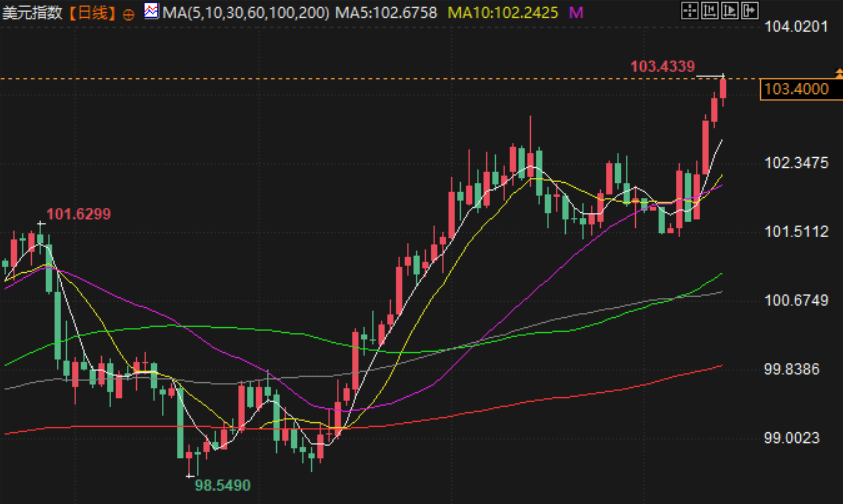
The dollar index rose 0.22% on Friday to close at 103.40, a 19-month high of 103.43, and gained 1.09% for the week, its biggest weekly gain in two months and its third consecutive week of gains. The main driver was rising market expectations of a significant interest rate hike by the Federal Reserve. Hawkish comments from Fed officials, coupled with stronger-than-expected US inflation data, led traders to weigh whether a larger-than-usual rate hike would be implemented next month.  The CME FedWatch tool shows that traders expect a roughly 90% probability of a 25 basis point rate hike next month, reinforcing the dollar's interest rate advantage. Interest rate expectations have directly pushed up US Treasury yields. This week, the two-year Treasury yield rose about 34 basis points to around 4.87%, marking its largest weekly gain since April 2025. Marc Chandler, chief market strategist at Bannockburn Global Forex, noted that the dollar's strength was mainly due to a strong jobs report and faster CPI growth, as well as hawkish comments from Fed officials such as Williams and Waller. The dollar rose 0.44% against the Swiss franc to 0.839, ending a two-week losing streak and further reflecting the overall strength of the dollar.
The CME FedWatch tool shows that traders expect a roughly 90% probability of a 25 basis point rate hike next month, reinforcing the dollar's interest rate advantage. Interest rate expectations have directly pushed up US Treasury yields. This week, the two-year Treasury yield rose about 34 basis points to around 4.87%, marking its largest weekly gain since April 2025. Marc Chandler, chief market strategist at Bannockburn Global Forex, noted that the dollar's strength was mainly due to a strong jobs report and faster CPI growth, as well as hawkish comments from Fed officials such as Williams and Waller. The dollar rose 0.44% against the Swiss franc to 0.839, ending a two-week losing streak and further reflecting the overall strength of the dollar.The yen is nearing the intervention red line.
The dollar fell 0.08% against the yen on Friday, closing at 159.71, after hitting a two-month high of 160.18 during the session. Traders were closely watching for potential intervention in the currency market from Tokyo, as the approaching 160 level would significantly increase the pressure on the Ministry of Finance. Finance Minister Satsuki Katayama stated on Friday that the government would respond appropriately to currency fluctuations, a statement seen as a verbal warning against speculative devaluation. Meanwhile, expectations for a Bank of Japan (BOJ) interest rate hike are strengthening. Citigroup strategist Tomohisa Fujiki wrote in a report that market expectations for a BOJ rate hike are rising, supported by a recovery in stock prices and strong inflation data. While the threshold for consecutive BOJ rate hikes remains high, the likelihood of continued quarterly rate increases has increased. Citigroup expects the BOJ to raise interest rates to 1.50% in December, with the market anticipating a 75% probability of a 25 basis point hike next month. Citigroup also expects the policy rate to rise to 1.75% in the first quarter, followed by a rise to 2.00% in the third quarter of next year. Therefore, the yen is currently caught in a tug-of-war between the risk of intervention and the expectation of interest rate hikes by the Bank of Japan, and the high volatility environment may continue.Euro and commodity currencies under pressure
The euro fell 0.3% against the dollar to close at 1.1021, after hitting a low of 1.1019 during the session, its lowest level against the dollar since April 2025, marking its fourth consecutive week of decline. The euro's weakness was attributed to both a stronger dollar and market repricing of the European Central Bank's (ECB) interest rate hike path. Mark Dowding, chief investment officer of fixed income at RBC BlueBay Asset Management, believes investors may have overestimated the magnitude of the ECB's rate hikes; with the base effect that previously pushed up inflation reversing, inflation is likely to fall below 2% by this time next year. He predicts that the ECB may hold rates steady after another hike in December this year, and may eventually ease policy before the end of 2027, giving RBC BlueBay a "relatively positive" view on eurozone government bond yields. Commodity currencies also came under pressure. The Australian dollar fell 0.48% to US$0.6773, making it the worst-performing G10 currency against the dollar so far this month; Australia is the only G10 country where the market expects a rate cut next year. Reserve Bank of Australia (RBA) Governor Michelle Bullock hinted at a wait-and-see approach to further tightening after policymakers voted divisively to raise the benchmark interest rate to an 18-year high. However, Bullock emphasized that the scale of this year's tightening has not yet transmitted to the economy, stating that "the last two rate hikes haven't even begun to transmit," while adding that tightening policy has already dampened demand, which is beginning to slow relative to supply and eventually return to equilibrium. Traders and economists interpreted her comments as dovish and lowered their expectations for further rate hikes. Cotality data showed that major city house prices fell 1.4% in October, heading towards the largest drop in 40 years. Shane Oliver of AMP Group believes that the housing market slump will drag down economic growth through the wealth effect, but it is not enough to distract the RBA from high inflation, which is expected to become a more significant consideration in the second half of next year. The New Zealand dollar fell 0.41% against the US dollar to 0.5525, poised for its third consecutive week of decline. This demonstrates that the strength of the US dollar is not a single-currency phenomenon, but rather a diffusion to major non-US currencies through US Treasury yields, carry trades, and policy divergence. Three key clues need to be observed going forward: first, the magnitude of the Fed's rate hike next month and whether the two-year US Treasury yield can continue to rise; second, whether the Japanese Ministry of Finance will actually intervene and whether the Bank of Japan's expectation of raising rates to 1.50% in December will materialize; and third, whether the Reserve Bank of Australia will truly hold its rates steady, and the extent to which falling house prices will drag down consumption and residential investment through the wealth effect. If the dollar's interest rate advantage continues to widen, non-dollar currencies may remain under pressure in the short term; if Japan intervenes or expectations of a central bank rate hike intensify, the yen's high volatility environment will persist. Investors should remain cautious between policy expectation gaps and data verification.
- Risk Warning and Disclaimer
- The market involves risk, and trading may not be suitable for all investors. This article is for reference only and does not constitute personal investment advice, nor does it take into account certain users’ specific investment objectives, financial situation, or other needs. Any investment decisions made based on this information are at your own risk.