CBOT Commodities Analysis: USDA report repricing led to soybeans hitting a two-week high, while corn rose 0.9% for the week.
2026-11-16 09:14:31
Last Friday (November 13), the CBOT grain market saw a corrective rebound. January soybeans closed at $12.315 per bushel, up 1.09%, reaching their highest level since October 30; December corn closed at $4.455 per bushel, up 0.85%, with a weekly gain of 0.9%; December wheat closed at $5.932 per bushel, up 1.89%, rebounding after hitting a low of $5.82 during the session, its lowest since June 30; December soybean meal closed at $329.80 per short ton, up 1.57%. The market began to digest the bullish USDA report again, and the sell-off triggered by the previous strengthening dollar proved to be "excessive." One broker stated, "We are still digesting the report from earlier this week; the corn and soybean carryover stock figures are more favorable"; a consulting firm executive said, "Grains have rebounded strongly after a significant sell-off." In other words, the across-the-board decline that occurred last Thursday due to the dollar hitting a 19-month high was reassessed on Friday – strong export sales data, supply tightening confirmed in the USDA report, and technical oversold correction all contributed to this rebound. Currently, CBOT grains are caught in a tug-of-war between the forces of "USDA supply tightening" and "dollar strength," and Friday's rebound indicates that, with the dollar pausing, supply-side fundamentals have regained dominance in pricing. Funds had significantly reduced their long positions during the previous sell-off, providing a base for the rebound. The basis performance provides a contrast – the Midwest basis remained largely stable, while the USD Gulf CIF premium remained stable to lower due to rising futures prices, indicating that the spot market is following futures rather than leading them. A summary of price changes for related commodities at 09:01 in the Asian morning session today (November 16th). 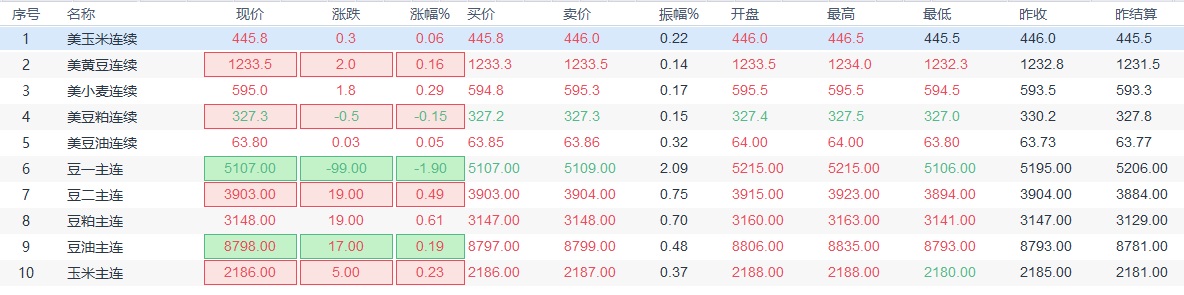 According to FX678's observations, estimates from overseas traders show that on Friday, November 13th, the speculative positions of commodity funds on corn futures, soybean futures, wheat futures, soybean meal futures, and soybean oil futures at the Chicago Board of Trade (CBOT), specifically the net positions and average net positions of CBOT commodity funds, are shown in the chart below created by FX678.
 The following is an interpretation of the net positions and averages in the above position charts: [CBOT corn speculative positions: net buying of 10,000 contracts; average net selling of 3,500 contracts over the past 3 trading days; average net buying of 833 contracts over the past 5 trading days; average net buying of 300 contracts over the past 10 trading days; average net selling of 450 contracts over the past 20 trading days; average net buying of 117 contracts over the past 30 trading days.] [CBOT soybean speculative positions: net buying of 8,500 contracts; average net buying of 2,167 contracts over the past 3 trading days; average net buying of 6,333 contracts over the past 5 trading days; average net buying of 1,900 contracts over the past 10 trading days; average net buying of 525 contracts over the past 20 trading days; average net buying of 183 contracts over the past 30 trading days.] [CBOT wheat speculative positions are net buying of 4,500 contracts; the average net position over the past 3 trading days is net buying of 833 contracts; the average net position over the past 5 trading days is net buying of 1,833 contracts; the average net position over the past 10 trading days is net buying of 200 contracts; the average net position over the past 20 trading days is net selling of 25 contracts; and the average net position over the past 30 trading days is net buying of 50 contracts.] [CBOT soybean meal speculative positions are net buying of 4,500 contracts; the average net position over the past 3 trading days is net buying of 833 contracts; the average net position over the past 5 trading days is net buying of 3,333 contracts; the average net position over the past 10 trading days is net buying of 1,200 contracts; the average net position over the past 20 trading days is net buying of 500 contracts; and the average net position over the past 30 trading days is net buying of 467 contracts.] [CBOT soybean oil speculative positions are net buys of 2,500 contracts; the average net position over the past 3 trading days is net buys of 833 contracts; the average net position over the past 5 trading days is net buys of 1,667 contracts; the average net position over the past 10 trading days is net buys of 250 contracts; the average net position over the past 20 trading days is net sells of 250 contracts; and the average net position over the past 30 trading days is net sells of 350 contracts.] CBOT grain positions, basis, and international supply and demand reveal new market trends. Detailed analysis of each commodity is provided below.
According to FX678's observations, estimates from overseas traders show that on Friday, November 13th, the speculative positions of commodity funds on corn futures, soybean futures, wheat futures, soybean meal futures, and soybean oil futures at the Chicago Board of Trade (CBOT), specifically the net positions and average net positions of CBOT commodity funds, are shown in the chart below created by FX678. The following is an interpretation of the net positions and averages in the above position charts: [CBOT corn speculative positions: net buying of 10,000 contracts; average net selling of 3,500 contracts over the past 3 trading days; average net buying of 833 contracts over the past 5 trading days; average net buying of 300 contracts over the past 10 trading days; average net selling of 450 contracts over the past 20 trading days; average net buying of 117 contracts over the past 30 trading days.] [CBOT soybean speculative positions: net buying of 8,500 contracts; average net buying of 2,167 contracts over the past 3 trading days; average net buying of 6,333 contracts over the past 5 trading days; average net buying of 1,900 contracts over the past 10 trading days; average net buying of 525 contracts over the past 20 trading days; average net buying of 183 contracts over the past 30 trading days.] [CBOT wheat speculative positions are net buying of 4,500 contracts; the average net position over the past 3 trading days is net buying of 833 contracts; the average net position over the past 5 trading days is net buying of 1,833 contracts; the average net position over the past 10 trading days is net buying of 200 contracts; the average net position over the past 20 trading days is net selling of 25 contracts; and the average net position over the past 30 trading days is net buying of 50 contracts.] [CBOT soybean meal speculative positions are net buying of 4,500 contracts; the average net position over the past 3 trading days is net buying of 833 contracts; the average net position over the past 5 trading days is net buying of 3,333 contracts; the average net position over the past 10 trading days is net buying of 1,200 contracts; the average net position over the past 20 trading days is net buying of 500 contracts; and the average net position over the past 30 trading days is net buying of 467 contracts.] [CBOT soybean oil speculative positions are net buys of 2,500 contracts; the average net position over the past 3 trading days is net buys of 833 contracts; the average net position over the past 5 trading days is net buys of 1,667 contracts; the average net position over the past 10 trading days is net buys of 250 contracts; the average net position over the past 20 trading days is net sells of 250 contracts; and the average net position over the past 30 trading days is net sells of 350 contracts.] CBOT grain positions, basis, and international supply and demand reveal new market trends. Detailed analysis of each commodity is provided below.Soybeans: Net buying of 8,500 contracts, marking the fifth consecutive day of net buying, supported by both purchases from major Asian countries and a downward revision of USDA inventories.
On Friday, commodity funds made net purchases of 8,500 soybean contracts, higher than the 3-day average of 2,167 contracts and the 5-day average of 6,333 contracts—net buying has continued for several days, indicating that fund purchases are gradual and sustained. The January contract closed at $12.315, up 12.5 cents, reaching its highest level since October 30. Support came from two directions. First, the USDA report confirmed a tightening supply—the agency lowered its 2026/27 soybean ending stocks forecast, while analysts had previously expected an increase, and simultaneously revised its export outlook upward. Second, continued confirmation of export demand—the USDA reported on Friday sales of 134,000 tons of soybeans to major Asian countries, 120,000 tons to Vietnam, and 100,000 tons to unknown destinations; soybean export sales for the week ending November 5 totaled 1.2 million tons, within the range of 850,000 to 2 million tons expected by analysts. One broker stated frankly, "We are still digesting the report from earlier this week; the corn and soybean ending stocks figures are more favorable." In terms of basis, soybean basis in the Midwest remained largely stable, with some locations shifting to January contract quotes due to the November contract expiry; basis at Suzhou crushing plants declined; and CIF soybean barge premiums in the US Gulf remained stable to lower due to rising futures prices. The stable basis while futures prices rose indicates that the spot market is following, rather than leading, this rebound. Some brokers pointed out that major Asian buyers are also purchasing Brazilian soybeans—this detail implies that major Asian buyers are diversified, and US soybean exports face competition from South America, limiting the extent of the soybean rebound. The closing price is expected to be $12.31-1/2, with upside targets at $12.40-$12.45. The sustainability of the rebound depends on whether major Asian buyers continue their purchases and whether the basis can strengthen in line with futures prices.Corn: Net buying of 10,000 lots reversed three days of net selling; export sales were at the upper end of expectations.
Corn commodity funds saw net buying of 10,000 contracts on Friday, compared to a 3-day average of net selling of 3,500 contracts—a significant reversal in daily flows, indicating that funds have shifted back to a bullish stance following the USDA report and export data. The December contract closed at $4.455, up 3 cents, and up 0.9% for the week, recovering from a four-month low. Support came from two directions. First, the USDA report lowered its estimate of US corn ending stocks to below analysts' expectations. Second, strong export sales—corn export sales for the week ending November 5th were 2.9 million tons, at the upper end of analysts' expectations of 2 million to 3 million tons; the USDA also reported sales of 303,300 tons of corn to Mexico. One broker stated that "the corn and soybean ending stock figures are more favorable," highlighting the core bullish aspect of the report. In terms of basis, the Midwest corn basis remained largely stable, while the Morris River Wharf and Consel Bluffs grain depots saw increases, and the Cincinnati grain depots saw decreases. The Gulf CIF corn barge premium remained stable to decline due to rising futures prices. Export sales were at the upper end of expectations, echoing the stable basis – indicating that export demand is real, but not strong enough to drive a significant increase in the basis. The closing price was $4.45-1/2, with upside targets at $4.50-4.55. A rebound would require continued stronger-than-expected export sales.Wheat: Net buying of 4,500 lots, continuing the trend of net buying, a technical rebound from the low point on June 30.
Wheat commodity funds saw net buying of 4,500 contracts on Friday, above the 3-day average of 833 contracts and the 5-day average of 1,833 contracts—net buying has continued for several days in a consistent direction. The December contract closed at $5.932, up 9 cents, after hitting a low of $5.82, its lowest since June 30, before rebounding. The rebound was driven by technical buying—some traders noted that Thursday's decline was "excessive," and Friday's rebound was a correction. A consulting firm executive stated, "There are no signs of progress in the Black Sea ceasefire, and limited shipments should support wheat prices," but added, "Competitive new Argentine wheat may still be the ceiling for prices." This set of judgments implies that the wheat rebound is driven by technical factors, while its fundamentals are constrained by two forces—continued disruptions to Black Sea supplies provide price support, but competitive pricing of the new Argentine crop constitutes a ceiling. One analyst bluntly stated, "If wheat starts flowing out of the Black Sea, prices may have more room to fall; if not, we are now approaching the bottom." In terms of basis, the basis for hard red winter wheat from the US Plains remained stable to rise due to rising futures prices and limited trading. On the international trading front, Jordan issued a tender for 120,000 tons of milled wheat and 120,000 tons of feed barley; Turkey will export 400,000 tons of milled wheat and 100,000 tons of durum wheat from November 17th to 18th—exports from Turkey due to a record harvest create additional pressure on the supply side. The closing price was $5.932, with an upside target of $6.00. Supply dynamics in the Black Sea and Argentina will be the dominant variables in the next phase. Net fund buying of 4,500 contracts echoes the assessment of "excessive decline," but whether the wheat rebound can be sustained depends on whether Black Sea supply continues to be constrained.Soybean Meal: Net buying of 4,500 lots, continuing the trend of net buying, with crushing expectations rebounding.
On Friday, commodity funds made net purchases of 4,500 contracts of soybean meal, close to the 5-day average of 3,333 contracts and 1,200 contracts higher than the 10-day average—the net buying direction is consistent, indicating that fund purchases are gradual. The December contract closed at $329.80, up $4.40. The cash basis remained stable at the railroad and trucking terminals due to rising futures prices. The USDA reported net export sales of 360,900 tons of soybean meal for the week, within analysts' expectations of 250,000 to 450,000 tons. Analysts expect the National Oilseed Processors Association's report on Monday to show that October soybean crushes totaled 225.428 million bushels, up 14.8% from September's 196.3 million bushels, but down 1.0% from the record high in October 2025. This expectation implies that crushing volumes have rebounded from a 13-month low as the harvest progresses and processors receive fresh supplies—increasing soybean meal supply but also reflecting improved crushing margins. The net purchase of 4,500 lots by funds echoes the rebound in crushing expectations, indicating that the rebound in soybean meal is supported by fundamentals rather than simply a cost transmission. The price of $329.80 corresponds to the marginal pricing of new crop crushing supply, and the price is likely to fluctuate between $325 and $335 per short ton in the short term.Soybean oil: Net buying of 2,500 lots, continuing the trend of net buying, supported by both cost and energy sources.
On Friday, commodity funds saw net buying of 2,500 contracts of soybean oil, exceeding the 3-day average by 833 contracts and the 5-day average by 1,667 contracts—net buying has continued for several days in a consistent direction. As a feedstock for biodiesel, soybean oil's pricing logic is tied to both soybeans (cost side) and crude oil (energy side). On Friday, soybeans rose 12.5 cents, providing upward pressure on the cost side; on the energy side, crude oil prices rose on Friday, increasing the production cost of polyester, a cotton substitute—this detail, while specifically targeting cotton, also illustrates that the strengthening of the energy side provides marginal support for vegetable oils. Looking at the crushing chain, rising soybean prices increase crushing costs, followed by soybean meal prices; changes in crushing profits depend on the difference in price increases between the two. Improved crushing profits could stimulate crushing volume and increase soybean oil supply, creating a bearish variable for soybean oil. However, the policy floor for biodiesel demand and the strengthening of crude oil provide downside support for soybean oil. The net buying of 2,500 contracts by funds echoes the dual support from the cost and energy sides, indicating that the rebound in soybean oil has two supporting channels. Soybean oil currently lacks independent upward momentum and is more passively following the trends of soybeans and crude oil, with a higher probability of short-term oscillations with a slightly upward bias.Summary: Net buying across the board; positions are now aligned with the USDA report.
A clear trend emerges from the combined open interest data of the five major commodities: net buying across the board. Specifically, corn saw 10,000 contracts, soybeans 8,500, wheat 4,500, soybean meal 4,500, and soybean oil 2,500. This pattern indicates that funds have shifted back to a long position following the USDA report and export data release—the net selling across the board that occurred last Thursday due to the dollar hitting a 19-month high (corn 12,000, soybeans 7,500, wheat 6,000, soybean meal 4,500, and soybean oil 3,500) was completely reversed on Friday. The reversal was most dramatic in corn (3-day average net selling of 3,500 contracts versus a single-day net buying of 10,000 contracts), while soybeans showed the most stable and continuous net buying (5-day average net buying of 6,333 contracts versus a single-day net buying of 8,500 contracts). The net buying in wheat aligns with the technical assessment of "excessive price decline." The divergence between basis and futures prices is a consistent signal. The basis for soybeans and corn in the Midwest remained largely stable, while the CIF premium for the US Gulf Coast stabilized or even declined due to rising futures prices—the spot market was following, rather than leading, this rebound. This pattern implies that export demand is real (weekly sales of 1.2 million tons of soybeans and 2.9 million tons of corn were both at or near the upper end of the expected range), but not strong enough to significantly strengthen the basis. Looking ahead, whether soybeans can hold above $12.20 and continue the momentum of net buying, whether corn can consolidate above $4.40, and whether wheat can break through $6.00 are three key points to observe whether this round of net buying across the board can develop into a trend. The key points for verification in the next one to two weeks are: the pace of purchases by major Asian countries (last Friday's single-day sales and weekly sales of 1.2 million tons indicate that purchases are progressing, but competition from South America poses a ceiling), the direction of the US dollar (if the dollar weakens, export demand may receive further support), and the supply dynamics in the Black Sea and Argentina (no progress in Black Sea negotiations supports wheat, while competition from Argentina's new crop poses a ceiling). With supply tightening once again dominating pricing and the dollar and exports yet to be fully realized, the short-term trend is biased towards an upward correction. However, the extent of the rebound depends on the sustainability of export sales and a pullback in the dollar. If neither of these factors materializes, this rebound may simply push prices back into the previous trading range.- Risk Warning and Disclaimer
- The market involves risk, and trading may not be suitable for all investors. This article is for reference only and does not constitute personal investment advice, nor does it take into account certain users’ specific investment objectives, financial situation, or other needs. Any investment decisions made based on this information are at your own risk.