Iran updates its narrative on nuclear weapons and Straits control; US deployment of three aircraft carriers makes it difficult for oil prices to fall.
2026-11-16 17:38:29
On Monday (November 16), during the Asian and European sessions, international oil prices consolidated slightly, currently trading around 88.29. The oil market is currently caught in a paradoxical narrative: on the fundamental side, institutions such as the IEA and JPMorgan Chase have begun trading on expectations of a global oil supply glut, but the geopolitical game over the Strait of Hormuz, a core energy corridor, continues to escalate. Iran recently updated its narrative on strait control and the nuclear issue, implying a dual deterrent approach to test the US's bottom line , somewhat recklessly. This involves formalizing and institutionalizing strait control, while maintaining an uncompromising stance on the nuclear issue. 
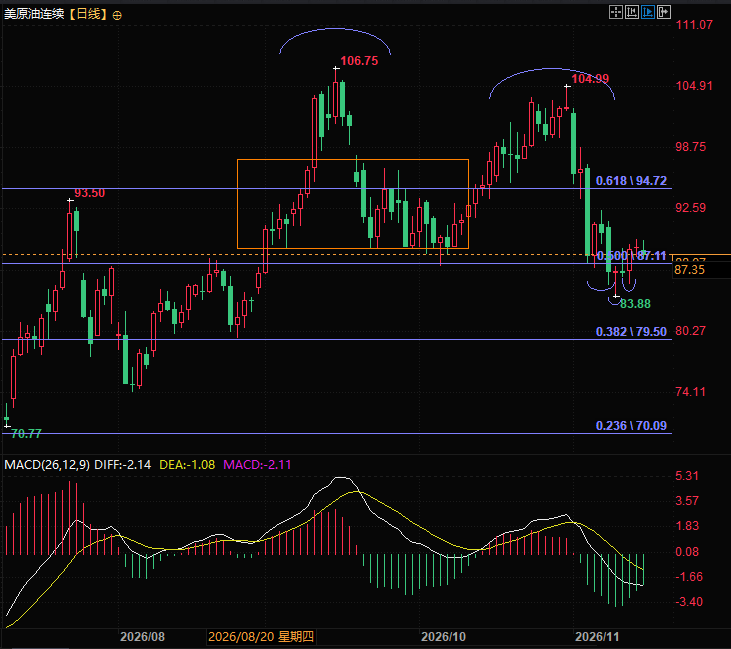 (WTI crude oil futures daily chart, source: EasyTrade) At 17:31 Beijing time, WTI crude oil futures are currently trading at $87.97 per barrel.
Strait of Hormuz: The shipping route itself is a deterrent, and the two-pronged approach exerts pressure.
The Iranian Parliament's National Security and Foreign Affairs Committee has reviewed and approved a plan for navigation through the Strait of Hormuz, reaching a consensus with Oman (another littoral state of the Strait). The plan is to initially implement a temporary arrangement, later transitioning to a permanent one. The plan still awaits a vote by the Iranian Parliament. Iranian Foreign Minister Araqchi will also travel to Oman for further consultations, stating publicly that any defensive strikes are only aimed at military targets and not at neighboring countries, maintaining a facade of communication with neighboring nations. However, it's important to note that this negotiation is not a settlement sought to be accepted by all parties, but rather a proactive effort by Iran to establish control over the Strait. The United States and mainstream international parties do not recognize the legitimacy of Iran's unilateral control over navigation rules in the Strait. Iran's move is essentially an attempt to use the bilateral agreement with Oman to solidify its control over the Strait into a written, long-term institutional fact—a risky attempt to seize control. Simultaneously, hard deterrence is being implemented: the Iranian Revolutionary Guard Navy has warned ship owners to avoid the southern route favored by the US, claiming that mines have been laid along this route, forming a "firewall." Iran has reported that several oil tankers with their AIS and navigation systems disabled attempted to use this southern route, subsequently striking mines and exploding; several oil tankers have recently caught fire. According to Vortexa, a third-party shipping data provider, a total of 112 ships were attacked in this round of conflict, including 95 mainstream oil tankers and liquefied gas carriers. Nearly half of these have been confirmed or are highly likely to have lost their operational capability. VLCCs (Very Large Crude Carriers) were the primary targets, resulting in substantial losses to the shipping capacity pool. Iran has also disclosed that the volume of illegal shipping lanes in the Strait of Hormuz has decreased by half. It is important to note that previous details regarding oil tanker mine strikes, sinkings, and large-scale pollution were all reported unilaterally by Iran without cross-verification from the US or maritime authorities. This constitutes a propaganda narrative within the context of strategic maneuvering. However, the data from Vortexa shows that ship damage and capacity depletion are verifiable facts, and cross-verification increases the credibility of Iran's claims .Iran's nuclear stance has locked in expectations of détente, and the risk of a black swan event remains.
On the nuclear issue, Iran has held firm to its bottom line, further dashing market hopes for détente. Iranian Foreign Ministry spokesman Baghae explicitly stated that suspending uranium enrichment or downgrading its enrichment level is currently ruled out, and that Iran will not use its nuclear program as a bargaining chip. Iranian Deputy Foreign Minister Gharibabadi added that IAEA inspectors will be refused access to damaged nuclear facilities until the war is permanently ended and Iran's conditions are met. Russia has also publicly criticized the IAEA for politicizing the Iranian nuclear issue and turning it into a tool for unilateral Western pressure. Whether Iran will use nuclear concessions to secure a ceasefire and the lifting of the maritime blockade remains a key point to watch; currently, Iran's stance is very firm. The tail risk of an Israeli airstrike against Iranian nuclear facilities persists, becoming a potential trigger for upward movement in oil prices.The US deploys a large military presence as a deterrent, but its decision-making regarding countermeasures remains wavering.
The US has adopted a strategy of "maximum military deployment, but postponed decision-making on strikes." The USS Roosevelt aircraft carrier has entered the Middle East, joining the USS Bush and USS Washington, forming three carrier strike groups in the region, supported by more than 20 ships to support the blockade of Iranian ports, presenting a complete military deterrent posture. Multiple sources familiar with the matter revealed that Trump is inclined to postpone launching a new round of strikes, provided that Iran and the Houthi rebels refrain from further provocations, and that the demands of Gulf allies to avoid a full-scale war are accepted. The US has not put airstrikes on the agenda in the short term, but retains the option of striking Iran's underground nuclear facilities. The decision will take into account political factors such as the benefits of strikes and the timing of the congressional elections.Israel's continued pressure is a key variable in the escalation of the conflict.
Israel is a disruptive factor in the de-escalation process. Mossad Director Goffman recently traveled to Washington to meet with senior CIA officials, continuously providing intelligence on Iran's military buildup and actively pushing for a renewed military strike against Iran. Israel continues to lobby the US to escalate operations, while the US, considering its own costs and regional stability, has exercised relative restraint. The differences between the US and Israel will determine whether the subsequent Middle East conflict will be limited friction or escalate into large-scale airstrikes—a signal that the crude oil market needs to closely monitor.The situation in the Red Sea is also escalating, with the Houthis gaining more influence.
In addition to the Strait of Hormuz, the situation in the Bab el-Mandeb Strait in the Red Sea is also escalating, further increasing global shipping risks. The Saudi-backed southern Yemeni armed forces have redeployed and withdrawn from Taiz al-Zoubab airport and the area around the Bab el-Mandeb Strait, giving the Houthi rebels advantageous positions overlooking this vital Red Sea waterway and increasing their influence over Red Sea shipping. The Saudi-led coalition continues to intercept Houthi ballistic missiles and drones fired at Riyadh; simultaneously, the Houthis have released approximately 600 detainees, signaling a partial de-escalation. The UKMTO, a British maritime trade agency, reported dangerous incidents involving armed small boats approaching merchant ships east of Socotra Island in Yemen. Several airlines in the UAE have already cancelled or rescheduled flights on Saudi routes, putting continued pressure on shipping insurance premiums.The conflict between Russia and Ukraine has taken another turn, adding uncertainty to energy supply expectations.
The Russia-Ukraine conflict continues to disrupt global energy supply expectations. Ukraine claims missiles struck a Tatarstan petrochemical plant, an oil refinery, and defense facilities in Bryansk, while also claiming to have crippled over 55% of Russia's refining capacity. Russia, in turn, continues to target Ukrainian logistics hubs, with a supply cargo ship in the Black Sea being attacked. Zelenskyy revealed that the US has proposed a territorial concession in exchange for Ukraine's NATO membership, introducing a new variable into the Russia-Ukraine negotiation framework. If the conflict escalates further, alternative routes for European refined oil and crude oil supplies will face renewed pressure.Trading Summary
Overall, the current main theme for crude oil remains global geopolitical risks and supply-demand structure. Iran's dual deterrent strategy of "rule-based rights confirmation + maritime strikes," the Iran nuclear deal, and the US-Israel differences collectively constitute a high-risk level. Iran's risky push to institutionalize the control of the Strait of Hormuz is the most crucial new variable in this round of competition. Recently, the market's main focus has been on Nvidia, but observing the strong trend of the US dollar index reveals that the current geopolitical tensions remain stubbornly persistent. Meanwhile, the market is susceptible to being suppressed by expectations of oversupply in the medium term, but if Israel pushes the US to restart strikes, or if there is a large-scale disruption of navigation in the Strait, the risk premium will be quickly recovered. In terms of trading, it is necessary to continuously monitor the results of the Iranian parliamentary vote on navigation, the latest statements from the US regarding strikes against Iran, daily ship data passing through the Strait, and Red Sea shipping warnings. Technically, oil prices are still influenced by the recent head and shoulders bottom pattern and have currently held the 0.5 Fibonacci retracement level at 87.11, suggesting a potential for further rebound. (WTI crude oil futures daily chart, source: EasyTrade) At 17:31 Beijing time, WTI crude oil futures are currently trading at $87.97 per barrel.
- Risk Warning and Disclaimer
- The market involves risk, and trading may not be suitable for all investors. This article is for reference only and does not constitute personal investment advice, nor does it take into account certain users’ specific investment objectives, financial situation, or other needs. Any investment decisions made based on this information are at your own risk.