Gold prices fell further due to a combination of spreading inflation and a strong dollar, compounded by liquidity selling pressure.
2026-11-16 18:02:36
Gold prices are currently being pulled by multiple forces: the ongoing geopolitical tensions in the Middle East are raising concerns about energy inflation, which should have provided safe-haven support for gold; however, geopolitical tensions are also boosting the US dollar, coupled with the Federal Reserve's hawkish statements pushing up expectations of real interest rates, and the Nvidia controversy causing cross-market liquidity to tighten. These multiple negative factors are diluting safe-haven buying, putting downward pressure on gold prices. 
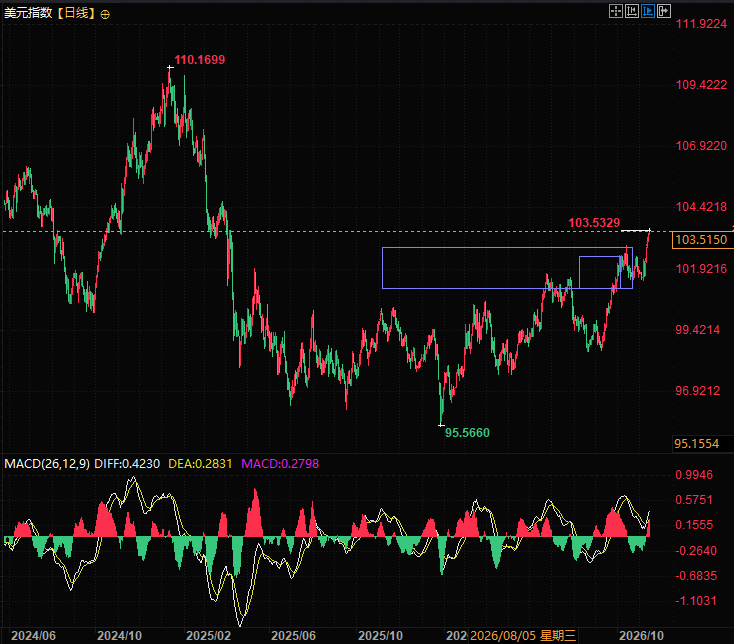 (US Dollar Index Daily Chart, Source: FX678)
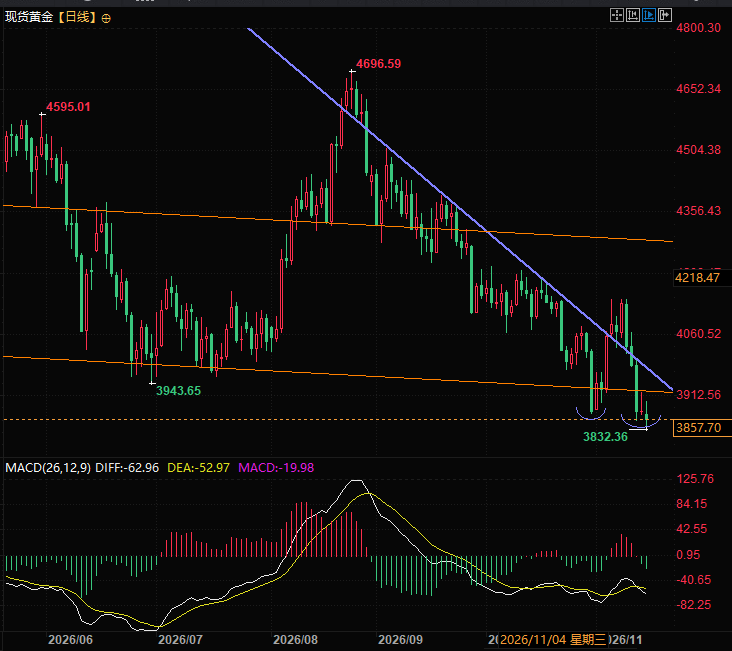 (Spot gold daily chart, source: FX678) At 18:00 Beijing time, spot gold is currently trading at $3,857 per ounce.
Federal Reserve officials signal a slow hawkish stance, raising the risk of inflation spreading.
Boston Fed President Collins' latest remarks, supporting a gradual interest rate hike, further solidify market expectations for a December rate hike and continued rate hikes into 2027. She pointed out that strong price and employment data over the past three months suggest that next year's interest rate center may be higher than previously estimated. The core concern is that the inflationary pressure from the energy shock is spreading outwards, no longer limited to crude oil alone. October's CPI exceeded expectations, with core inflation excluding energy and food rising to 2.8% year-on-year, higher than September's 2.6%, with prices for groceries, household goods, and medical services generally rising; tariffs have also pushed commodity inflation from deflation to a slight increase. The World Gold Council warns that the energy shock could trigger a second round of diffuse inflation, but a rebound in inflation does not necessarily mean a rise in gold prices; the core pricing factor still depends on real interest rates and the US dollar. LNG also believes that the current focus has shifted to inflation stickiness and interest rate expectations. As long as core inflation remains high, rising real interest rates will continue to suppress gold, a non-interest-bearing asset. Goldman Sachs' recent downward revision of its gold price target stems from the collective hawkish shift of Fed officials and the repricing of interest rate hike expectations. Collins emphasized that with inflation remaining high for an extended period, the Federal Reserve needs to continue tightening monetary policy to push inflation back down to the 2% target. However, she is a "slow hawk," taking into full account tail risks such as geopolitical instability, rising long-term interest rates, and the waning enthusiasm for AI investment. She does not advocate aggressive rate hikes, and the policy path will adhere to data assessment on a meeting-by-meeting basis, without pre-setting a fixed pace.The Middle East geopolitics presents a dual picture: energy inflation provides a safe haven, while a stronger dollar suppresses gold prices.
The Strait of Hormuz standoff continues, with Iran adhering to its nuclear red line and pushing for written confirmation of its control over the strait, testing the US's bottom line with a dual deterrent. This prolongs the risk of disruption to the shipping lanes, extending the anticipated energy crisis and significantly increasing the probability of inflation spreading outwards. Geopolitical conflicts have a distinct two-sided effect: shipping lane risks and rising oil prices can spur safe-haven buying of gold; however, in a crisis environment, global funds prioritize the US dollar and US Treasury bonds, with capital inflows pushing up the dollar index, directly suppressing dollar-denominated gold and significantly offsetting its safe-haven premium. The unique transmission chain of this round of geopolitical events is: geopolitical events push up oil prices → inflation expectations rise → interest rate hike expectations and rising US Treasury yields; simultaneously, oil settlements increase demand for the dollar, passively strengthening it, creating a situation where "safe-haven buying is the dollar rather than gold," rendering gold's safe-haven attribute temporarily ineffective. Furthermore, in a high-interest-rate environment, holding the dollar earns interest, while gold does not generate returns, which is the core reason why funds prioritize the dollar. Morgan Stanley's research report observes that gold and risk assets weakened simultaneously during recent geopolitical escalations, the root cause being the flow of safe-haven funds to the dollar and US Treasury bonds. (US Dollar Index Daily Chart, Source: FX678)The robust job market provides room for the Federal Reserve to tighten monetary policy.
The labor market has demonstrated unexpected resilience, with solid fundamentals. October saw an increase of 165,000 non-farm payroll jobs, and the unemployment rate fell to 4.1%. Demand for labor has spread from the previously concentrated healthcare sector to multiple industries, with businesses in the region showing strong hiring interest. In the short term, there are no conditions for a slowdown in employment to force the Federal Reserve to shift to easing. Strong employment provides the Fed with policy space to address diffuse inflation, and rising real interest rates will suppress gold prices in the medium to long term. Institutions believe that the resilience of employment is the foundation for the Fed's continued tightening. As long as employment does not weaken rapidly, inflation stickiness will dominate policy, making it easier for real interest rates to rise than fall, putting pressure on gold prices. Only when employment cools rapidly will tightening expectations ease quickly, allowing gold to usher in a trend-driven opportunity.The turmoil in the AI sector has spilled over, and tightening liquidity has put downward pressure on gold prices.
Besides the Federal Reserve's policy and the strength of the US dollar, the volatility in the AI sector has become a new variable affecting liquidity. The market views Nvidia as the "central bank of computing power" in AI, and its recent troubles have triggered a spread of pessimism towards risk assets, which has also impacted the gold market. Some funds are selling off highly liquid gold positions to cover margin calls on other holdings; the pullback in risk assets has led to a passive tightening of overall liquidity, creating temporary selling pressure. Even if geopolitical risk aversion continues to play a role, it is difficult to offset the dual pressure of a strong dollar and tightening liquidity. Multiple overseas trading institutions have observed this phenomenon: when highly leveraged portfolios encounter pullbacks in tech stocks, gold is often sold first to cover margin calls, resulting in a deleveraging trend where stocks and gold fall in tandem. This is a short-term disturbance and does not negate gold's long-term safe-haven value. Institutions also caution that this is only a secondary factor amplifying volatility; interest rate hike expectations and the US dollar are the core pricing drivers for gold.Summary and Technical Analysis:
In the medium to long term, the ongoing Middle East situation and the potential for energy inflation provide a bottom support for gold prices. Short-term negative factors are clear: geopolitical safe-haven flows are pushing up the US dollar, expectations of gradual interest rate hikes by the Federal Reserve are raising real interest rates, and the Nvidia controversy is causing margin calls and tightening liquidity, leading to repeated fluctuations in gold prices, with bulls and bears alternating in control. Institutional opinions are significantly divided: StoneX and Mott Capital, which are cautious in the short term, believe that as long as the upward trend of the US dollar and interest rates remains unchanged, gold prices still have room to fall, potentially reaching around $3600 in an extreme scenario. UBS and Goldman Sachs, which are bullish in the medium to long term, point out that continued central bank gold purchases, long-term credit risk of the US dollar, and the risk of stagflation provide underlying support, and this round of adjustment is merely a disturbance within the interest rate hike cycle; gold prices still have room to rise in 2027. Key areas to monitor include: US inflation data, speeches by Federal Reserve officials, shipping anomalies in the Strait of Hormuz, changes in the US dollar index, and global liquidity disruptions caused by news related to Nvidia. Technical Analysis: Spot gold has broken below the downtrend line and the downtrend channel line, also breaking the recent double bottom pattern. Technically, this suggests further downside potential, with support around 3600. (Spot gold daily chart, source: FX678) At 18:00 Beijing time, spot gold is currently trading at $3,857 per ounce.- Risk Warning and Disclaimer
- The market involves risk, and trading may not be suitable for all investors. This article is for reference only and does not constitute personal investment advice, nor does it take into account certain users’ specific investment objectives, financial situation, or other needs. Any investment decisions made based on this information are at your own risk.