Euro/Dollar: Rising expectations of a hawkish Fed stance put continued pressure on the exchange rate.
2026-11-16 18:08:32
On Monday (November 16), US inflation data again highlighted upward pressure on prices, causing the euro to fall against the US dollar, a key focus for major financial institutions. This downward trend in the euro against the dollar is quite strong. While some traders have entered short positions, those who have been expecting a reversal and are hastily trying to buy the dip will inevitably find themselves in a passive position.  The euro has now fallen to its lowest level against the dollar since April 2025. The foreign exchange market is in turmoil as major financial institutions price in the Federal Reserve's policy direction—the market is assessing not only what action the Fed will take at its December 9th meeting, but also whether it will continue to raise interest rates in the coming months. Downward momentum has intensified, with the euro approaching the 1.10 level . This morning, the euro's downward momentum against the dollar further intensified, with the exchange rate currently trading around 1.10150. Last Friday, the pair continued its decline, reaching around 1.10220. Since breaking below the 1.11000 level last Wednesday, the euro has almost failed to mount a sustained rebound against the dollar. It was during this phase that contrarian traders began to consider buying the dip; the decline over the past few days has been rapid. Many experienced traders believe that after a period of rapid price volatility, a consolidation phase often follows. In other words, some large institutional traders believe that the euro against the dollar has entered oversold territory. However, for ordinary traders with limited capital, holding long positions with this mindset is likely to lead to losses if the trading cycle doesn't allow for extended periods of waiting, as the downward trend of the euro against the dollar remains clear. Attempts to rebound continue to be suppressed by negative news related to the Federal Reserve . Traders are always tempted to rush in, trying to catch turning points in asset markets. The idea of expecting the euro against the dollar to experience a sustained upward trend within the day and thus profit from speculation is certainly tempting. However, it's clear that major financial institutions remain wary of the Federal Reserve's December interest rate meeting and any subsequent potential rate hikes, a force that continues to pressure the euro against the dollar downward. Since the release of US inflation data last Tuesday, which significantly dampened market enthusiasm, the downward trend has become very clear; do not hold positions against the trend. A deep decline is underway, and conditions for a market reversal are not yet present . The euro against the dollar has a huge daily trading volume, and the pair often experiences significant one-sided movements, but this is not always the case. Broadly speaking, this round of decline began at the end of August, when the exchange rate briefly tested the 1.17000 level. After a sustained decline, the market may gradually develop expectations of an impending reversal, but betting on such a reversal usually requires substantial financial resources and exceptional patience. Short selling also carries the risks of intraday trading.
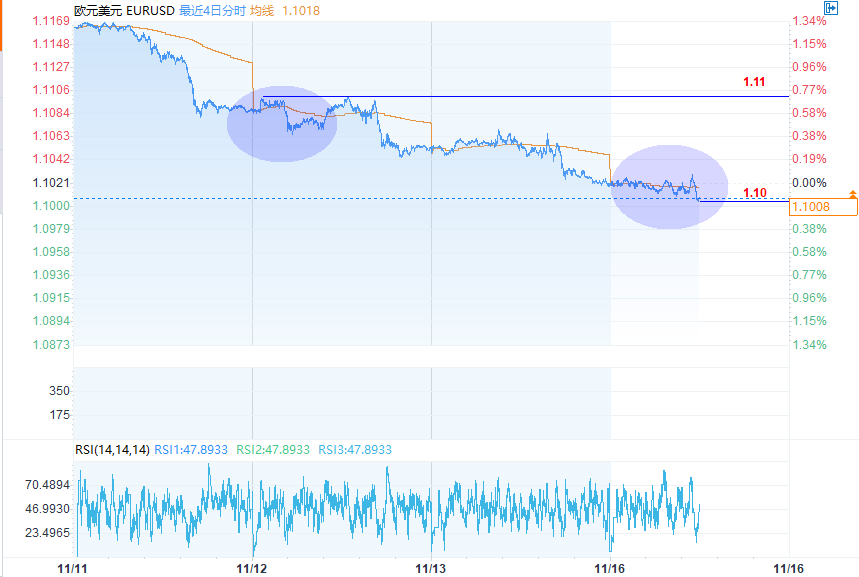 The recent declines may tempt many traders to short the market. However, the forex market is inherently characterized by rapid and volatile fluctuations, and shorting carries inherent risks. In the short term, multiple factors are intertwined, and the intraday volatility of the Euro/USD pair may further increase, requiring close monitoring from intraday traders. Euro/USD Approaching 1.10: Key Level and Next Sentiment Test By observing nearby support and resistance levels, we can determine whether selling pressure remains dominant or whether the current decline is beginning to slow. We need to distinguish between two scenarios: a mere temporary pullback or a substantial improvement in buying power. Key Levels Short-term Resistance: 1.10165. If the price continues to hold above this level, it indicates an initial recovery in buying power; if it only briefly breaks through and then resumes selling, it is insufficient to indicate that downward pressure has eased. Short-term Support: 1.10110. Holding this level indicates that selling pressure has encountered buying support; if it breaks down effectively, the 1.10000 psychological level will soon be tested. Upper reference level: 1.10290. If the exchange rate holds above the recent resistance level, the rebound will further develop, targeting this higher level. Lower reference level: 1.09970. If the support is broken, the price will extend below 1.10000, which is a downside target. If the exchange rate continues to trade below this psychological level, it indicates that buying pressure has not yet stabilized. In the next trading session, two possibilities exist: the euro/dollar pair may experience a brief consolidation after a rapid decline, or expectations of tighter US monetary policy may continue to suppress buying. The market is focusing on the exchange rate's performance around the 1.10 level to observe whether the rebound can withstand a new round of selling pressure. It is still uncertain whether large financial institutions will consider the recent decline excessive or still see the rebound as an opportunity to reduce their euro positions.
The euro has now fallen to its lowest level against the dollar since April 2025. The foreign exchange market is in turmoil as major financial institutions price in the Federal Reserve's policy direction—the market is assessing not only what action the Fed will take at its December 9th meeting, but also whether it will continue to raise interest rates in the coming months. Downward momentum has intensified, with the euro approaching the 1.10 level . This morning, the euro's downward momentum against the dollar further intensified, with the exchange rate currently trading around 1.10150. Last Friday, the pair continued its decline, reaching around 1.10220. Since breaking below the 1.11000 level last Wednesday, the euro has almost failed to mount a sustained rebound against the dollar. It was during this phase that contrarian traders began to consider buying the dip; the decline over the past few days has been rapid. Many experienced traders believe that after a period of rapid price volatility, a consolidation phase often follows. In other words, some large institutional traders believe that the euro against the dollar has entered oversold territory. However, for ordinary traders with limited capital, holding long positions with this mindset is likely to lead to losses if the trading cycle doesn't allow for extended periods of waiting, as the downward trend of the euro against the dollar remains clear. Attempts to rebound continue to be suppressed by negative news related to the Federal Reserve . Traders are always tempted to rush in, trying to catch turning points in asset markets. The idea of expecting the euro against the dollar to experience a sustained upward trend within the day and thus profit from speculation is certainly tempting. However, it's clear that major financial institutions remain wary of the Federal Reserve's December interest rate meeting and any subsequent potential rate hikes, a force that continues to pressure the euro against the dollar downward. Since the release of US inflation data last Tuesday, which significantly dampened market enthusiasm, the downward trend has become very clear; do not hold positions against the trend. A deep decline is underway, and conditions for a market reversal are not yet present . The euro against the dollar has a huge daily trading volume, and the pair often experiences significant one-sided movements, but this is not always the case. Broadly speaking, this round of decline began at the end of August, when the exchange rate briefly tested the 1.17000 level. After a sustained decline, the market may gradually develop expectations of an impending reversal, but betting on such a reversal usually requires substantial financial resources and exceptional patience. Short selling also carries the risks of intraday trading. The recent declines may tempt many traders to short the market. However, the forex market is inherently characterized by rapid and volatile fluctuations, and shorting carries inherent risks. In the short term, multiple factors are intertwined, and the intraday volatility of the Euro/USD pair may further increase, requiring close monitoring from intraday traders. Euro/USD Approaching 1.10: Key Level and Next Sentiment Test By observing nearby support and resistance levels, we can determine whether selling pressure remains dominant or whether the current decline is beginning to slow. We need to distinguish between two scenarios: a mere temporary pullback or a substantial improvement in buying power. Key Levels Short-term Resistance: 1.10165. If the price continues to hold above this level, it indicates an initial recovery in buying power; if it only briefly breaks through and then resumes selling, it is insufficient to indicate that downward pressure has eased. Short-term Support: 1.10110. Holding this level indicates that selling pressure has encountered buying support; if it breaks down effectively, the 1.10000 psychological level will soon be tested. Upper reference level: 1.10290. If the exchange rate holds above the recent resistance level, the rebound will further develop, targeting this higher level. Lower reference level: 1.09970. If the support is broken, the price will extend below 1.10000, which is a downside target. If the exchange rate continues to trade below this psychological level, it indicates that buying pressure has not yet stabilized. In the next trading session, two possibilities exist: the euro/dollar pair may experience a brief consolidation after a rapid decline, or expectations of tighter US monetary policy may continue to suppress buying. The market is focusing on the exchange rate's performance around the 1.10 level to observe whether the rebound can withstand a new round of selling pressure. It is still uncertain whether large financial institutions will consider the recent decline excessive or still see the rebound as an opportunity to reduce their euro positions.
- Risk Warning and Disclaimer
- The market involves risk, and trading may not be suitable for all investors. This article is for reference only and does not constitute personal investment advice, nor does it take into account certain users’ specific investment objectives, financial situation, or other needs. Any investment decisions made based on this information are at your own risk.