A chart shows that the Baltic Dry Index has declined slightly, with Capesize and Panamax freight rates weakening.
2026-11-16 23:50:30
The latest data shows that on November 16, 2026, the Baltic Dry Index (BDI) closed at 2921 points, a four-day low, down 1.98% from the previous day, marking the largest drop since November 3, 2026, and the second consecutive day of decline (including zero growth). Looking at the short-term charts, the BDI has seen positive growth 7 times, negative growth 4 times, and zero growth in the last 11 BDI data points. Specifically, the Panamax Freight Index (BPI) closed at 2113 points, down 0.24% from the previous day; the Capesize Freight Index (BCI) closed at 4558 points, down 3.41%; and the Supramax Freight Index (BSI) closed at 1837 points, up 0.05%. For detailed charts of the latest 720-day and 10-year trends of the Baltic Dry Index and its three main sub-indices, please refer to the charts specially created by FX678. 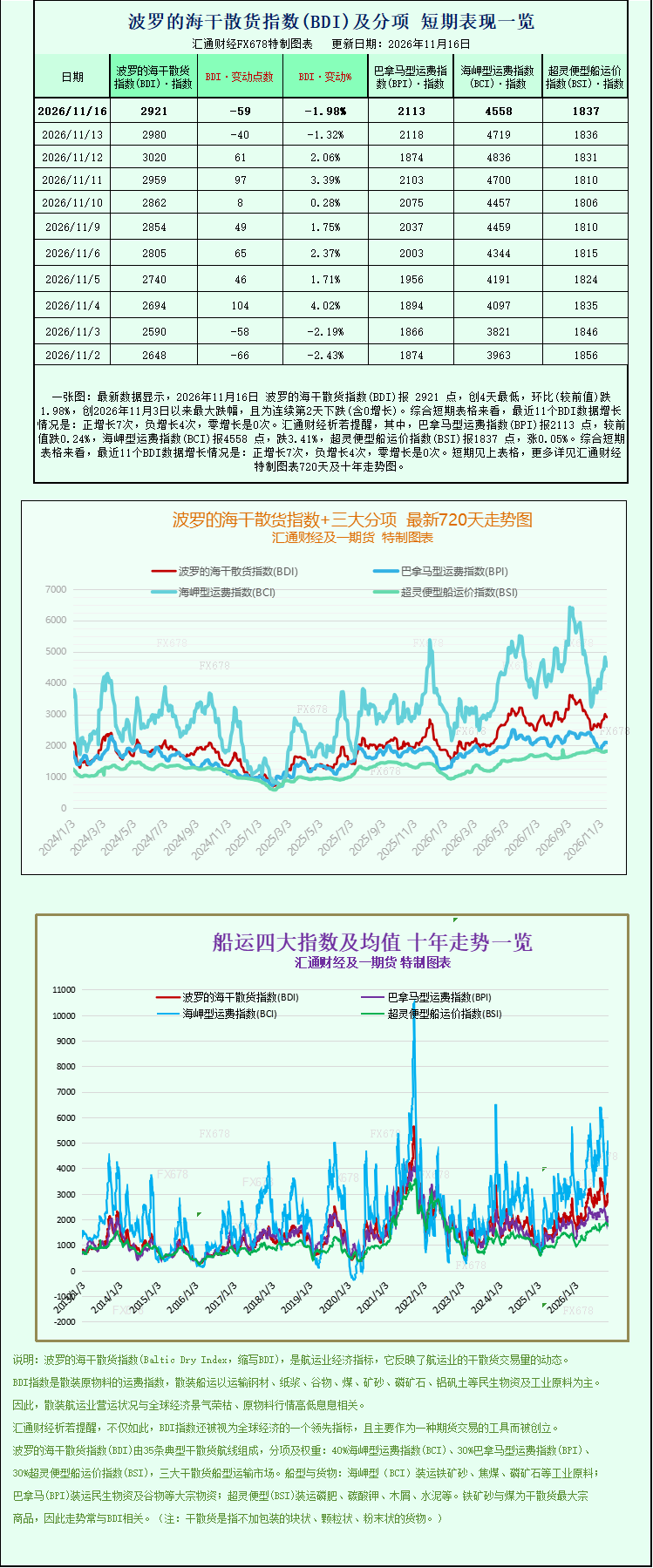 The Baltic Dry Index (BDI) for major dry bulk shipping declined slightly on Monday, primarily due to a simultaneous softening of spot charter rates for Capesize and Panamax vessels. The market was pressured by weak expectations for steel raw material demand. Only Supramax vessel rates maintained a slight resilience, failing to offset the overall downward pressure. The Baltic Dry Index, reflecting the combined performance of Capesize, Panamax, and Supramax freight rates, fell 59 points, or 2%, to close at 2921 points. This decline broke the previous period of relatively strong fluctuations in the index, highlighting a significant structural divergence: large vessel rates fell sharply, while small and medium-sized vessels showed relative resilience, highlighting a clear divergence in supply and demand fundamentals across different cargo types and routes. The dry bulk shipping market is a barometer of global commodity trade. Index fluctuations directly reflect the cross-border flow of basic commodities such as iron ore, coal, and grain. As the world's largest importer of iron ore and coal, China's domestic downstream demand expectations are one of the most important variables influencing the sentiment of the Capesize shipping market. Looking at the sub-categories, the Capesize index led the market decline, falling sharply by 161 points, a drop of 3.4%, closing at 4558 points. Capesize vessels are the largest and most important vessel type in the dry bulk fleet, with a typical deadweight tonnage of approximately 150,000 tons. They primarily transport iron ore and thermal coal, and their routes are highly tied to long-haul maritime trade from Australian and Brazilian ore to China. Freight rate fluctuations are highly sensitive to expectations in the steel industry chain. Supporting data shows that the average daily earnings of Capesize vessels decreased by $1464, falling to $37831 per day. This decline in profitability indicates a contraction in shipowners' short-term charter income and also reflects a mismatch between recent mine shipments and steel mills' restocking intentions: overseas mine shipments remain stable, but domestic steel mills' purchasing intentions are insufficient, resulting in limited cargo volume increases. Charterers' bargaining power has increased, forcing shipowners to lower their quotes to secure deals. On the same day, iron ore futures prices on the Dalian Commodity Exchange in China fell to a new low in over 16 months. Weak domestic economic data continues to ferment, further exacerbating market pessimism regarding steel end-user demand. Steel is a basic raw material for infrastructure, real estate, and manufacturing. Multiple factors, including weaker-than-expected recovery in real estate investment, a slowdown in infrastructure project commencement, and weak manufacturing orders, have combined to suppress steel mills' raw material procurement strategies. Most steel mills are maintaining low inventory levels, purchasing only small quantities as needed, and lack the incentive to actively restock. The weakening iron ore prices have a reverse impact on the shipping sector, with traders reducing forward chartering operations to lock in cargo, leading to a contraction in cargo volume on forward routes and continuously suppressing freight rates for long-distance large ore carriers. Market participants are generally adopting a wait-and-see approach, awaiting signals of domestic policies aimed at stabilizing growth and a recovery in downstream steel demand. Until clear positive factors emerge, the Capesize sector is unlikely to experience an independent upward trend. The Panamax index weakened slightly, falling only 5 points to close at 2113, a much smaller decline than the Capesize index. Panamax vessels are concentrated in the 60,000 to 70,000 tonne range, with core cargoes being thermal coal and grain. Their routes cover multiple transoceanic routes across the Atlantic and Pacific, resulting in a more diversified trade structure. Supported by seasonal grain exports and restocking demand from thermal power plants in the Asia-Pacific region, their volatility is typically lower than that of the iron ore-dominated Capesize sector. Average daily earnings for Panamax vessels decreased by $46 to $19,017 per day. The moderate adjustment in the Panamax market indicates that demand for coal and grain trade has not collapsed entirely; however, insufficient new cargo volume is making it difficult to drive freight rates higher. The Northern Hemisphere has entered the autumn and winter heating season, which is traditionally the peak season for coal imports in the Asia-Pacific region. However, this year, the peak season expectations were partially priced in earlier, and some power plants had already completed their coal stockpiling in advance, resulting in weaker demand during the peak season compared to previous years. This limited the upside potential for Panamax shipping rates. Regarding grains, the export window for grains from North and South America remained stable, with a steady shipment pace, providing a floor for this sector. Therefore, freight rates only saw a slight correction and did not experience a sharp drop. The Supramax index was the only sector to close higher, rising 1 point, or 0.1%, to 1837 points. This type of vessel belongs to small and medium-sized dry bulk carriers, with flexible routes, able to call at more small and medium-sized ports with limited water depth, and carrying more diversified cargoes. In addition to small batches of coal and grain, it also carries cement clinker, fertilizer, and small batches of mineral sands, making it less affected by the cycle of a single commodity. The activity of regional short-haul trade is the source of its resilience. Short-haul cargoes within the region and small-volume trade demand from Southeast Asia and the Indian Ocean coast provided a floor, offsetting the pressure from weak demand for bulk commodities in the open ocean. This resulted in a slight increase despite the overall market downturn, reflecting structural differences within the shipping market. From an overall market perspective, the dry bulk market is currently in a phase of "peak season expectations realized, but actual demand remains weak." On the supply side, there is no large-scale concentrated delivery of new ships in the short term, and fleet growth remains moderate. The contradiction lies on the demand side, especially the demand expectations of China's steel industry chain. The significant weakening of Capesize vessels is essentially a pricing result of iron ore demand expectations; the fluctuations in Panamax vessels reflect the weaker-than-expected strength of the coal peak season; and the resilience of Supramax vessels relies on the buffer of regionally dispersed trade. The future direction of the index will depend on two factors: firstly, whether domestic macroeconomic policies can effectively stimulate steel demand in the real estate and infrastructure sectors, leading to a recovery in iron ore procurement; and secondly, monitoring the realization of coal demand in the Northern Hemisphere, the pace of grain shipments from South America, and overall changes in global industrial activity. If domestic steel demand remains weak and iron ore prices remain low, the Cape of Good Hope sector is likely to continue to face pressure, dragging down the Baltic Dry Index. Conversely, if downstream demand shows marginal improvement, large vessel freight rates are expected to recover first, leading to a broader market rebound. Shipping market participants are also continuously monitoring risk variables: changes in overseas mine shipment plans, port congestion, fuel price fluctuations, and ocean insurance costs will all affect shipowners' actual returns. Currently, market sentiment is cautious, charterers are adopting a wait-and-see approach, and transactions are mainly short-term spot charters, with fewer long-term charter orders. The market lacks incremental funds and cargo support to continuously push up freight rates. The structural divergence in the index also reminds traders that the cyclical rhythms of different vessel types and cargoes within the dry bulk sector have diverged, and the overall shipping sector's performance cannot be judged from a single perspective.
- Risk Warning and Disclaimer
- The market involves risk, and trading may not be suitable for all investors. This article is for reference only and does not constitute personal investment advice, nor does it take into account certain users’ specific investment objectives, financial situation, or other needs. Any investment decisions made based on this information are at your own risk.