Why are oil prices falling even though oil tankers are still under attack?
2026-11-17 10:04:33
On Tuesday (November 17) in early Asian trading, US crude oil futures continued their decline, currently trading above $85.00, down about 0.68% from Monday's settlement price. US crude oil futures fell after reports that the global oil market is returning to a surplus, even as attacks on oil tankers in the Strait of Hormuz continue. 
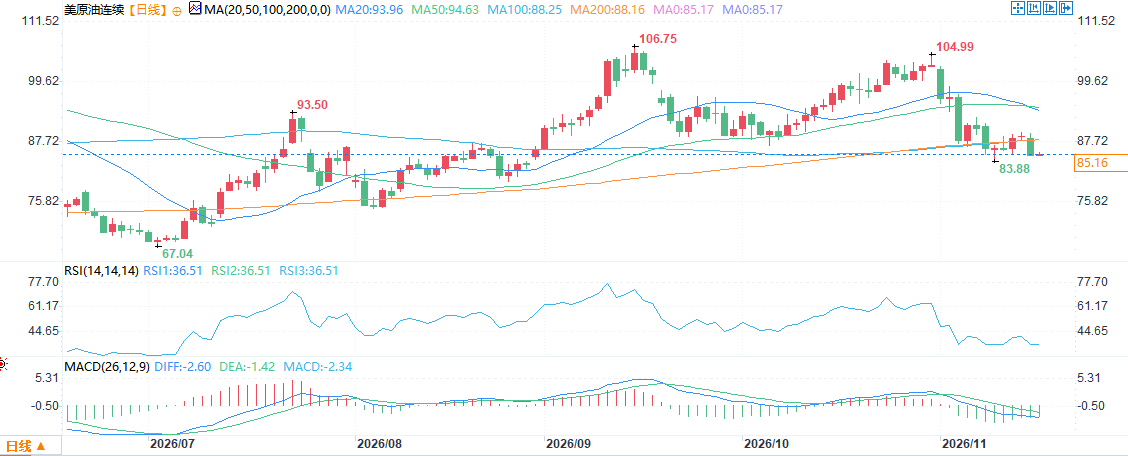 (US crude oil futures daily chart, source: FX678) At 10:01 Beijing time, US crude oil futures were trading at $85.16 per barrel.
Oversupply: IEA projects supply will exceed demand by 1.7 million barrels per day in the fourth quarter, reversing deficit forecasts.
The International Energy Agency (IEA) said last Friday that it expects global supply to exceed demand by 1.7 million barrels per day in the fourth quarter of 2026, reversing its previous deficit forecast. The agency cited declining demand due to high prices and a recovery in Middle Eastern supply. One industry insider stated, "While geopolitical tensions appear to have become the new normal, global oil supplies appear to remain relatively stable, and the US is operating at near-record production levels." This recovery in supply combined with declining demand has driven the shift from a deficit to a surplus—a key driver of the price decline from above $90 to around $84, as it signifies a shift in market pricing from tight to loose.Geopolitical risk: A fourth oil tanker struck a mine and caught fire in the Hormuz, but market reaction was limited.
The Iranian Navy said on Monday that a fourth oil tanker had struck a mine and caught fire in the restricted area east of the Strait of Hormuz in the past 24 hours; the UK's Maritime Trade Operations Office also said it had received a third-party report that the incident occurred about 7 nautical miles north of Hasab on the Musandem Peninsula in Oman. Geopolitical events continue, but the market reaction has been limited—because the forces of supply recovery (IEA's surplus forecast) and tanker attacks (geopolitical risk) are offsetting each other, and the current market is more inclined to price for "surplus" rather than "disruption."Inventory data: API verifies supply and demand.
Traders await the American Petroleum Institute's crude oil inventory report later on Tuesday. A larger-than-expected drop in crude oil inventories suggests stronger demand, potentially pushing up WTI crude futures prices; while a larger-than-expected increase suggests weaker demand or oversupply, potentially depressing WTI prices. With the IEA's oversupply forecast and geopolitical events acting as a hedge, inventory data becomes the most direct pricing input of the day—providing immediate confirmation of whether the oversupply is materializing.Institutional View: Costs and vulnerabilities have pushed oil price floor higher; "improvement" does not equal "normal".
One energy strategist emphasized, "The key issue isn't just oil flow, but also its costs and vulnerabilities." They argued that inventories "are simply accumulated flow"; therefore, "if high delivery costs solidify in the system, the floor for crude oil prices must move higher." In their view, tight supply, high transportation costs, and ongoing geopolitical risks "will remain significant in the first half of 2027 and beyond." The bank noted that "although freight rates have fallen, they remain historically high, with additional costs for delivery to Asian markets still close to $20 per barrel," explaining why "futures prices will remain high in 2027 as the costs of oil flow are slowly solidifying in the system." The bank warned that "if the US continues as it is, despite improvements in oil and refined product flows, global oil and refined product inventory buffers will continue to be depleted daily." Therefore, "this is why oil prices remain above $90 after improved flow—'improvement' does not equal 'normal'." The "bottom" of oil prices is not determined by the flow itself, but by "cost + vulnerability" - even if supply recovers, high transportation and insurance costs will still support prices; this sets a lower limit for oil price declines that is higher than the historical norm.in conclusion
US crude oil futures are currently trading around $85, as the IEA projects a supply surplus of 1.7 million barrels per day in the fourth quarter, reversing its deficit forecast. This is attributed to declining demand due to high prices and a recovery in Middle Eastern supply. Even with the fourth oil tanker catching fire after striking a mine in the Hormuz, the market's reaction to the geopolitical event has been limited – the forces of supply recovery and geopolitical risk are offsetting each other, leading the market to favor pricing in a "surplus." The API inventory report, as an intraday immediate indicator, shows that a larger-than-expected decrease in inventories often reflects strong demand and can boost oil prices; a larger-than-expected increase in inventories points to significant supply pressure and can suppress oil prices. Analysts point out that the key factors are not only flow rates but also costs and vulnerabilities – if delivery costs are entrenched in the system, the floor for oil prices must rise; transportation costs add nearly $20 per barrel to the cost of delivery in the Asian market, explaining why futures prices remain high in 2027 and why oil prices are still above $90 after improved flow rates – "improvement" does not equal "normal." This assessment sets a lower limit for oil price declines higher than historical norms: even with supply recovery, costs and vulnerabilities will still support prices. (US crude oil futures daily chart, source: FX678) At 10:01 Beijing time, US crude oil futures were trading at $85.16 per barrel.
- Risk Warning and Disclaimer
- The market involves risk, and trading may not be suitable for all investors. This article is for reference only and does not constitute personal investment advice, nor does it take into account certain users’ specific investment objectives, financial situation, or other needs. Any investment decisions made based on this information are at your own risk.