With oil prices falling, can the USD/INR exchange rate move into a new range of 93-95?
2026-11-17 16:14:33
On Tuesday (November 17) during the European session, the US dollar fell by about 0.3% against the Indian rupee yesterday and is currently trading around 93.60. 
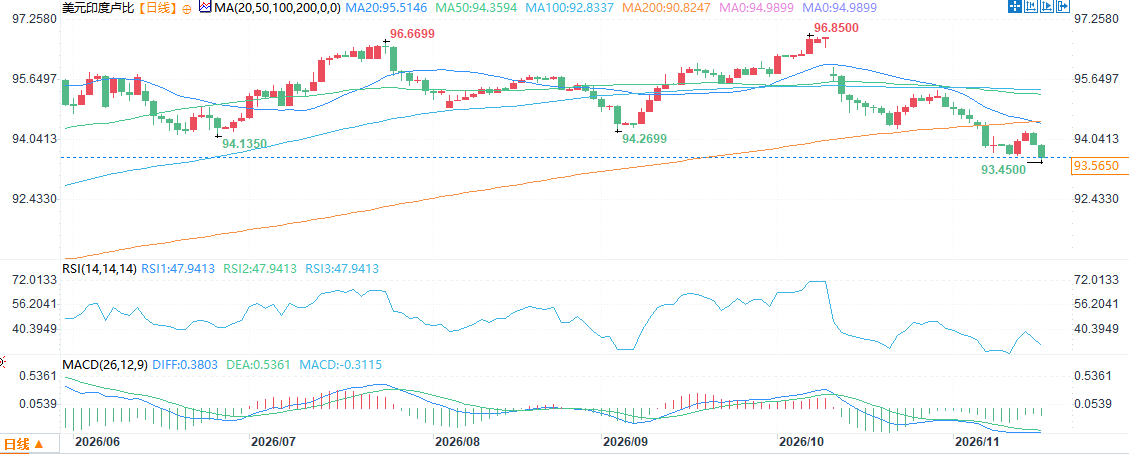 (USD/INR daily chart, source: FX678) At 16:07 Beijing time, the USD/INR exchange rate was 93.55/56.
Oil prices dominate the rupee's medium-term range; two-way scenario projection.
Commerzbank strategists point out that international oil price movements will dominate the medium-term outlook for the Indian rupee. If oil prices cool significantly, India's energy import costs are expected to decline substantially, easing trade deficit pressures and potentially pushing the USD/IRR exchange rate into a new trading range of 93-95. In this scenario, the rupee will receive fundamental support, its depreciation momentum will weaken, and the exchange rate is expected to stabilize. Conversely, if oil prices remain high, it will further increase India's import bills, exacerbating current account pressures and putting renewed downward pressure on the rupee. As an economy heavily reliant on oil imports, rising energy prices will directly impact the rupee exchange rate, limiting its upside potential and potentially pushing the USD/IRR exchange rate back to a higher range. The directional changes in oil prices remain the core external variable influencing the rupee's medium-term trajectory.October trade data: Goods deficit widens sharply, services surplus provides a buffer
India's merchandise trade deficit widened to a one-year high of $39.88 billion in October, significantly exceeding market expectations of $33.3 billion, compared to $30.21 billion in September. Breaking it down, merchandise exports surged 45.1% year-on-year to a record high of $49.47 billion, while merchandise imports rose 16.5% year-on-year to $89.35 billion, with import growth being the core factor driving the widening deficit. The significant increase in imports was driven by two main factors. First, persistently high international energy prices led to a 54.3% year-on-year surge in oil imports, reaching $22.82 billion. Second, the approaching Diwali festival saw a concentrated release of gold consumption demand, with gold imports nearly tripling from September to $5.51 billion. Meanwhile, imports from China rose 46.5% year-on-year, reflecting the continued high dependence of India's manufacturing sector on external intermediate goods. India's substantial services surplus partially offset the merchandise trade deficit. The service surplus in October approached $19.8 billion. After offsetting, the combined deficit for goods and services narrowed to $20.1 billion, compared to $25.2 billion in the same period last year, indicating some easing of pressure on the monthly external balance of payments. However, looking at a longer timeframe, external pressures have not fundamentally subsided. From April to October, the cumulative total deficit for goods and services rose to $93.4 billion, higher than $83.3 billion in the same period last year. The persistently accumulating external deficit poses a potential negative factor for the rupee's medium- to long-term trend.The ripple effects of oil prices on the rupee and central bank policy
India faces a severe shortage of domestic crude oil supply and a persistently high dependence on imports, making oil prices a core variable affecting its balance of payments. Sustained high oil prices directly increase crude oil imports, amplify the current account deficit, and boost demand for foreign exchange, thus putting direct downward pressure on the rupee. High oil prices also pose a risk of imported inflation, creating a dilemma for the Reserve Bank of India (RBI). When prices rise, the central bank needs to tighten monetary policy to curb inflation; however, tightening measures would increase financing costs and slow the pace of domestic economic recovery, significantly increasing the difficulty of policy balancing. According to institutional benchmarks, as long as the environment of high oil prices remains unchanged, the rupee will struggle to escape persistent external headwinds. The pressure of foreign exchange purchases on the trade side and policy constraints on inflation will continue to coexist, limiting the rupee's rebound potential. Only a substantial and sustained decline in oil prices can simultaneously alleviate the pressures of the current account deficit and imported inflation, reduce the central bank's policy burden, open up more room for the rupee to recover, and push the USD/IRR exchange rate towards a lower range.Summarize
The USD/INR pair is currently near the bottom of its range. India's goods trade deficit hit a one-year high in October, and high oil prices remain the biggest risk to the rupee. While a service export surplus partially offsets the goods deficit, the cumulative external deficit continues to rise. The key focus going forward is on crude oil prices. If oil prices fall, the exchange rate could potentially move to the 93-95 range; continued strength in oil prices would put further pressure on the rupee. (USD/INR daily chart, source: FX678) At 16:07 Beijing time, the USD/INR exchange rate was 93.55/56.
- Risk Warning and Disclaimer
- The market involves risk, and trading may not be suitable for all investors. This article is for reference only and does not constitute personal investment advice, nor does it take into account certain users’ specific investment objectives, financial situation, or other needs. Any investment decisions made based on this information are at your own risk.