UK employment figures exceeded expectations, but the payroll list saw a significant drop; how should the sterling market interpret these mixed signals?
2026-11-17 16:00:30
On Tuesday, November 17th, the UK Office for National Statistics released labor market data up to September, revealing a mixed picture. The International Labour Organization's unemployment rate fell from 4.7% to 4.6%, lower than the market expectation of 4.7%. Employment increased by 156,000, higher than the expected 136,000 and the previous month's 102,000, raising the employment rate to 75.4%. Meanwhile, the number of people on the payroll in October decreased by 34,000, job vacancies continued to decline, and average weekly earnings growth excluding bonuses slowed to 3.5%. The data release came after the Bank of England raised its benchmark interest rate to 4% on November 5th, and the market is focused on how the balance between employment resilience and slowing wages will affect the inflation outlook assessment. 
Key indicators of the UK labor market are diverging.
The decline in the unemployment rate and the better-than-expected employment growth constitute the positive aspects of the data. The employment rate increased by 0.3 percentage points quarter-on-quarter and 0.4 percentage points year-on-year, while the economic inactivity rate fell to 20.8%. The National Bureau of Statistics clearly pointed out that the rotation of the survey sample led to significant differences in the employment status of people entering and leaving the sample. This technical factor partially explains the magnitude of changes in the employment and unemployment rates, suggesting that it is necessary to distinguish between the true trend and the statistical effect when interpreting the data. High-frequency indicators present a different picture. The payroll list decreased by 34,000 in October, while the previous value was revised upward to an increase of 20,000, indicating that the adjustment of employment on the enterprise side has not been fully synchronized. Job vacancies continued to shrink, with small businesses being more significantly affected by rising labor and operating costs, reflecting the transmission of cost pressures to recruitment behavior. Although the overall employment scale has expanded, structural imbalances still exist.Slowing wage growth in the UK and real income conditions
Wage data provides clues to a marginal easing of inflationary pressures. Average weekly earnings excluding bonuses rose 3.5% year-on-year, lower than the expected 3.6% and the previous value of 3.7%. Including bonuses, the growth rate was 3.6%, slightly higher than the expected 3.5%, but lower than the revised previous value of 3.8%. The slowdown was mainly driven by a decline in public sector wage growth, with regular public sector earnings increasing by 5.4% year-on-year and private sector by 3.1%, reflecting the gradual fading of the point-in-time effect of previous wage incentives. Measured by the Consumer Price Index, regular real wage growth was about 0.4%, and although nominal growth has eased, the improvement in household purchasing power remains limited. This background echoes the 3.5% year-on-year CPI increase in September, with rising energy prices remaining the main driving factor. The transmission chain between wages and inflation has not yet fully loosened, and policymakers need to continue to observe whether nominal growth can further converge towards the target range.Implications for the Bank of England's policy considerations
The Bank of England raised its benchmark interest rate by 25 basis points to 4% in early November, in an 8-1 vote, aiming to prevent energy price shocks from solidifying into broader inflation expectations and wage-setting behavior. Current data presents a mixed picture of resilience and softening. Improved employment and a declining unemployment rate indicate that the labor market remains somewhat resilient, but the indicators of a declining wage list, fewer job vacancies, and slower regular wage growth are gradually weakening. Policymakers tend to seek more evidence to confirm that wage pressures can be sustainably eased before forming a clearer judgment on the medium-term inflation path. The market currently prices a high probability of further tightening at the December meeting, while also anticipating cumulative tightening potential until the end of 2027. The subsequent October CPI data, continued wage performance, and energy price trends will be key variables influencing the assessment of policy pace.A comprehensive overview of the pound sterling market
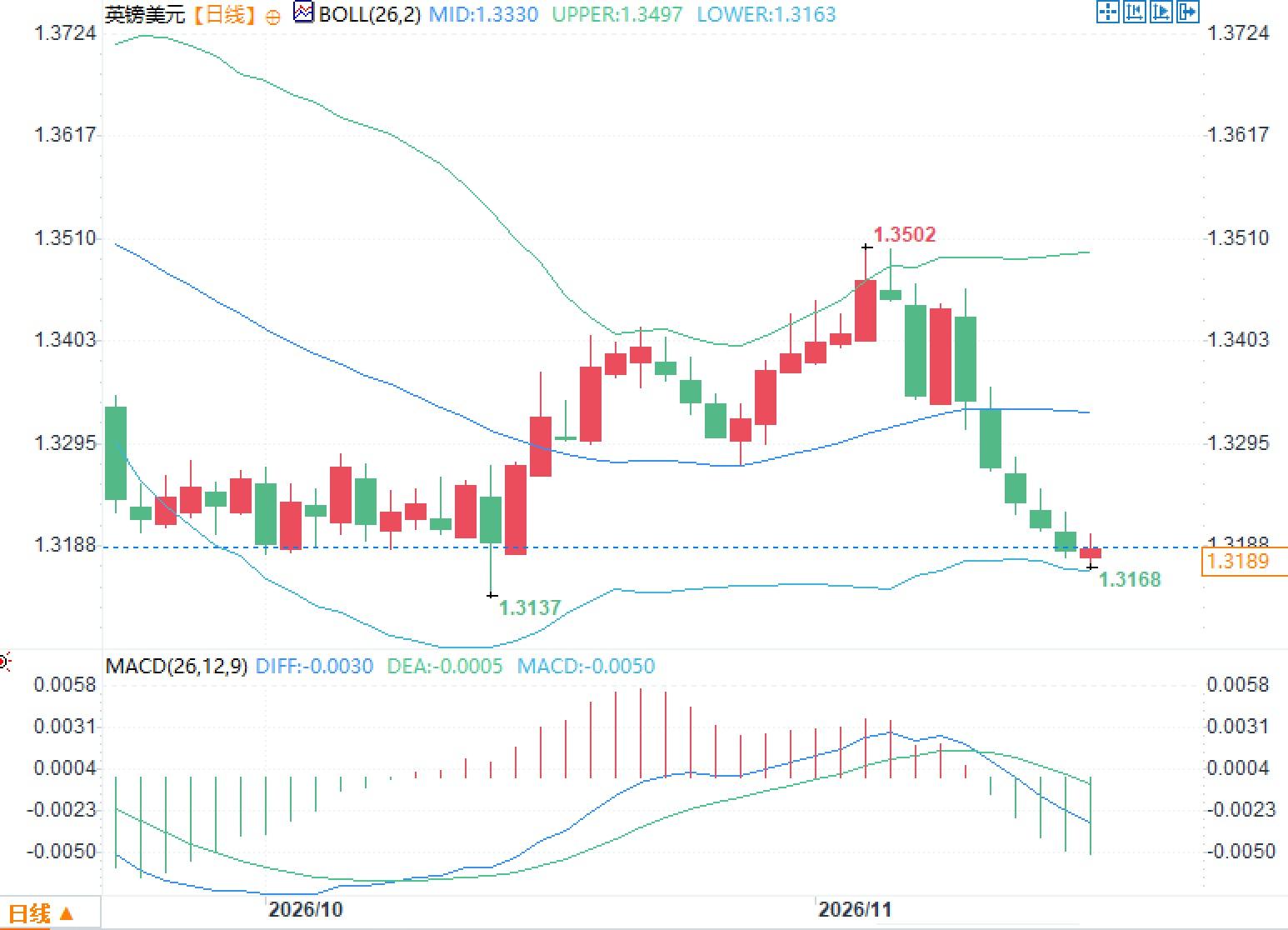
The British pound has been fluctuating around 1.32 against the US dollar recently, with the daily price below the middle Bollinger Band and near the lower band, and the MACD indicator remaining negative. Mixed fundamental signals and upcoming inflation data are currently the focus of attention. An unexpected drop in the unemployment rate and job growth provide some support, while slowing wages and weak high-frequency employment data provide a counterbalancing effect. With the Bank of England maintaining a restrictive policy to address potential inflation stickiness, the market is placing more emphasis on data quality, statistical factors, and trend persistence than on the immediate reaction of a single indicator. Global energy prices and the situation in the Middle East continue to be external variables, affecting overall risk appetite and interest rate spread expectations. Overall, the divergent patterns in the labor market strengthen the need for further data verification.Frequently Asked Questions
Question 1: Does the recent decline in the unemployment rate indicate a significant strengthening of the UK labor market? Answer: The data presents mixed characteristics. The improvement in the unemployment rate and employment figures is partly influenced by the rotation of the survey sample, while the decrease in the wage list and vacancies suggests continued weakening at the lower levels. A comprehensive assessment of the true trend requires combining subsequent high-frequency indicators and wage performance. Question 2: What reference value does the slowdown in wage growth have for the Bank of England's inflation assessment? Answer: The decline in conventional wage growth to 3.5% is mainly due to the fading public sector effect. Limited real wage growth helps alleviate concerns about double-dip inflation, but policymakers are still seeking more evidence of a sustainable slowdown to confirm whether the transmission chain has truly loosened. Question 3: How will current data affect the market's understanding of the UK's monetary policy path? Answer: The coexistence of resilience and softening signals does not change the Bank of England's cautious stance on the stickiness of wages and inflation. Market pricing reflects expectations of further tightening, but ultimately depends on the quality of subsequent data, the evolution of energy prices, and the continued validation of statistical effects.- Risk Warning and Disclaimer
- The market involves risk, and trading may not be suitable for all investors. This article is for reference only and does not constitute personal investment advice, nor does it take into account certain users’ specific investment objectives, financial situation, or other needs. Any investment decisions made based on this information are at your own risk.