A chart shows the Baltic Dry Index falling to a one-week low, with Capesize and Supramax freight rates weakening.
2026-11-17 23:32:30
The latest data shows that on November 17, 2026, the Baltic Dry Index (BDI) was 2893 points, a five-day low, down 0.96% from the previous day, marking the third consecutive day of decline (including zero growth). Looking at the short-term charts, the BDI has seen positive growth seven times, negative growth four times, and zero growth in the last 11 BDI data points. Specifically, the Panamax Freight Index (BPI) was 2122 points, up 0.43% from the previous day; the Capesize Freight Index (BCI) was 4486 points, down 1.58%; and the Supramax Freight Index (BSI) was 1827 points, down 0.54%. For detailed charts of the Baltic Dry Index and its three main sub-indices, including the latest 720-day and ten-year trends, please refer to the charts specially created by FX678. 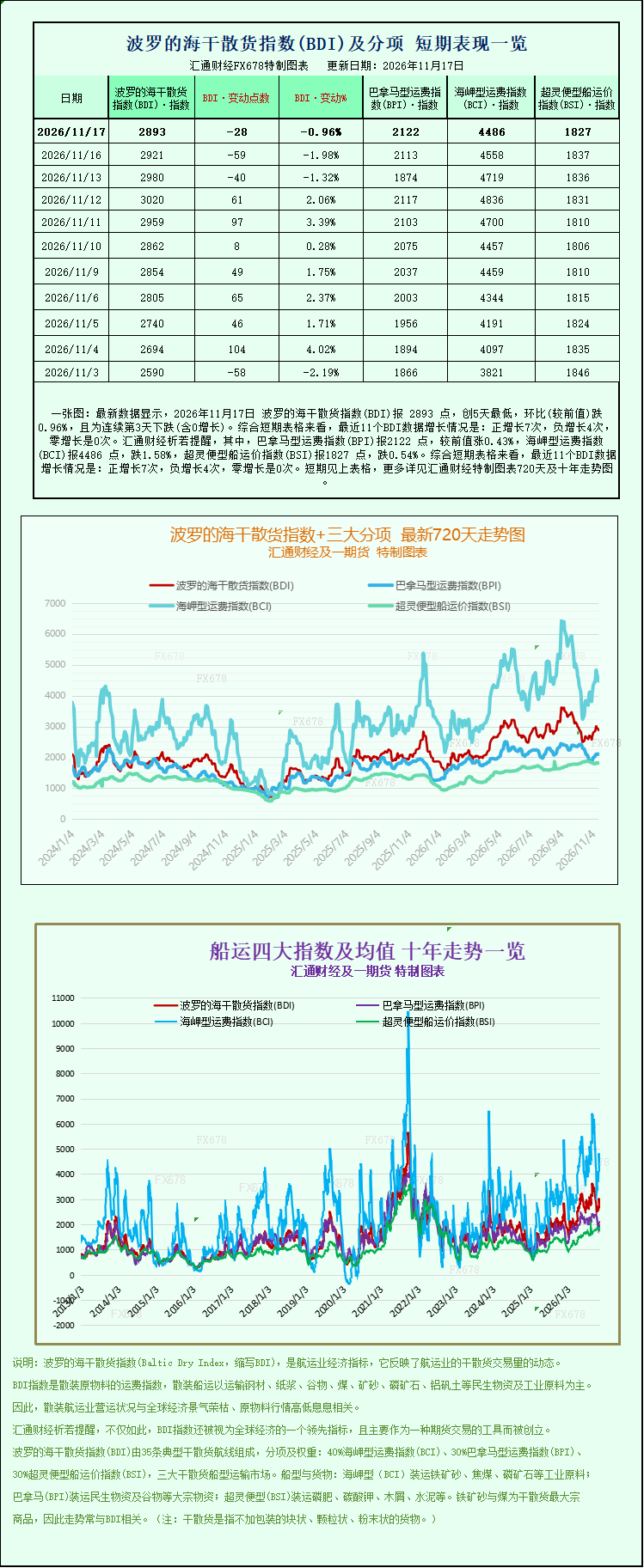 November 17th news: The Baltic Dry Index (BDI), the core shipping index of the Baltic Exchange that tracks freight rates for dry bulk commodities, fell slightly on Tuesday, reaching a one-week low. The weakness was mainly due to a simultaneous decline in spot freight rates for both Capesize and Supramax vessels. Dry bulk shipping is a crucial vehicle for global commodity trade, and the BDI has long been regarded by the market as a leading indicator of global physical trade activity. It does not directly reflect shipping company profits but is compiled by combining spot charter rates for different vessel types, making it highly sensitive to the cross-border flow of basic raw materials such as iron ore, coal, and grain. The recent volatile pattern of the index reflects the current state of global commodity demand differentiation and uneven regional cargo flow, with significant structural divergence in prices among different vessel types, without a unified upward or downward trend. The Baltic Dry Index (BDI), which incorporates freight rates for Capesize, Panamax, and Supramax dry bulk carriers, fell 28 points, or 1%, to 2893 points, its lowest level since November 10th. Looking at recent trends, the index had previously experienced a rebound, with the market hoping that Chinese iron ore restocking and Northern Hemisphere coal winter transport preparations would continue to drive demand for ocean-going chartering. However, this correction indicates that the previous demand-driven positive factors have not been as strong as the market had anticipated. Many charterers have slowed their pace of acquiring vessels at higher freight rates, adopting a wait-and-see approach, leading to a decrease in spot market activity and putting downward pressure on the index. However, in absolute terms, the BDI remains relatively high for the year and has not yet entered a deep bear market; it is more of a period of consolidation after the recent rise. The Capesize index fell 72 points, or 1.6%, to 4486 points, also a one-week low. Capesize vessels saw their average daily earnings decline by $647 to $37,184. These vessels, typically with a deadweight tonnage of around 150,000 tons, are the mainstay of ocean-going bulk commodity trade, primarily carrying large-tonnage cargoes such as iron ore and thermal coal. Their routes are concentrated on long-haul routes from Brazil and Australia to China, and their freight rates are most closely tied to the raw material procurement schedules of China's steel industry. The continued weakening of domestic iron ore fundamentals is the core factor suppressing demand for Capesize shipping. On Tuesday, the main iron ore futures contract on the Dalian Commodity Exchange closed lower for the fifth consecutive trading day. On the one hand, supply and demand pressures continued to intensify. Domestic steel mills had limited room to increase blast furnace operating rates, resulting in weak profits for finished steel products. Steel mills were reluctant to actively replenish their inventories, maintaining a strategy of purchasing only as needed, without large-scale concentrated stockpiling. On the other hand, overseas mine shipments increased, accelerating the global iron ore loading and unloading process, with increased supply entering the market. These two factors combined dragged down ore prices. The overall cooling of market risk appetite and decreased willingness to allocate long positions in commodities further suppressed iron ore prices, indirectly weakening charter demand for long-haul Capesize vessels. Insufficient cargo volume and reduced shipowner bargaining power led to a corresponding decline in freight rates. In stark contrast to the weakness in Capesize vessels, Panamax vessels saw a slight increase of 9 points to 2122, reaching a new high since October 22. Average daily earnings for Panamax vessels rose by $84 to $19,101. This vessel type typically operates with a deadweight range of 60,000 to 70,000 tons, carrying coal and grain as typical cargoes. It boasts a wider route coverage, capable of handling trans-Pacific coal transport as well as grain export orders from North and South America and the Black Sea region. The independent performance of Panamax vessels was primarily supported by grain and regional coal cargoes. Currently, the global grain trade is in a period of high activity, with South American soybean and corn exports gradually increasing and Black Sea grain shipments remaining stable, resulting in a large release of short- and medium-haul and transoceanic grain cargoes. Meanwhile, demand for coal replenishment for thermal power plants in some parts of the Asia-Pacific region continues, and these types of cargoes are well-suited to the carrying capacity and navigation conditions of Panamax vessels. Compared to Capesize vessels, which are highly dependent on iron ore, Panamax vessels have a more diversified cargo structure, mitigating the impact of weakening iron ore demand. Therefore, they have maintained resilience in a weak market environment, exhibiting a counter-trend upward trend, which is the most prominent manifestation of the structural divergence in the index this time. Meanwhile, the smaller Supramax vessel index fell 10 points, a 0.5% decrease, to 1827 points, the lowest value since November 11. Supramax vessels are the most numerous and flexible type of vessel in the dry bulk fleet, with a deadweight tonnage generally ranging from 35,000 to 50,000 tons. Their advantage lies in their ability to call at many small and medium-sized ports with limited water depth. They handle a wider variety of cargoes, including small-batch coal, grain, cement clinker, fertilizer, and iron ore, resulting in fragmented trade flows and a greater focus on serving regional trade and near-sea feeder trade. Freight rates for this type of vessel are typically more sensitive to changes in regional cargo flows. Recently, near-sea bulk cargo orders to Southeast Asia and South Asia have decreased, while continuous new vessel deliveries have put pressure on fleet supply. Against the backdrop of a diverging market for large vessels, Supramax vessels lack sustained and stable cargo support, leading to a moderate decline in freight rates. Overall, the current dry bulk shipping market is entering a typical phase of structural differentiation, with the driving logic shifting from unilateral demand expansion to the misalignment of supply and demand cycles for different commodities. Weak iron ore demand is dragging down Cape-class vessels, while grain and regional coal are supporting Panamax vessels, and a slowdown in near-sea cargo volume is suppressing Supramax vessels. The key points to watch in the market going forward remain the pace of restocking by Chinese steel mills, iron ore shipments from Australia and Brazil, the pace of coal procurement in the Northern Hemisphere during the winter, and the pace of grain exports from South America. If domestic steel profits recover and steel mills initiate a new round of concentrated restocking, Capesize freight rates may see a recovery. Conversely, if iron ore demand remains weak, the Baltic Dry Index (BDI) is likely to maintain a weak and volatile pattern, with the market focus continuing to be driven by grain and regional energy cargoes. Shipping market participants are also continuously monitoring the pace of cargo releases, port congestion, and new ship deliveries to determine the direction of short-term freight rate fluctuations.
- Risk Warning and Disclaimer
- The market involves risk, and trading may not be suitable for all investors. This article is for reference only and does not constitute personal investment advice, nor does it take into account certain users’ specific investment objectives, financial situation, or other needs. Any investment decisions made based on this information are at your own risk.