How should we interpret Lagarde's speech today as a policy signal from the European Central Bank?
2026-11-19 19:04:30
On Thursday, November 19th, the euro saw a modest recovery against the dollar, trading around 1.100, after hitting a 19-month low of 1.0952 on Wednesday. The exchange rate remains on a four-week losing streak. Market risk appetite remained moderate, with most European stock markets rising and oil prices remaining relatively low, all of which combined to somewhat curb the dollar's upward momentum. European Central Bank President Christine Lagarde will attend the Brussels Financial Literacy Conference that day, and the market is closely watching for any potential monetary policy signals she might release. 
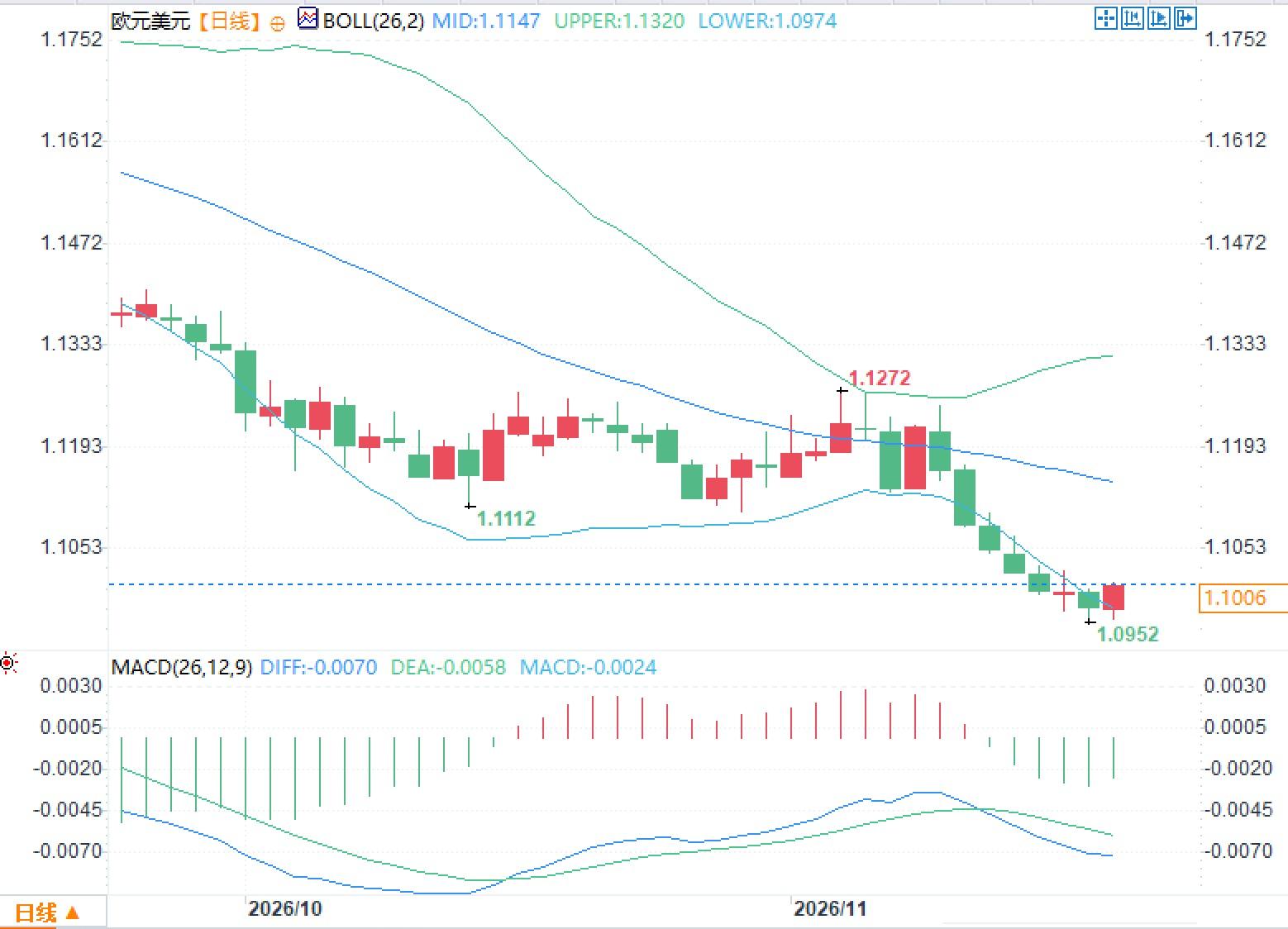
Euro Recent Trends and Technical Analysis
The euro has been under pressure against the dollar since mid-October, with the daily chart showing the pair repeatedly testing the lower range. The Bollinger Band middle line is at 1.1147, the upper line at 1.1320, and the lower line at 1.0974; the current price is trading close to the lower line. The MACD indicator shows the DIFF at -0.0070, the DEA at -0.0058, and the histogram at -0.0024, all below the zero line. After rebounding near 1.0952, the price has risen back to around the 1.1000 psychological level. The previous rebound high is marked at 1.1272, and the local low is at 1.1112.The logic behind the support for the euro from falling oil prices.
Brent crude oil prices are currently hovering around $92 per barrel, down more than 20% from last month's high. Market reports indicate that concerns about a loan glut in 2027 and rising US inventories have eased concerns about potential supply shortages due to traffic restrictions in the Strait of Hormuz. The situation in Iran remains unchanged and has not further boosted oil prices. As a net energy importer, the Eurozone benefits from lower oil prices, which help improve terms of trade, reduce import cost pressures, and provide marginal support to the current account. This mechanism indirectly affects the relative value of the euro by lowering energy bills and improving the path of net exports, but the effect needs to be observed in conjunction with other macroeconomic variables.Current account data and fundamental background
Data released by the European Central Bank showed that the eurozone's current account surplus widened to €12.5 billion in September, up from €11.6 billion in August, but below market expectations of €16.6 billion. Trade in goods and services remained in surplus, while primary and secondary income showed deficits. The cumulative surplus over the past 12 months accounted for approximately 1.5% of eurozone GDP, narrowing compared to the same period last year. Although the data fell short of expectations, it still indicates a current account surplus. For the foreign exchange market, the current account is an important window for observing medium- to long-term capital flows. Changes in the surplus size affect the assessment of the support for the euro's fundamentals, but fluctuations in monthly data need to be considered in conjunction with trends and other indicators.Risk appetite and the focus of Lagarde's speech
Market risk appetite rebounded moderately, with most European stocks rising. Improved risk appetite typically reduces demand for safe-haven assets, putting some pressure on the US dollar. European Central Bank President Christine Lagarde participated in the Brussels Financial Literacy Conference that day, engaging in discussions about the future resilience of European finance. Markets are focused on whether she will comment on the path of inflation, interest rates, or the impact of energy prices on policy. Lagarde previously stated that the ECB is concerned about the impact of energy prices on inflation but believes the second-round effect will be limited. Her remarks will serve as a supplement to policy signals, and the market will assess the continuity of the policy stance in conjunction with her wording.Frequently Asked Questions
Question 1: Why did the decline in oil prices support the euro? Answer: The Eurozone is a net energy importer. Lower oil prices reduce import costs, improve terms of trade and the marginal position of the current account, thus supporting the relative value of the euro through fundamental channels. Question 2: Did the lower-than-expected current account surplus weaken the euro's fundamentals? Answer: The September surplus was still positive, but lower than expected, indicating limited expansion. The market is more focused on trends and changes in energy and export structures than on the absolute value of a single month. Question 3: What market watchpoints might Lagarde's speech affect? Answer: Pay attention to her statements on energy prices, the persistence of inflation, and the path of interest rates. These will provide updated information on the ECB's policy stance.- Risk Warning and Disclaimer
- The market involves risk, and trading may not be suitable for all investors. This article is for reference only and does not constitute personal investment advice, nor does it take into account certain users’ specific investment objectives, financial situation, or other needs. Any investment decisions made based on this information are at your own risk.