A December rate hike is almost a certainty, but the end point remains unclear: Why are yen bears still lingering?
2026-11-20 11:28:31
A December rate hike by the Bank of Japan (BOJ) is almost a consensus. Kazuo Ueda recently stated in the Diet that the recent weakness in consumption is temporary and that consumption is expected to recover; core inflation in October remained above the 2% target for the second consecutive month. Most economists expect the policy rate to be raised from 1.25% to 1.50% at the December 17-18 meeting, with a possible further increase before the end of March next year. The market has largely priced in this move. The problem is that a rate hike itself may not be enough to truly stabilize the yen. More importantly, the BOJ lacks a clear consensus on "where the rate will ultimately go." This ambiguity is a key reason why short sellers can continue to operate. 
Policy committee members have differing opinions on the "end point".
The Bank of Japan (BOJ) has a wide range of estimates for the neutral interest rate (the level of interest rate that neither stimulates nor inhibits the economy), ranging from 1.1% to 2.5%. Hawkish board member Naoki Tamura leans towards 2%, while Hajime Takada advocates pushing rates to near the middle of the range as soon as possible, while avoiding a fixed pace. Dovish voices believe there is limited room for further tightening. The existence of swing voters makes it difficult for the market to form a unified expectation. Currently, the mainstream view among the market and economists is that the end of this cycle will roughly fall between 1.75% and 2%. Views of a higher 2.5% remain in the minority. BOJ officials are currently only emphasizing that the financial environment remains loose, leaving room for further rate hikes, but are unwilling to explicitly anchor a specific endpoint. Analysts such as Nomura point out that stabilizing inflation at around 2% is a new challenge for Japan, and the official cautiousness in communication is reasonable, but it also makes the market skeptical about the subsequent path. The foreign exchange market is far more sensitive to the interest rate path than to a single rate hike itself. When the endpoint is unclear, traders' expectations for a narrowing interest rate spread are suppressed. If the Federal Reserve maintains a tight stance, the interest rate differential between the US and Japan will be difficult to narrow quickly, and the logic of the yen's downward pressure will be difficult to completely reverse with a single 25 basis point rate hike.History serves as a reminder: "Selling after interest rate hikes" is not a new phenomenon.
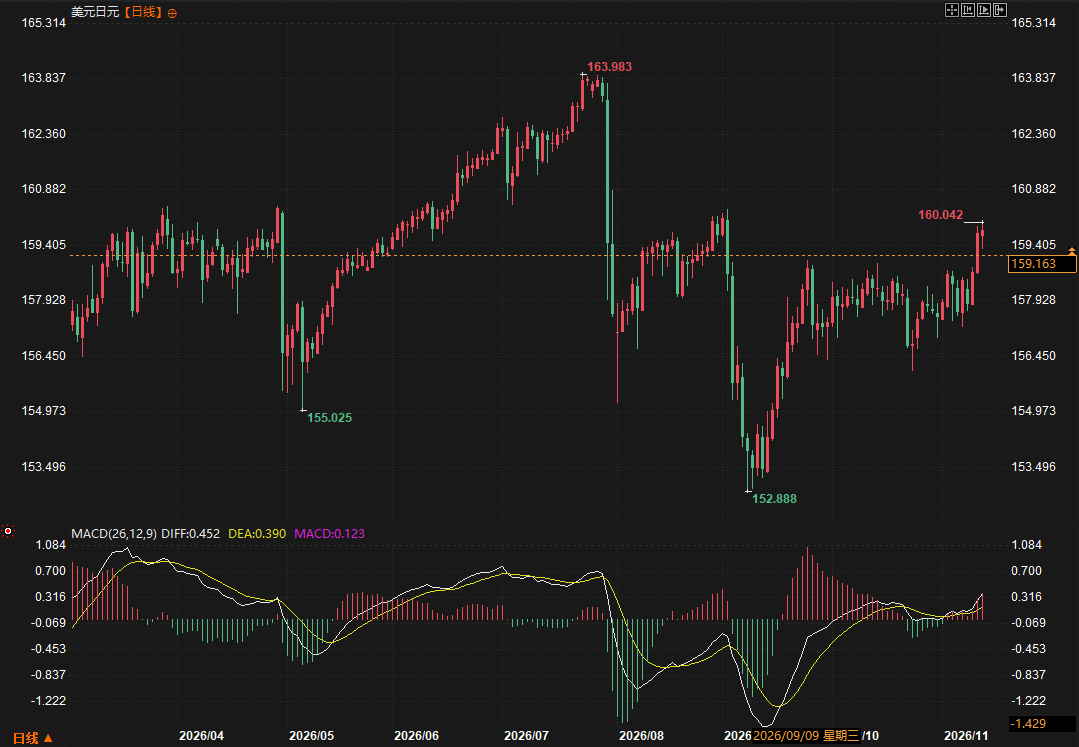
Following the Bank of Japan's rate hike last December, the yen depreciated instead of rising, with the market interpreting the official hawkish signal as insufficiently strong. Similar risks remain today. If the December statement or Ueda's press conference is cautiously worded and lacks clear commitment to the subsequent path, the market could very well react with a "sell on rate hikes" mentality again. Conversely, if the government provides a clearer signal of continued tightening, moving towards 2%, the yen is likely to receive more sustained support. Currently, USD/JPY is still hovering around the 159-160 range. Intervention risk is substantially constrained around 160, and the Japanese authorities have repeatedly demonstrated their willingness to maintain this level. Intervention itself is more of a short-term buffer than a tool to change fundamental interest rate expectations. What truly changes medium-term pricing remains the Bank of Japan's communication regarding the endpoint and pace.Personnel changes and political background
The uncertainty surrounding the policy path is compounded by personnel factors. Two relatively hawkish committee members, Naoki Tamura and Hajime Takada, will have their terms expire next July, leaving Prime Minister Sanae Takaichi with two appointment opportunities. There is widespread concern that at least one of these seats may lean towards a more moderate stance. While Takaichi herself has not spoken extensively about interest rate policy, some observers believe her tolerance for excessive yen depreciation is limited, which could, in turn, affect how far the Bank of Japan can ultimately go. This medium- to long-term "dovish tail risk" will be reflected in forward pricing, keeping some traders cautious about the yen. For forex traders, this is not just a matter of short-term interest rate meetings, but also a judgment on the stability of Japan's policy framework.The US-Japan interest rate differential and the global context continue to play a role.
Even if the Bank of Japan (BOJ) raises interest rates as planned, if the Federal Reserve continues its tight stance or takes further action, the narrowing of the interest rate differential will be slower than some of the market's previous optimistic expectations. Therefore, the carry trade logic still has room for support. The yen's movement largely depends on the relative pace of monetary policy between the two countries, rather than unilateral action by Japan. Inflation data, the recovery of consumption, and the overseas interest rate environment will continue to influence the tone of the BOJ's communication in the coming months. For traders, the focus of the December meeting is no longer just on whether or not to raise rates, but on the wording of the statement, the dot plot or similar guidance, and the details of Ueda's press conference. These are the key variables that truly determine how the market reprices the yen's path. In summary, a December rate hike is highly likely, but the "ambiguity of the endpoint" and personnel changes together constitute continuous upward pressure on the yen. Intervention risk provides short-term protection but cannot replace a clear policy path. For forex traders, what is truly worth tracking next is how the BOJ communicates with the market after the rate hike and how the pace of US-Japan policy interacts. As long as the ambiguous endpoint remains, short sellers still have reason to continue to wait and see.- Risk Warning and Disclaimer
- The market involves risk, and trading may not be suitable for all investors. This article is for reference only and does not constitute personal investment advice, nor does it take into account certain users’ specific investment objectives, financial situation, or other needs. Any investment decisions made based on this information are at your own risk.