With opinions divided within the Federal Reserve, how likely is a significant 50bp rate hike?
2026-11-20 14:08:30
On Friday (November 20) during Asian trading hours, the US dollar index traded around 103.80, down about 0.1%. Overnight, the dollar index surged to 103.96, a new high since early April 2025. Philadelphia Fed President and FOMC voting member Anna Paulson, in her formal written speech in New York, did not provide any guidance on the short-term interest rate path; however, she released hawkish signals during the subsequent Q&A session, confirming that the Fed would have more tightening operations and advocating a cautious, gradual pace to allow the economy sufficient time to adjust. The speech solidified the market's pricing of a 25bp rate hike in December, while weakening Waller's expectation of a single 50bp rate hike, which benefited short-term US Treasury yields and the dollar, further putting downward pressure on gold prices. 
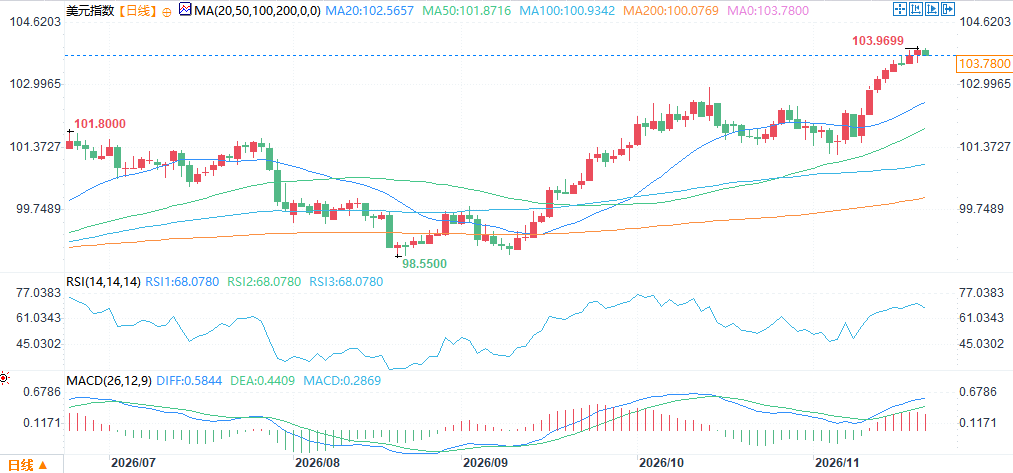 (US Dollar Index Daily Chart, Source: EasyTrade) At 14:03 Beijing time, the US Dollar Index was at 103.78.
The formal speech downplayed forward guidance, while the Q&A session released key hawkish signals.
Paulson delivered a keynote address to the New York University Money Market Association, focusing entirely on the Federal Reserve's communication framework and deliberately avoiding direct statements on December and subsequent interest rates. However, her policy stance became more explicit during the Q&A session. She pointed out that current inflation levels remain too high, the US labor market is at full employment, and suppressing inflation is the primary goal of current monetary policy. The Fed needs to implement further tightening operations. She emphasized the need for a cautious and gradual pace of interest rate hikes, allowing the economy sufficient time to absorb high borrowing costs and avoiding drastic policy changes that could shock the real economy. This statement echoed her stance from November 10th, maintaining a restrictive policy, prioritizing small 25bp rate hikes, and only supporting a faster pace of tightening if inflation expectations, wages, and core inflation all rise more than expected. She also reiterated that the pause in rate hikes in October does not signify the end of this tightening cycle. Her candid statements during the Q&A session allowed the market to more clearly perceive her vigilance regarding sticky inflation and her determination to continue with restrictive policies, further reinforcing the Fed's overall hawkish communication tone.Internal disagreement: Gradual 25bp vs. a single, massive 50bp rate hike
There is currently a clear division within the Federal Reserve. Governor Waller suggested that a 50-basis-point rate hike in December could be considered in the face of persistent inflation. Paulson's statements during the recent Q&A session clearly favored a cautious approach, reducing market expectations for a single, large rate hike in December. However, she does not oppose continued rate hikes, only aggressive, leapfrog adjustments. Her position aligns with the mainstream view of the FOMC committee; the minutes of the October FOMC meeting showed that almost all members believed further rate hikes were necessary in the coming months. The market consensus is for a 25-bp rate hike at the December 8-9 meeting, raising the interest rate range to 4.00%-4.25%. Several major banks, including JPMorgan Chase, Deutsche Bank, and Bank of America, continue to bet on further rate hikes in January and March 2027. This internal disagreement on the pace has not shaken the consensus of "continued tightening," but rather presents a struggle between gradual and aggressive options regarding the magnitude of the rate hikes. Therefore, the market is paying closer attention to whether subsequent data can provide evidence for an accelerated path.Market implications of asset prices
This speech did not increase the probability of a 50bp rate hike, but it further solidified the trading benchmark of "rate hikes continuing until 2027." Short-term US Treasury yields were supported, and the US dollar remained strong. Gold, already in a selling trend, retreated towards the $3600 mark, with the persistently hawkish Fed expectations creating another headwind for gold prices. As long as the restrictive interest rate remains in place for longer, non-interest-bearing precious metals will continue to be under pressure. The speech overall reinforced expectations of a persistent high-interest-rate environment, thus providing additional support for short-term interest rates and the US dollar, while risk assets and gold face prolonged liquidity tightening pressure. Traders adjusted their positions accordingly, tending to maintain a bullish allocation to short-term US Treasuries, while remaining cautious about a gold rebound, awaiting further data to confirm the continuity of the policy path.Main themes for market outlook
The focus will be on the non-farm payroll report on December 4th, particularly on wage and inflation expectations data. If wages rise significantly, Waller's 50bp proposal will likely resurface; if the data remains relatively stable, the Fed will likely follow Paulson's proposed 25bp gradual tightening approach. In addition to the non-farm payrolls, the market will also be watching the subsequent inflation expectations survey and core inflation readings, which will collectively determine the final tightening rate at the December meeting. If the data continues to show sticky inflation and an overheated labor market, the probability of accelerated tightening will rise rapidly; conversely, it will solidify the gradual tightening path. Overall, the data window before the December meeting will be a crucial observation period to verify whether the "hawkish gradual" approach can continue. (US Dollar Index Daily Chart, Source: EasyTrade) At 14:03 Beijing time, the US Dollar Index was at 103.78.
- Risk Warning and Disclaimer
- The market involves risk, and trading may not be suitable for all investors. This article is for reference only and does not constitute personal investment advice, nor does it take into account certain users’ specific investment objectives, financial situation, or other needs. Any investment decisions made based on this information are at your own risk.