The US dollar has retreated slightly, but why is gold still unable to rebound?
2026-11-20 15:00:30
On Friday (November 20) during Asian trading hours, spot gold continued its decline, briefly touching around $3,514 per ounce, a low since September 2025. The unique aspect of this downturn is the continued escalation of geopolitical tensions between the US and Iran. The safe-haven logic that should have supported gold has failed, and the market's main focus is entirely on expectations of continued tightening by the Federal Reserve. Even with a slight pullback in the dollar during the session, gold prices failed to find respite, and the $3,500 level became a crucial short-term support test. 
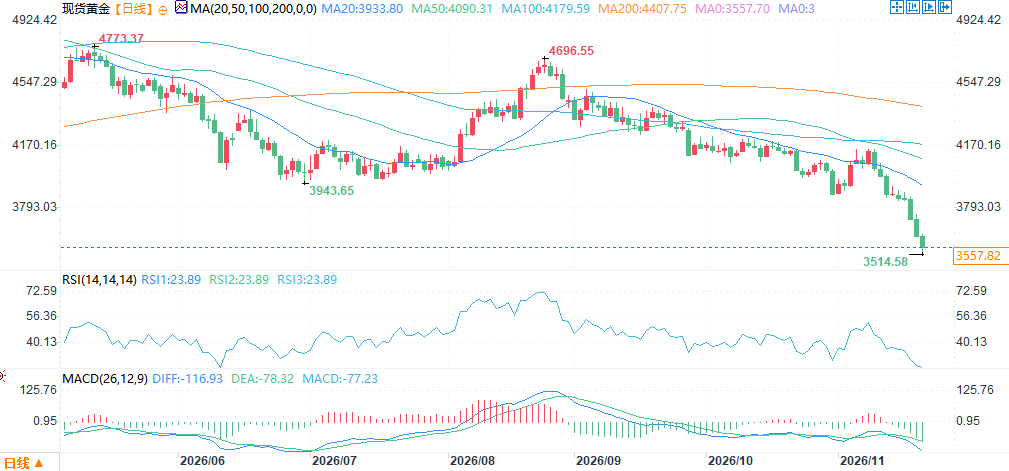 (Spot gold daily chart, source: FX678) At 14:54 Beijing time, spot gold was trading at $3558.56 per ounce.
Interest rate hike expectations continue to be priced in, leading to a sustained sell-off of non-interest-bearing assets.
The October FOMC meeting minutes released a clear hawkish signal, with almost all members agreeing that further rate hikes were still necessary to push inflation back to the 2% target. The CME FedWatch Tool shows that the market has almost fully priced in a 25 basis point rate hike at the December meeting, while trading is also beginning to factor in the possibility of further rate hikes in January and April 2027, continuously extending the duration of high, restrictive interest rates. Gold does not generate fixed interest, and rising real yields on US Treasury bonds directly increase the opportunity cost of holding gold, which is the core driver of the continued weakness in gold prices over the past two weeks. A noteworthy signal is that a slight pullback in the US dollar did not lead to a rebound in gold prices, indicating that current pricing is dominated by expectations of Fed policy, rather than the strength of the dollar itself; fluctuations in the dollar alone are unlikely to reverse the downward trend in gold.A paradigm shift in dollar trading: from equity beta to a hawkish Fed stance.
TD Securities' observations indicate that the resilience of US inflation is driving a shift in the underlying logic of the foreign exchange market. For most of 2026, the dollar's performance followed that of US stocks, falling within an equity beta trading framework. Currently, the market is comparing the policy stances of various central banks, with the Federal Reserve being relatively more hawkish. This, coupled with the bear flattening of the US Treasury yield curve, is providing support for the dollar. Analysts believe that the dollar's overall resilience is unlikely to dissipate quickly before the Fed's hawkish expectations peak. The December Fed dot plot (SEP) may trigger a period of adjustment for the dollar bulls. There are two scenarios for the hawkish expectations to peak, which still require further confirmation from subsequent data and policy signals. As long as this pattern remains unchanged, gold will continue to face dual pressure from the dollar and US Treasury yields.Geopolitical conflicts benefit the US dollar, causing a shift in safe-haven capital flows.
The initial market consensus was that escalating geopolitical risks in the Middle East would drive safe-haven buying of gold, but this round of market movements has shown a clear divergence. Reports indicate that the US is considering a new round of large-scale military strikes against Iran. Coupled with the nuclear issue and shipping tensions in the Strait of Hormuz, geopolitical risks continue to escalate, leading safe-haven funds to prioritize the US dollar, which is now just a step away from its April 2025 high. Behind this divergence lies an inflationary logic: if conflicts push up energy prices, it will strengthen upward inflationary pressures, which in turn will constrain the Federal Reserve's easing measures, indirectly negatively impacting gold. Geopolitical events are no longer independent bullish variables but have been incorporated into the Fed's tightening narrative, significantly weakening their effect on boosting gold prices.Technically, the market has entered oversold territory, but the downward trend has not yet reversed.
After a continuous decline, short-term technical indicators for gold have entered extremely oversold territory, which will likely discourage new short positions and create the possibility of a temporary rebound. However, oversold conditions do not equate to a bottom being established. Without fundamental signals of a reversal, gold prices are highly likely to record a second consecutive week of declines, with $3500 becoming the next key support level to watch. From a trading perspective, institutions generally advise against blindly shorting, as any rebound is more of a technical correction and unlikely to reverse the overall downward trend.The main focus of market observation is awaiting a policy turning point.
The future direction of gold prices depends on the interplay of two main factors. First, US inflation and employment data will continue to revise expectations of Fed rate hikes and real US Treasury yields. Second, the evolution of the US-Iran conflict; if large-scale military action occurs, the flow of safe-haven funds will need to be reassessed. The real turning point signal will come from the Fed's December dot plot. If the dot plot releases a dovish signal, market expectations for continued rate hikes will cool, and gold will have a chance for a sustained recovery. Conversely, if the Fed's hawkish stance strengthens further, the $3,500 level risks being breached. (Spot gold daily chart, source: FX678) At 14:54 Beijing time, spot gold was trading at $3558.56 per ounce.
- Risk Warning and Disclaimer
- The market involves risk, and trading may not be suitable for all investors. This article is for reference only and does not constitute personal investment advice, nor does it take into account certain users’ specific investment objectives, financial situation, or other needs. Any investment decisions made based on this information are at your own risk.