The USD/JPY pair continued to trade within a range, awaiting a directional move.
2026-11-23 14:24:33
The USD/JPY pair attracted some bargain hunting at the start of the new week, partially recovering losses from Friday's drop to a low of around 158.40 . However, the spot price is currently struggling to extend its momentum above 159.00 , as the dollar is generally showing a mild weakness. Nevertheless, the fundamental backdrop still appears to favor bullish traders and provides a basis for further gains.  Regarding the US dollar, the Dollar Index (DXY) is showing a mildly negative bias, slightly below its highest level since April 2025 , as traders have reduced their expectations for more aggressive tightening by the Federal Reserve. However, a precise distinction needs to be made: a 25 basis point rate hike in December has been fully priced in , and traders are placing greater likelihood on subsequent rate hikes in January and April . This combination, coupled with tensions in the Middle East, could provide a tailwind for the safe-haven dollar, thus supporting the USD/JPY pair. Geopolitically, Trump stated on Sunday that he would prefer to resume strikes against Iran in the new year if no agreement is reached, while the US maritime blockade of Iranian shipping remains in place. Meanwhile, Iran has intensified its attacks in recent days. This keeps geopolitical risk premiums above the market, benefiting dollar bulls. The yen, on the other hand, is pressured by uncertainty surrounding the Bank of Japan's (BoJ) policy path – its subsequent path remains unclear after a potential December rate hike. However, yen bears remain highly vigilant as the market speculates that authorities will intervene to support the currency. This is particularly important now: with Japanese markets closed and liquidity relatively thin, it's prudent to wait for strong follow-through buying before positioning for further gains. Breakouts in a illiquid environment often lack sustainability and are easily corrected. The focus during the North American session will be on the US Flash Purchasing Managers' Index (PMI) . However, the real focus is on Wednesday's release of the US Personal Consumption Expenditures (PCE) price index , which should provide new momentum for USD/JPY. Technically, USD/JPY maintains a mildly constructive stance on the daily chart, with the price above the 100-day simple moving average (SMA) at 158.81 , while still capped by the 61.8% Fibonacci retracement level of the recent move at 159.74 . The rebound after last week's pullback suggests potential demand in the mid-range around 158.00 , but unless the spot price recovers the Fibonacci resistance above, broader upside is still likely to encounter deeper pullbacks. On the 4-hour chart, the price has been consolidating between 158.40 and 159.00, with rebounds failing to reach new highs, indicating a range-bound pattern rather than a breakout. Today's unique factor is the thin liquidity due to the Japanese market being closed – in this environment, the probability of a false breakout above 159.00 increases, as does the probability of a false break below 158.40. Therefore, in the short term, it's more appropriate to use the range boundaries as a reference point rather than judging direction from the middle.
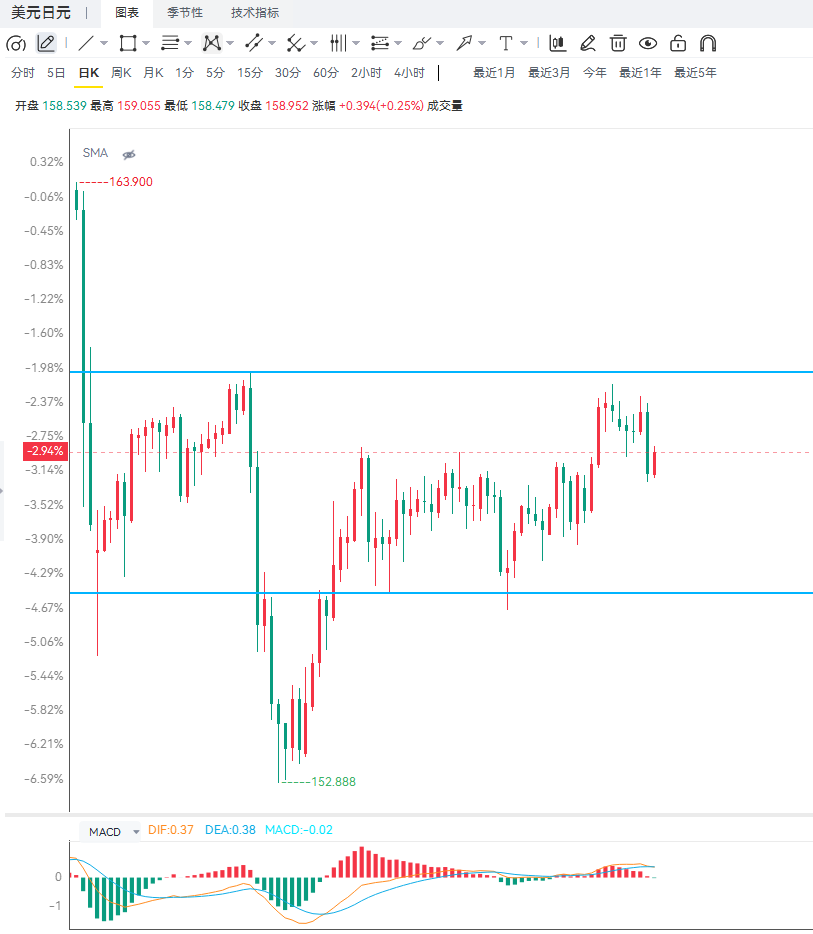 Editor's Summary: The USD/JPY pair is currently in a stalemate characterized by "bullish fundamentals but technical resistance," with a remarkably clear boundary. The bulls are supported by three factors: the 25 basis point rate hike in December is fully priced in; expectations of further rate hikes in January and April are increasing; and the Middle East geopolitical risk premium persists. The bears are also constrained by three factors: a mildly weak US dollar index; uncertainty surrounding the Bank of Japan's post-December rate hike path; and speculation about government intervention preventing excessive short selling. The equilibrium point of these three forces lies precisely within a 93-point gap between the 100-day moving average at 158.81 and the 61.8% Fibonacci retracement level at 159.74 . Wednesday's PCE data is a near-term variable that could break the stalemate. If inflation is stronger than expected, it will simultaneously strengthen near-term certainty and long-term escalation, making a test of 159.74 more significant. Key events to watch include the US PMI during the North American session, the US PCE on Wednesday, the Bank of Japan's policy guidance after its December meeting, actual government intervention, the battle between 159.74 and 158.44, and whether the scope of the Middle East conflict continues to expand.
Regarding the US dollar, the Dollar Index (DXY) is showing a mildly negative bias, slightly below its highest level since April 2025 , as traders have reduced their expectations for more aggressive tightening by the Federal Reserve. However, a precise distinction needs to be made: a 25 basis point rate hike in December has been fully priced in , and traders are placing greater likelihood on subsequent rate hikes in January and April . This combination, coupled with tensions in the Middle East, could provide a tailwind for the safe-haven dollar, thus supporting the USD/JPY pair. Geopolitically, Trump stated on Sunday that he would prefer to resume strikes against Iran in the new year if no agreement is reached, while the US maritime blockade of Iranian shipping remains in place. Meanwhile, Iran has intensified its attacks in recent days. This keeps geopolitical risk premiums above the market, benefiting dollar bulls. The yen, on the other hand, is pressured by uncertainty surrounding the Bank of Japan's (BoJ) policy path – its subsequent path remains unclear after a potential December rate hike. However, yen bears remain highly vigilant as the market speculates that authorities will intervene to support the currency. This is particularly important now: with Japanese markets closed and liquidity relatively thin, it's prudent to wait for strong follow-through buying before positioning for further gains. Breakouts in a illiquid environment often lack sustainability and are easily corrected. The focus during the North American session will be on the US Flash Purchasing Managers' Index (PMI) . However, the real focus is on Wednesday's release of the US Personal Consumption Expenditures (PCE) price index , which should provide new momentum for USD/JPY. Technically, USD/JPY maintains a mildly constructive stance on the daily chart, with the price above the 100-day simple moving average (SMA) at 158.81 , while still capped by the 61.8% Fibonacci retracement level of the recent move at 159.74 . The rebound after last week's pullback suggests potential demand in the mid-range around 158.00 , but unless the spot price recovers the Fibonacci resistance above, broader upside is still likely to encounter deeper pullbacks. On the 4-hour chart, the price has been consolidating between 158.40 and 159.00, with rebounds failing to reach new highs, indicating a range-bound pattern rather than a breakout. Today's unique factor is the thin liquidity due to the Japanese market being closed – in this environment, the probability of a false breakout above 159.00 increases, as does the probability of a false break below 158.40. Therefore, in the short term, it's more appropriate to use the range boundaries as a reference point rather than judging direction from the middle. Editor's Summary: The USD/JPY pair is currently in a stalemate characterized by "bullish fundamentals but technical resistance," with a remarkably clear boundary. The bulls are supported by three factors: the 25 basis point rate hike in December is fully priced in; expectations of further rate hikes in January and April are increasing; and the Middle East geopolitical risk premium persists. The bears are also constrained by three factors: a mildly weak US dollar index; uncertainty surrounding the Bank of Japan's post-December rate hike path; and speculation about government intervention preventing excessive short selling. The equilibrium point of these three forces lies precisely within a 93-point gap between the 100-day moving average at 158.81 and the 61.8% Fibonacci retracement level at 159.74 . Wednesday's PCE data is a near-term variable that could break the stalemate. If inflation is stronger than expected, it will simultaneously strengthen near-term certainty and long-term escalation, making a test of 159.74 more significant. Key events to watch include the US PMI during the North American session, the US PCE on Wednesday, the Bank of Japan's policy guidance after its December meeting, actual government intervention, the battle between 159.74 and 158.44, and whether the scope of the Middle East conflict continues to expand.
- Risk Warning and Disclaimer
- The market involves risk, and trading may not be suitable for all investors. This article is for reference only and does not constitute personal investment advice, nor does it take into account certain users’ specific investment objectives, financial situation, or other needs. Any investment decisions made based on this information are at your own risk.