Stronger-than-expected UK retail sales coupled with a strong dollar kept the pound sterling trading near lows against the dollar.
2026-11-23 14:32:32
The British pound strengthened against the US dollar (GBP/USD) to around 1.31120 in early Asian trading on Monday. The pound's rise was mainly driven by stronger-than-expected UK retail sales data, which provided fundamental support for the exchange rate. Traders are now focused on the release of the preliminary US November S&P Global Purchasing Managers' Index (PMI) later in the day.  According to data released by the UK Office for National Statistics (ONS) last Friday, UK retail sales rose 0.7% month-on-month in October , rebounding from a revised 0.6% decline in September and far exceeding market expectations of 0% . Year-on-year growth was 2.3% , a significant acceleration compared to September's 0.4%. Excluding motor fuel, retail sales rose 0.9% month-on-month (market expectation 0.1%), reversing September's 0.9% decline, partly driven by strong sales of long-shelf-life foods. However, interest rate differentials and robust US economic data could boost the US dollar, thus creating headwinds for major currency pairs. According to the CME FedWatch tool, federal funds futures are currently pricing in a 93.2% implied probability of a 25 basis point rate hike at the Fed's December policy meeting , and a 6.8% probability of no change. Notably, a sharp 50 basis point rate hike, considered 11.5% a week ago, is now completely excluded from pricing . “We expect the dollar to continue to outperform,” said Eric Robertsen, head of global FX, interest rates and credit research at Standard Chartered Dubai. “If global risk appetite improves, the dollar should also benefit,” he added. This view is noteworthy—it implies that the dollar’s strength is not entirely dependent on safe-haven demand; even if risk sentiment improves, funds may still flow into the dollar, making the pound’s rebound lack sustained support. Strategists at Brown Brothers Harriman (BBH) pointed out that the latest UK data strengthened the case for further tightening by the Bank of England (BoE), believing that “ UK retail sales in October exceeded expectations, supporting the case for a December rate hike .” The bank also noted that “the UK government launched the Be Ready campaign on October 22,” adding a policy context to the improved data tone. Against this backdrop, BBH believes that policy divergence will dominate currency performance: “ We believe the pound has more upside potential against the euro than against the dollar .” Their logic is that “the European Central Bank (ECB) is increasingly concerned about the drag on growth from tighter financing conditions, meaning its rate hikes may be smaller than the market expects,” while “ the Federal Reserve looks more in position to capitalize on the market’s hawkish pricing .” This assessment carries significant relative value implications—the relative strength of the pound stems more from the relative weakness of the euro than from the absolute strength of the pound itself. Regarding the Federal Reserve, Governor Cook's statements were clearly hawkish, with his FXS speech tracking score reaching 8.6/10 , significantly higher than the historical average of 7.7/10, highlighting that the current policy stance "does not provide the necessary restraint." His emphasis that a September rate hike was "insufficient" and that delaying further tightening carries the risk of embedding inflation, coupled with comments that financial conditions are "too loose," points to a clear inclination towards further rate hikes. Strong US growth, a healthy labor market, and "extreme concerns" about inflation have collectively reinforced the narrative of tighter policy and a stronger dollar. The FXS Fed Sentiment Index rose 1.58 points to 152.14 , indicating a substantial hawkish shift in the market's perception of the Fed's reaction function; the index's depth above the neutral line of 100 suggests that the market is pricing in a higher probability of further tightening and continued support for the dollar relative to low-yielding currencies. From a technical perspective, the GBP/USD pair maintains a clear bearish bias on the daily chart, with the spot price trading below the 20-day Bollinger Band simple moving average and the 100-day simple moving average . The pair is declining along the lower half of the recent Bollinger Bands, and the 14-day Relative Strength Index (RSI) is around 36 , leaning towards oversold territory, suggesting that while conditions are starting to "stretch," downward pressure continues. On the upside, initial resistance is at the Bollinger Middle Band around 1.3290 , followed by the 100-day simple moving average at 1.3385 , and the Bollinger Upper Band around 1.3535 – where sellers are expected to defend the overall downtrend. On the downside, the next key support level to watch is at the Bollinger Lower Band, currently around 1.3048 ; a decisive break below this level would open up a deeper bearish extension, while holding above it could allow a corrective rebound to the 1.3300 area (near the Bollinger Middle Band). On the 4-hour chart, the price entered a weak consolidation phase after breaking below 1.3165. The strength of any short-term rebound is constrained by the pullback resistance at 1.3165 – this level has shifted from a previous "confirmation level" to "upper resistance." Two levels need to be observed: first, whether the rebound can regain a foothold above 1.3165 , which is the primary indicator of whether the weakness has eased; second, whether the lower Bollinger Band at 1.3048 can hold, which is the dividing line between a potential escalation of the downtrend. If 1.3048 is effectively broken, the next psychological level will directly target 1.3000.
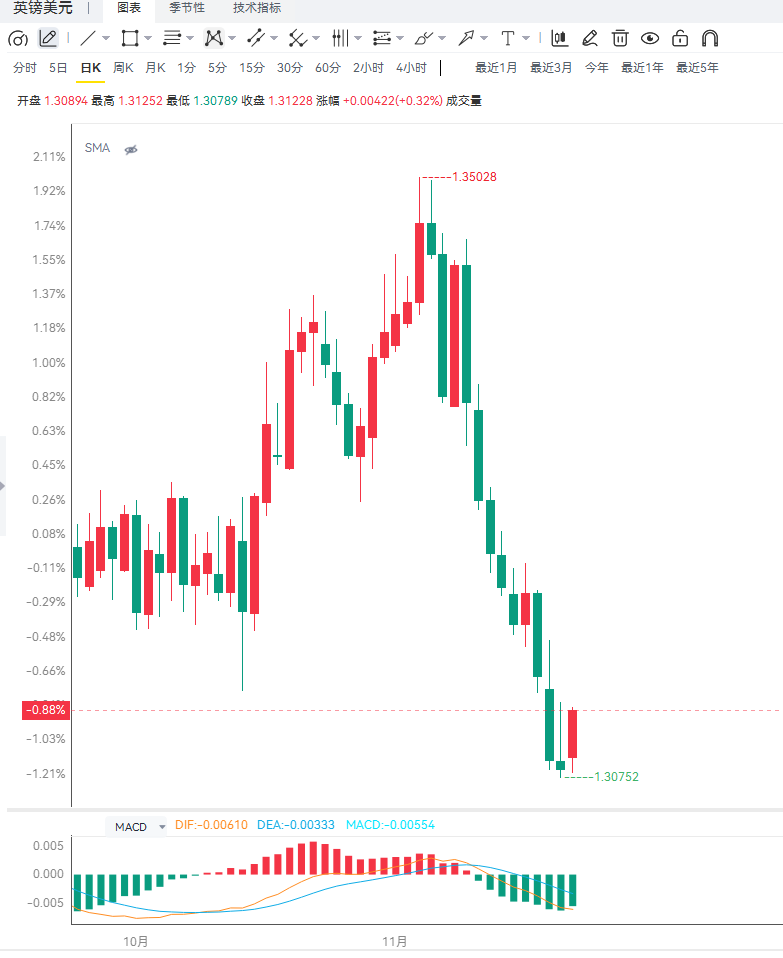 Editor's Summary: The pound's strength today stemmed from a single, clear source—October retail sales rose 0.7% month-on-month (expected 0%), 2.3% year-on-year, and core sales rose 0.9% month-on-month (expected 0.1%). This undeniably exceeded expectations and indeed strengthened the case for a December rate hike by the Bank of England. However, the problem lies in the fact that a single data improvement is insufficient to counteract structural interest rate differentials. The evidence chain for the US dollar is equally complete: a 25 basis point rate hike in December has been priced in by 93.2%, a 50 basis point hike has been completely reduced from 11.5% a week ago, Cook's speech (8.6/10) stated that the current stance "does not provide the necessary restraint," and the sentiment index rose to 152.14. Key focus will be on the US flash PMI later today, Wednesday's US PCE, the battle between the Bank of England and the Fed's December rate hike pricing of 1.3048 and 1.3165, and whether subsequent UK data can continue to improve.
According to data released by the UK Office for National Statistics (ONS) last Friday, UK retail sales rose 0.7% month-on-month in October , rebounding from a revised 0.6% decline in September and far exceeding market expectations of 0% . Year-on-year growth was 2.3% , a significant acceleration compared to September's 0.4%. Excluding motor fuel, retail sales rose 0.9% month-on-month (market expectation 0.1%), reversing September's 0.9% decline, partly driven by strong sales of long-shelf-life foods. However, interest rate differentials and robust US economic data could boost the US dollar, thus creating headwinds for major currency pairs. According to the CME FedWatch tool, federal funds futures are currently pricing in a 93.2% implied probability of a 25 basis point rate hike at the Fed's December policy meeting , and a 6.8% probability of no change. Notably, a sharp 50 basis point rate hike, considered 11.5% a week ago, is now completely excluded from pricing . “We expect the dollar to continue to outperform,” said Eric Robertsen, head of global FX, interest rates and credit research at Standard Chartered Dubai. “If global risk appetite improves, the dollar should also benefit,” he added. This view is noteworthy—it implies that the dollar’s strength is not entirely dependent on safe-haven demand; even if risk sentiment improves, funds may still flow into the dollar, making the pound’s rebound lack sustained support. Strategists at Brown Brothers Harriman (BBH) pointed out that the latest UK data strengthened the case for further tightening by the Bank of England (BoE), believing that “ UK retail sales in October exceeded expectations, supporting the case for a December rate hike .” The bank also noted that “the UK government launched the Be Ready campaign on October 22,” adding a policy context to the improved data tone. Against this backdrop, BBH believes that policy divergence will dominate currency performance: “ We believe the pound has more upside potential against the euro than against the dollar .” Their logic is that “the European Central Bank (ECB) is increasingly concerned about the drag on growth from tighter financing conditions, meaning its rate hikes may be smaller than the market expects,” while “ the Federal Reserve looks more in position to capitalize on the market’s hawkish pricing .” This assessment carries significant relative value implications—the relative strength of the pound stems more from the relative weakness of the euro than from the absolute strength of the pound itself. Regarding the Federal Reserve, Governor Cook's statements were clearly hawkish, with his FXS speech tracking score reaching 8.6/10 , significantly higher than the historical average of 7.7/10, highlighting that the current policy stance "does not provide the necessary restraint." His emphasis that a September rate hike was "insufficient" and that delaying further tightening carries the risk of embedding inflation, coupled with comments that financial conditions are "too loose," points to a clear inclination towards further rate hikes. Strong US growth, a healthy labor market, and "extreme concerns" about inflation have collectively reinforced the narrative of tighter policy and a stronger dollar. The FXS Fed Sentiment Index rose 1.58 points to 152.14 , indicating a substantial hawkish shift in the market's perception of the Fed's reaction function; the index's depth above the neutral line of 100 suggests that the market is pricing in a higher probability of further tightening and continued support for the dollar relative to low-yielding currencies. From a technical perspective, the GBP/USD pair maintains a clear bearish bias on the daily chart, with the spot price trading below the 20-day Bollinger Band simple moving average and the 100-day simple moving average . The pair is declining along the lower half of the recent Bollinger Bands, and the 14-day Relative Strength Index (RSI) is around 36 , leaning towards oversold territory, suggesting that while conditions are starting to "stretch," downward pressure continues. On the upside, initial resistance is at the Bollinger Middle Band around 1.3290 , followed by the 100-day simple moving average at 1.3385 , and the Bollinger Upper Band around 1.3535 – where sellers are expected to defend the overall downtrend. On the downside, the next key support level to watch is at the Bollinger Lower Band, currently around 1.3048 ; a decisive break below this level would open up a deeper bearish extension, while holding above it could allow a corrective rebound to the 1.3300 area (near the Bollinger Middle Band). On the 4-hour chart, the price entered a weak consolidation phase after breaking below 1.3165. The strength of any short-term rebound is constrained by the pullback resistance at 1.3165 – this level has shifted from a previous "confirmation level" to "upper resistance." Two levels need to be observed: first, whether the rebound can regain a foothold above 1.3165 , which is the primary indicator of whether the weakness has eased; second, whether the lower Bollinger Band at 1.3048 can hold, which is the dividing line between a potential escalation of the downtrend. If 1.3048 is effectively broken, the next psychological level will directly target 1.3000. Editor's Summary: The pound's strength today stemmed from a single, clear source—October retail sales rose 0.7% month-on-month (expected 0%), 2.3% year-on-year, and core sales rose 0.9% month-on-month (expected 0.1%). This undeniably exceeded expectations and indeed strengthened the case for a December rate hike by the Bank of England. However, the problem lies in the fact that a single data improvement is insufficient to counteract structural interest rate differentials. The evidence chain for the US dollar is equally complete: a 25 basis point rate hike in December has been priced in by 93.2%, a 50 basis point hike has been completely reduced from 11.5% a week ago, Cook's speech (8.6/10) stated that the current stance "does not provide the necessary restraint," and the sentiment index rose to 152.14. Key focus will be on the US flash PMI later today, Wednesday's US PCE, the battle between the Bank of England and the Fed's December rate hike pricing of 1.3048 and 1.3165, and whether subsequent UK data can continue to improve.
- Risk Warning and Disclaimer
- The market involves risk, and trading may not be suitable for all investors. This article is for reference only and does not constitute personal investment advice, nor does it take into account certain users’ specific investment objectives, financial situation, or other needs. Any investment decisions made based on this information are at your own risk.