The dollar index's pullback from its highs does not change its bullish trend; it awaits confirmation of support.
2026-11-23 14:40:37
The US dollar index (DXY) hovered around 103.60 during Monday's Asian session, marking its second consecutive day of negative bias . However, it should be noted that the index remains close to its highest level since April 2025 , and the current supporting fundamentals have not collapsed.  Traders have reduced their bets on aggressive tightening by the Federal Reserve, which has dampened new long positions in the dollar. A 25-basis-point rate hike at the December FOMC meeting is already fully priced in ; the reduction is only in the "more aggressive" part, not the rate hike itself. More informative is the latest distribution shown by the CME FedWatch tool— traders are placing greater likelihood on subsequent rate hikes in January and April 2027. In other words, the near end is already determined, while the far end is being priced in, creating a "short-term bearish, long-term bullish" tug-of-war structure, which is the direct reason why the index has fallen for two consecutive days without a significant drop. Geopolitical factors continue to support the dollar. Trump stated on Sunday that he would prefer to restart strikes against Iran in the new year if no agreement is reached, while the US maritime blockade of Iranian shipping remains in place. Meanwhile, Iran has intensified its attacks in recent days. The scope of the conflict is expanding—the Iranian Revolutionary Guard claims to have struck US positions in Bahrain, while the Iranian-backed Houthi rebels in Yemen continue to attack Saudi energy infrastructure. This kept the geopolitical risk premium above the charts and provided a basis for bargain hunting in the dollar . Traders are currently awaiting the release of the US Flash PMI during the North American session for momentum. However, the real focus remains on Wednesday's key inflation data – the US Personal Consumption Expenditures (PCE) price index . The market will be looking for more clues about the Fed's future policy path, which will provide new directional drivers for the dollar index. On the 4-hour chart, the price is consolidating above the 200-period EMA, and the pullback lows have not yet touched the lower edge of the 103.50 range, indicating a healthy consolidation rather than a breakout. Two levels need to be observed: first, whether the 103.50-103.55 level can hold, which is the bottom line of the range structure; second, whether the rebound can re-challenge and effectively break through 103.80 , which is a necessary condition to break the deadlock. If 103.50 is breached, the next target is the 200-period EMA at 102.27; if 103.80 is confirmed by the daily closing price, the high since April 2025 is expected to be refreshed again.
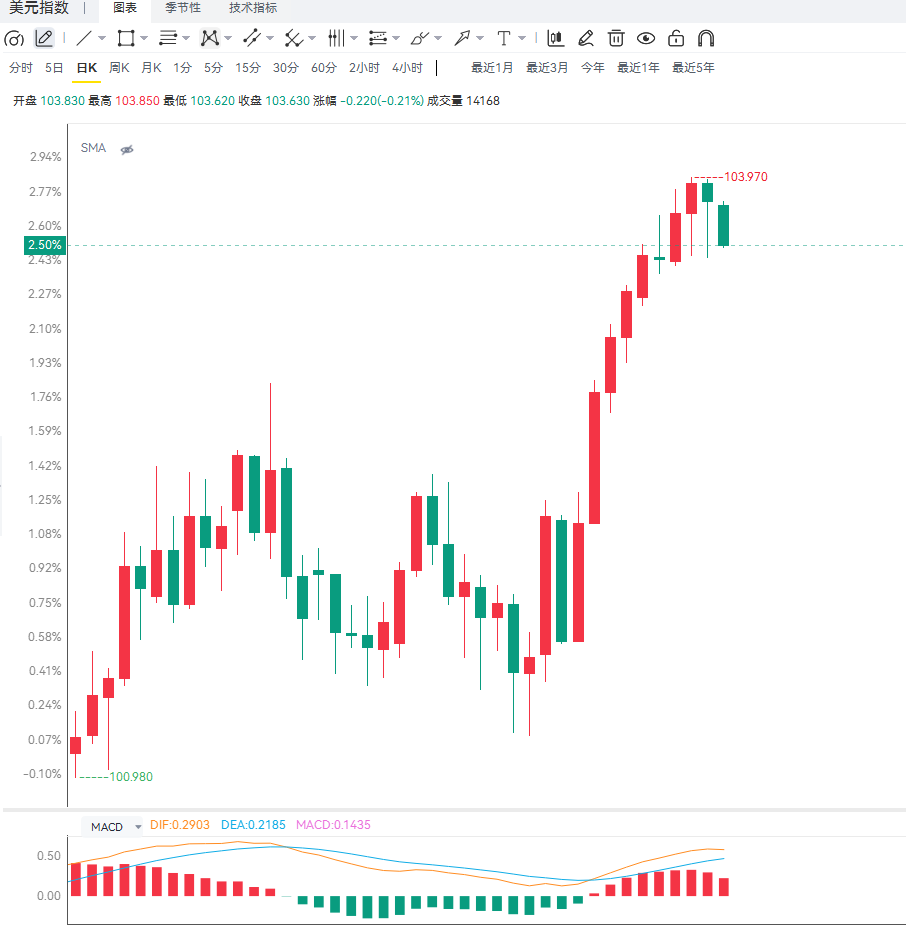 Editor's Summary: The US dollar index is currently in a stalemate, "unable to fall back from its high level, but also unable to break through," a stalemate maintained by two opposing forces. There are three supporting factors: the 25 basis point rate hike in December is fully priced in; expectations of subsequent rate hikes in January and April 2027 are increasing; and geopolitical risk premiums continue to rise—Trump's inclination to restart strikes against Iran in the new year, the Iranian Revolutionary Guard's attack on US military positions in Bahrain, and the Houthi's continued attacks on Saudi energy facilities all clearly benefit the US dollar from safe-haven demand. On the suppressing side, there is one crucial factor: the market has reduced its bets on aggressive tightening, meaning that a "faster and higher" rate hike path is not accepted, thus flattening the upward slope of the dollar. The result of these two forces is that the index is repeatedly resisted below the hard top of 103.80 —a level that failed to break through in mid-November, and the current price of 103.75 remains below it, with resistance remaining effective for several days. 103.50 to 103.55 is the lower limit of the range, 103.80 is the threshold for breaking through, and 102.27 is the next target after the breakout.
Traders have reduced their bets on aggressive tightening by the Federal Reserve, which has dampened new long positions in the dollar. A 25-basis-point rate hike at the December FOMC meeting is already fully priced in ; the reduction is only in the "more aggressive" part, not the rate hike itself. More informative is the latest distribution shown by the CME FedWatch tool— traders are placing greater likelihood on subsequent rate hikes in January and April 2027. In other words, the near end is already determined, while the far end is being priced in, creating a "short-term bearish, long-term bullish" tug-of-war structure, which is the direct reason why the index has fallen for two consecutive days without a significant drop. Geopolitical factors continue to support the dollar. Trump stated on Sunday that he would prefer to restart strikes against Iran in the new year if no agreement is reached, while the US maritime blockade of Iranian shipping remains in place. Meanwhile, Iran has intensified its attacks in recent days. The scope of the conflict is expanding—the Iranian Revolutionary Guard claims to have struck US positions in Bahrain, while the Iranian-backed Houthi rebels in Yemen continue to attack Saudi energy infrastructure. This kept the geopolitical risk premium above the charts and provided a basis for bargain hunting in the dollar . Traders are currently awaiting the release of the US Flash PMI during the North American session for momentum. However, the real focus remains on Wednesday's key inflation data – the US Personal Consumption Expenditures (PCE) price index . The market will be looking for more clues about the Fed's future policy path, which will provide new directional drivers for the dollar index. On the 4-hour chart, the price is consolidating above the 200-period EMA, and the pullback lows have not yet touched the lower edge of the 103.50 range, indicating a healthy consolidation rather than a breakout. Two levels need to be observed: first, whether the 103.50-103.55 level can hold, which is the bottom line of the range structure; second, whether the rebound can re-challenge and effectively break through 103.80 , which is a necessary condition to break the deadlock. If 103.50 is breached, the next target is the 200-period EMA at 102.27; if 103.80 is confirmed by the daily closing price, the high since April 2025 is expected to be refreshed again. Editor's Summary: The US dollar index is currently in a stalemate, "unable to fall back from its high level, but also unable to break through," a stalemate maintained by two opposing forces. There are three supporting factors: the 25 basis point rate hike in December is fully priced in; expectations of subsequent rate hikes in January and April 2027 are increasing; and geopolitical risk premiums continue to rise—Trump's inclination to restart strikes against Iran in the new year, the Iranian Revolutionary Guard's attack on US military positions in Bahrain, and the Houthi's continued attacks on Saudi energy facilities all clearly benefit the US dollar from safe-haven demand. On the suppressing side, there is one crucial factor: the market has reduced its bets on aggressive tightening, meaning that a "faster and higher" rate hike path is not accepted, thus flattening the upward slope of the dollar. The result of these two forces is that the index is repeatedly resisted below the hard top of 103.80 —a level that failed to break through in mid-November, and the current price of 103.75 remains below it, with resistance remaining effective for several days. 103.50 to 103.55 is the lower limit of the range, 103.80 is the threshold for breaking through, and 102.27 is the next target after the breakout.
- Risk Warning and Disclaimer
- The market involves risk, and trading may not be suitable for all investors. This article is for reference only and does not constitute personal investment advice, nor does it take into account certain users’ specific investment objectives, financial situation, or other needs. Any investment decisions made based on this information are at your own risk.