Bessenter's softened stance and AI-driven sentiment analysis triggered a rebound in precious and industrial metals.
2026-11-23 16:10:31
On Monday (November 23), spot gold saw a strong recovery during the Asian and European sessions, rebounding nearly $100 from its more than one-year low of around $3502.73 per ounce hit last Friday, reaching a high of $3630.32 per ounce, a single-day increase of up to 2.7%. The core catalyst for this rebound came from a shift in policy statements by US Treasury Secretary Bessant. In an interview on November 22, when asked, "Trump said that Jensen Huang should return to his post. And you said that Nvidia needs to find a CEO from outside," Bessant replied, "Jensen Huang is now an outsider." When pressed further, "You mean you think it's a good idea to let him go back to lead the company?" Bessant stated, "I think we have to figure out who should ultimately bear the responsibility. We need to find out who at the grassroots level deliberately violated regulations." Bessant also publicly warned that if the Federal Reserve continues to tighten monetary policy by closely monitoring inflation data, it could easily make policy mistakes and jeopardize the US economy, while also stating bluntly that the financial system has shown signs of fragility. This statement clearly signaled a dovish stance, and the market began to reprice the Fed's future interest rate hike path. 
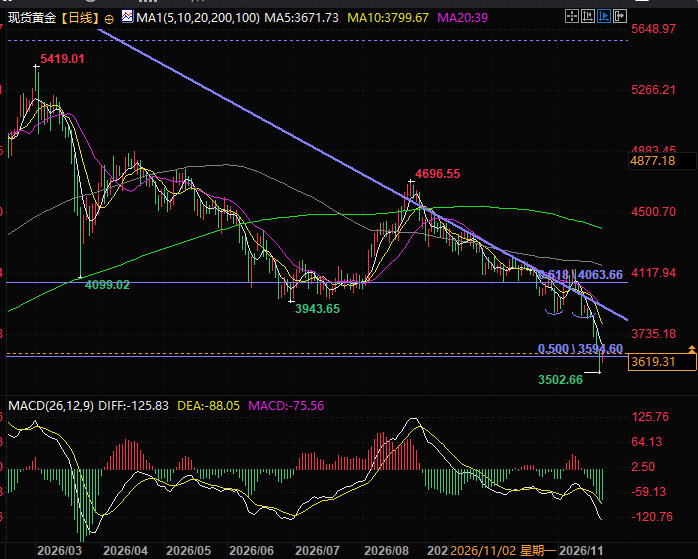 (Spot gold daily chart, source: FX678) At 16:08 Beijing time, spot gold is currently trading at $3,610 per barrel.
Gold prices rebounded sharply from their lows following changes in interest rate expectations.
Interest rate futures data quickly adjusted: market expectations for a 50 basis point rate hike in December have essentially disappeared. Interest rate futures show that the market now expects the probability of the Federal Reserve keeping interest rates unchanged in December to rise to 10%, up from 0% last week. The probability of a 25 basis point rate hike is 91.4%, and the probability of a 50 basis point rate hike has fallen to 0% (from as high as 15% last week). The fear of a rate hike that had been suppressing gold prices has clearly cooled, the dollar index has fallen from a one-and-a-half-year high, the cost pressure of holding gold (a non-interest-bearing asset) has eased marginally, and bargain hunters have entered the market.AI narratives are showing signs of recovery, risk appetite is improving, and liquidity pressures are easing.
The main driver of last week's sharp market volatility was the concentrated deleveraging of highly leveraged AI trading, leading to a significant pullback in tech stocks. Many institutions were forced to sell highly liquid gold to cover margin calls, putting heavy selling pressure on gold prices. However, in pre-market trading on Monday, US stock index futures rebounded significantly, with S&P 500 futures rising 1.5% and Nasdaq futures gaining over 2%, indicating a recovery in panic surrounding the AI sector. JPMorgan Chase's view also supported market confidence, believing that the current correction was essentially a deleveraging process in AI trading, and that the long-term logic of the AI supercycle remains intact. After the clearing of positions, risk assets have a basis for recovery. Coupled with Trump's public support for Jensen Huang's return to lead Nvidia, and Treasury Secretary Bessent's reversal of stance, further eased market pessimism regarding the AI industry chain. Market risk appetite improved, the liquidity crunch eased, and the previous negative cycle of "selling gold to cover margin calls" was broken.New characteristics of asset linkage: Precious metals and industrial metals strengthen in tandem, and the logic of using gold in technology is being realized.
One noteworthy change is that this rebound is no longer solely a safe-haven rally for gold; gold and industrial metals like copper have moved in tandem. On one hand, AI computing infrastructure and chip manufacturing continue to drive demand for gold and copper in the electronics sector. Gold, as a conductive material in chips and precision electronic components, and copper, as a core raw material for AI servers and high-speed interconnect hardware, share the same driving force of demand from the technology industry. On the other hand, as sentiment in the technology sector stabilizes, funds are simultaneously restoring expectations for demand in technology metals. Gold is no longer simply negatively correlated with technology stocks, but rather exhibits a phase of synchronized gains. Geopolitical factors also play a supporting role. Trump's statement that he prefers to take action after the New Year if negotiations with Iran fail, coupled with Iran's continued willingness to engage in diplomatic negotiations, has cooled expectations of a short-term deterioration in the Middle East situation. The decline in inflation premiums has also reduced trading expectations for extreme interest rate hikes, indirectly benefiting precious metals.Trading Summary
The current market trend is driven by a turning point in policy expectations and a liquidity recovery resulting from the end of AI-driven deleveraging. Bessant's easing stance is key to the repricing of interest rate expectations; the stabilization of the AI narrative has boosted risk appetite, leading to a liquidity recovery, with precious and industrial metals rebounding in tandem. The demand for gold in the technology sector has resulted in a phase of synchronized price movements for both gold and the technology sector. However, it's important to note that this recovery is a rebound following the release of panic. The Fed's policy remains uncertain, and continued monitoring of inflation data and Fed officials' speeches is necessary. Technically, as previously mentioned, 3600 is a key Fibonacci 0.500 level; below 3600 represents an opportunity rather than a risk. Gold prices have indeed returned above 3600 and are currently consolidating. However, the overall moving averages are still in a bearish alignment. If a significant rebound fails to form a reversal pattern, gold prices are likely just a rebound, and further consolidation is needed to wait for the moving averages to flatten out from their bearish alignment. (Spot gold daily chart, source: FX678) At 16:08 Beijing time, spot gold is currently trading at $3,610 per barrel.
- Risk Warning and Disclaimer
- The market involves risk, and trading may not be suitable for all investors. This article is for reference only and does not constitute personal investment advice, nor does it take into account certain users’ specific investment objectives, financial situation, or other needs. Any investment decisions made based on this information are at your own risk.