Analysts believe oil prices are unlikely to fall further, with Sunday's OPEC+ meeting being the key variable.
2026-11-27 14:04:36
International oil prices have begun a recovery from previous lows, with the risk premium from supply disruptions in the Middle East outweighing previous market concerns about a global oil oversupply. Standard Chartered analysts predict that further price declines will require stronger evidence of inventory and supply deficiencies, and the upcoming OPEC+ ministerial meeting will be a key variable in the short-term market.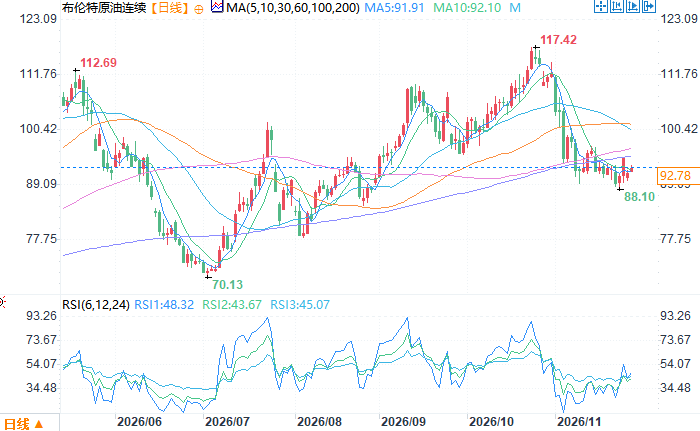 Brent crude oil daily chart source: FX678. At 13:56 Beijing time on November 27th, Brent crude oil was trading at $92.78 per barrel.
News of attacks in the Middle East spurred a rebound in oil prices, while US inventories continued to accumulate.
At midnight Beijing time on Friday, January Brent crude oil rose 1.3% to $95.90 a barrel, a significant rebound from Monday's close of only $89.37. WTI crude oil rose 1.2% to $84.65 a barrel. The Houthi rebels in Yemen claimed responsibility on Wednesday for an attack on the Ras Tanura oil refinery and export complex in Saudi Arabia, causing fires. Satellite imagery from NASA and Planetary Laboratory showed thick black smoke rising from the area. The Houthis also claimed responsibility for multiple attacks on Riyadh's financial district. Saudi Civil Defense reported that a tower housing the Saudi Public Investment Fund was attacked on Tuesday, the second such attack in a week, resulting in 11 injuries. In addition to supply-side risks, US crude oil inventory data was bearish. For the week ending November 20, US commercial crude oil inventories increased by 1.1 million barrels to a total of 418.9 million barrels, marking the third consecutive week of increases. Increased net imports and domestic production offset the destocking effect of increased refinery processing, coupled with rising freight rates and weakening Asian demand, causing crude oil exports to fall to their lowest level since early August. Market attention is focused on the OPEC+ ministerial meeting on November 29, where member countries will discuss production policies for 2027. The interplay of expectations of oversupply and internal quota disputes is increasing the pressure of strategic maneuvering.The fundamental outlook is bearish, but the downside for oil prices is limited.
Standard Chartered's oil and commodities analysts stated that crude oil prices are unlikely to fall below recent lows. For a sustained decline, clear signals of continued inventory accumulation or a faster recovery in physical supply are needed. Continued geopolitical uncertainty further complicates the outlook. Brent crude, after retreating from its late October highs, consolidated above $90 for most of last week before breaking below $90 on Monday, closing at $89.37, a near three-month low. Analysts say the current oil price movement reflects a bearish fundamental outlook. The International Energy Agency significantly raised its fourth-quarter supply forecast in its November oil report by 3.3 million barrels per day. The faster-than-expected recovery in Gulf region oil production and exports has led the market to anticipate a return to oversupply by the end of the year, with the surplus expected to expand further in 2027. However, Standard Chartered believes that the current oil price correction has already fully priced in the market's anticipated oversupply. For a sustained decline in oil prices, it would be necessary to demonstrate that the oversupply arrived earlier, on a larger scale, or lasted longer, rather than simply repeating existing forecasts.The decline in refined oil prices and freight rates has eased the tightness in the physical market.
Beyond crude oil, refined product prices, refining margins, and shipping costs have all weakened, indicating that the temporary supply shortage caused by geopolitical shocks is gradually subsiding. Jet kerosene in the Northwest European shipping region has fallen 24% year-to-date, while Singapore 380 fuel oil has dropped 31%. European diesel crack spreads have narrowed by 21%, and the adjustment has spread beyond crude oil. Asian fluidized bed catalytic cracking margins and Northwest European hydrocracking margins have both declined by 25% year-to-date. Freight rates for clean refined products from the Middle East to China have fallen by 27%, while freight rates for crude oil from the Gulf to China have plummeted by as much as 55%. Although absolute prices and freight rates remain high, a series of data points suggest that the physical market tensions have eased marginally. Uncertain progress in US-Iran diplomatic negotiations and continued attacks on regional energy facilities mean that supply recovery is highly vulnerable; however, the market has gradually absorbed the risks of ongoing conflict, provided there is no substantial large-scale supply disruption. A diplomatic breakthrough would accelerate crude oil circulation and put downward pressure on prices; further attacks on export facilities and shipping routes would quickly overturn expectations of oversupply. Continued attacks on Russian energy facilities also limit the recovery of middle distillate supply.Intensified internal power struggles within OPEC+ make this meeting more significant than previous ones.
OPEC+ will meet on Sunday. In September, the organization completed its voluntary production cut of 1.65 million barrels per day, raising its production target by 188,000 barrels per day. According to Rezid Energy, the organization has maintained its September production target until December. Amid rising expectations of oversupply, member countries need to decide whether to increase production, maintain the status quo, or cut production again, while finalizing the 2027 production benchmark to avoid a split within the alliance. Following the UAE's withdrawal in May, Iraq's weight within the organization has increased. Iraq has long been producing above its quota and hopes to have its production capacity formally recognized. Previous OPEC+ meetings have had little impact on oil prices. Standard Chartered believes this meeting will be different; if member countries reach a consensus on coordinated production cuts, it will significantly affect short-term crude oil prices.Conclusion
The current crude oil market is caught between geopolitical risk premiums and expectations of oversupply in the fundamentals. While the tightness in the physical market has eased marginally, the risk of supply disruptions remains. The policy choices of OPEC+ will determine the direction of oil prices in the next stage. Brent crude oil daily chart source: FX678. At 13:56 Beijing time on November 27th, Brent crude oil was trading at $92.78 per barrel.
- Risk Warning and Disclaimer
- The market involves risk, and trading may not be suitable for all investors. This article is for reference only and does not constitute personal investment advice, nor does it take into account certain users’ specific investment objectives, financial situation, or other needs. Any investment decisions made based on this information are at your own risk.