Warsh faces a 2018-style dilemma: AI stocks plummet, and the Federal Reserve prioritizes combating inflation.
2026-11-27 14:20:33
On Friday (November 27) during the Asian session, the US dollar index fluctuated slightly lower, currently trading around 103.70. Under inflationary constraints, the Fed's "rescue threshold" has significantly increased, and the market is repricing the upside potential of the dollar and US Treasuries. The plunge in the AI sector is testing Fed Chairman Warsh, mirroring the classic predicament of the 2018 US stock market sell-off. With core PCE rising to 3.3% and persistently high inflation stickiness, the Fed is clearly more tolerant of orderly stock market corrections, and the market remains confident of a rate hike at the December meeting. Only a disorderly plunge, especially an outbreak of AI-related credit risks, could potentially reverse the policy path. The biggest difference between this environment and 2018 lies in the inflation level; there is little room for a repeat of 2019's shift to easing. 
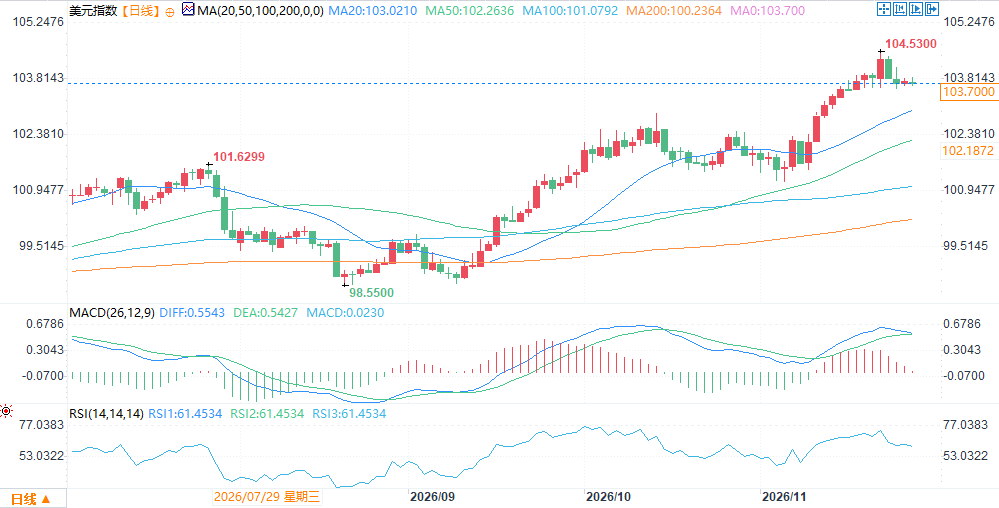 (US Dollar Index Daily Chart, Source: FX678) At 14:15 Beijing time, the US Dollar Index was at 103.69.
Historical Comparison: The predicament of 2018 is repeating itself, but the underlying inflationary issues are completely different.
In December 2018, during a sharp correction in the US stock market, Warsh called on the Federal Reserve to pause interest rate hikes. That year, inflation had just reached the 2% target, and the Fed quickly shifted to easing, creating the well-known "Fed put option" expectation. The historical scenario is similar now: the new chairman is raising interest rates against a backdrop of a weak stock market and a strong dollar, compounded by geopolitical disturbances. However, the core difference is inflation: the current core PCE has risen to 3.3%, and inflation has been consistently above the target for over five years. Warsh has explicitly stated that he cannot tolerate inflation slightly exceeding the 2% target for an extended period, directly locking in the possibility of rapid rate cuts and a shift to easing. The key to this comparison lies in the "different starting points." In 2018, inflation had just reached the target, leaving ample policy space. The Fed could quickly shift from tightening to a wait-and-see approach or even easing, leading to a strong "rescue during a fall" expectation in the market. The current situation is completely different: core PCE has been significantly above the target for several years, and inflation stickiness continues to manifest through the service sector, wages, and AI-related demand. Warsh has repeatedly emphasized in public statements that inflation cannot be allowed to deviate slightly from the target for an extended period, otherwise it will weaken the anchoring effect. This means that even if the stock market experiences a correction similar to that of 2018, the policy response function has fundamentally changed. While historical experience can be referenced, it cannot be simply replicated. If the market continues to trade "Fed put options" based on the logic of 2018-2019, it will face the risk of expectation discrepancies. The current environment is closer to "continuation of tightening under high inflation constraints" than "rapid shift under low inflation." Traders need to be wary of blindly applying historical templates and focus on whether inflation data itself shows a substantial decline, rather than simply stock price fluctuations.The Federal Reserve's new stance: An orderly decline is part of tightening; it refuses to easily intervene to rescue the market.
Federal Reserve officials are increasingly viewing the orderly pullback in the AI sector as a spontaneous tightening of financial conditions, a means to curb overheating of the economy, rather than a crisis requiring intervention. The robust demand driven by AI is seen as a source of sustained inflation, unlike short-term shocks such as oil prices and tariffs. Many officials believe that curbing AI investment is a necessary step in cooling the economy. At the same time, the Fed is deliberately avoiding reinforcing expectations of a "market rescue" and reducing market reliance on put options. Under this line of thinking, a simple decline in stock prices is unlikely to change the baseline expectation of a December rate hike. This shift in attitude has significant signaling implications. In the past, the market tended to interpret sharp stock market corrections as a harbinger of an impending policy shift, but the Fed is now more willing to view the adjustment in the AI sector as part of a tightening effect. Overheated AI investment has boosted demand for energy, chips, data centers, and other related sectors, thus providing sustained support for inflation. By allowing valuations to return to normal and investment to slow, financial conditions will naturally tighten, helping to reduce overall demand pressure. Officials are deliberately downplaying expectations of a "market support" measure to prevent moral hazard and excessive speculation. If the Federal Reserve signals easing too early, it could reignite risk asset bubbles and offset the effects of previous rate hikes. Therefore, as long as the pullback remains orderly and does not trigger systemic liquidity problems, the baseline path of a December rate hike is unlikely to waver. Traders should reduce their pricing weight of the assumption that "a market bailout is inevitable once the decline reaches a certain threshold," and focus more on the nature of the pullback—whether it's valuation digestion or a break in the credit chain.The real risk trigger: AI credit markets, not stock prices.
While stock market volatility itself remains within the Federal Reserve's tolerance range, disorderly panic selling and credit market defaults are the key hurdles for a policy shift. Federal Reserve Vice Chairman for Supervision Bowman warned that AI-related debt is expected to exceed $800 billion this year, with off-balance-sheet commitments more than three times that figure. Only if the decline in the AI sector transmits to the credit side, causing financing pressure on highly indebted AI entities and creating systemic risk, will the Fed be forced to reassess its interest rate hike path. New York Fed President Williams stated that current volatility is merely normal and does not constitute a reassessment of AI fundamentals. A decline in stock prices alone is not a sufficient condition for a policy shift; the real risk lies in credit transmission. The AI industry has expanded rapidly in recent years, heavily relying on debt financing and off-balance-sheet commitments, significantly increasing leverage. If stock prices remain under pressure, the refinancing costs of highly indebted entities will rise, and the value of collateral will decline, potentially triggering a liquidity crisis. Bowman's warning indicates that the Fed has begun to pay attention to this potential vulnerability. If the volatility only affects the equity market, the policy response will be limited; only if it spreads to the credit market, leading to large-scale defaults or financing freezes, and increasing systemic risk, will the Fed be forced to reconsider the pace of interest rate hikes. The fact that officials like Williams are still characterizing market fluctuations as normal volatility suggests that no significant deterioration in credit conditions has been observed. Traders need to shift their focus from simply stock index levels to high-frequency credit indicators such as AI-related bond spreads, loan default rates, and the fulfillment of off-balance-sheet commitments. Only a sharp deterioration in these indicators would provide a realistic basis for reversing expectations of a December rate hike.Internal opinions are divided: a December rate hike is basically a foregone conclusion, but disagreements are widening on the subsequent path.
The market consensus is that a rate hike will be implemented at the December 8-9 meeting. Internal disagreements within the Federal Reserve focus on the final rate hike target: the dovish camp argues that if commodity prices continue to decline and inflation further eases, a rate hike could be paused after one round; the hawkish camp, represented by St. Louis Fed President Mussallem, suggests three more rate hikes may be needed next year, and Williams does not rule out consecutive rate hikes. Warsh's own stance remains uncertain: while he consistently emphasizes market price signals, he initially stated in 2018 that there was no need to worry about a stock market correction, but later called for a pause in rate hikes. This makes the current AI market trend a crucial test for him early in his term. A December rate hike is largely considered a consensus; the real disagreement lies in the final rate and the subsequent pace. Dovish officials are more concerned about commodity prices and recent signs of easing inflation data, believing that a one-time rate hike could lead to a period of observation; hawkish officials emphasize the stickiness of inflation and the sustainability of AI demand, advocating for a higher level of restraint. Warsh's personal position has become the market focus: on the one hand, he values market price signals and is sensitive to changes in financial conditions; on the other hand, he explicitly opposes a prolonged deviation of inflation from the target. The shift in stance in 2018 has left the market with lingering doubts about his policy response. The current performance of the AI sector and the credit situation will serve as an early litmus test for his policy preferences. If the market remains orderly, he will likely maintain a tightening stance; if signs of credit risk emerge, he may adjust his position more quickly. Investors need to simultaneously monitor the evolution of the dot plot and Warsh's own statements to determine the final point where interest rate hikes will end.Impact on major asset classes
The Federal Reserve's continued interest rate hikes continue to put pressure on gold, a non-interest-bearing asset; the US dollar and short-term US Treasury yields are supported. If subsequent adjustments are only mild, tightening expectations will persist; however, if a liquidity crisis occurs in AI lending, expectations will ease rapidly, driving an asset inflection point. In the baseline scenario, the Fed's continued rate hikes will further increase real interest rates and the US dollar, directly suppressing gold while supporting short-term US Treasury yields and the US dollar index. Risk assets will face dual constraints of valuation and liquidity. If the AI sector only maintains an orderly correction, and tightening expectations remain stable, asset prices will likely continue the current logic: gold under pressure, a stronger dollar, and increased volatility in stocks and bonds, but the direction will still be dominated by interest rates. The real catalyst for the inflection point lies in whether the credit side gets out of control. Once AI-related debt experiences large-scale financing difficulties or a wave of defaults, the market will quickly reprice the Fed's path, and expectations of rate cuts may rise ahead of time, thereby driving a rebound in gold, a decline in the dollar, and a correction in oversold risk assets. Current pricing is still mainly based on "orderly adjustments + continued tightening," therefore the traditional negative correlation between gold and the US dollar continues to dominate. Traders should prepare two scenarios: interest rate-driven trading during a mild pullback, and rapid expectation reversal trading during a credit crisis, and set position switching conditions in advance. (US Dollar Index Daily Chart, Source: FX678) At 14:15 Beijing time, the US Dollar Index was at 103.69.
- Risk Warning and Disclaimer
- The market involves risk, and trading may not be suitable for all investors. This article is for reference only and does not constitute personal investment advice, nor does it take into account certain users’ specific investment objectives, financial situation, or other needs. Any investment decisions made based on this information are at your own risk.