With US PCE inflation remaining high and renewed conflict erupting in the Middle East, how far can the gold price rebound go?
2026-11-27 15:14:33
On Friday (November 27) during the European session, spot gold continued its intraday rebound, rising above $3,650 per ounce, further recovering from its lows since September 2025, reached earlier this week. Improved risk appetite led to a weaker dollar, becoming the main driver of the gold price rebound. However, escalating conflicts in the Middle East provided safe-haven support for the dollar, coupled with expectations of a hawkish rate hike by the Federal Reserve, which may limit the extent of gold's gains. Overall market trading was thin, and further buying is needed to confirm a bottom. 
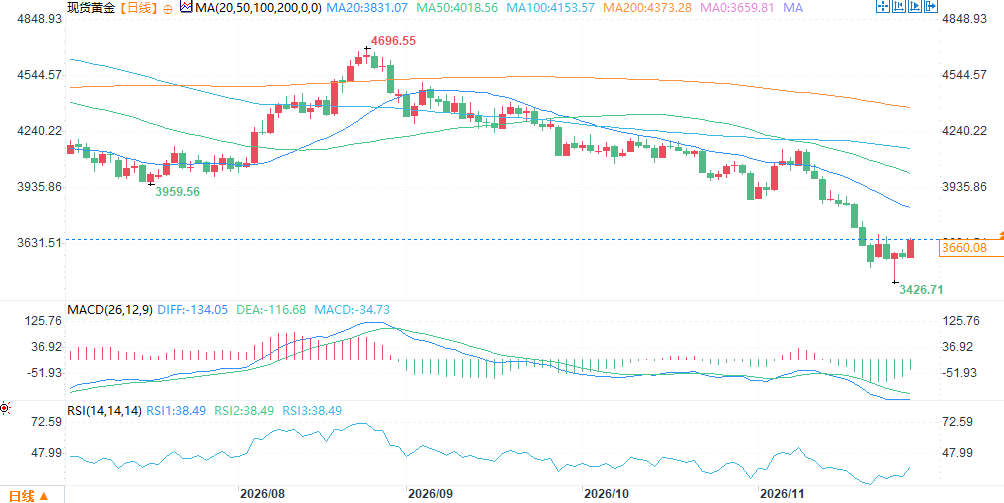 (Spot gold daily chart, source: FX678) At 15:09 Beijing time, spot gold was trading at $3658.12 per ounce.
Improved risk appetite and a weaker dollar boosted gold's rebound.
Global market risk sentiment was generally positive, leading to a decline in the US dollar index and a direct boost to dollar-denominated gold, which broke through $3,650, completing a further recovery from this week's lows. However, there are clear balancing factors: on the one hand, technical patterns support further upward movement today; on the other hand, two major negative factors remain, making it premature to conclude a reversal has been established. The core driver of this rebound is the phased recovery in risk appetite. As market concerns about the previous correction in the AI sector have eased, funds have flowed back into risk assets, causing the US dollar index to fall, directly reducing the dollar cost of holding gold and pushing gold prices up from this week's lows to above the $3,650 mark. Technically, gold prices have moved away from the lows since September 2025, and short-term moving averages and oversold indicators also support further upward attempts today. However, the sustainability of the rebound still faces significant constraints. Escalating geopolitical risks in the Middle East have provided safe-haven buying of the US dollar, while expectations of a hawkish rate hike by the Federal Reserve continue to rise real interest rates, both limiting the upside potential of gold. Current trading volume is thin, lacking confirmation from large-scale incremental buying. Therefore, this round of movement should be characterized as a technical correction rather than the start of a trend reversal. Traders need to observe whether sustained follow-up buying occurs and whether the dollar's decline has any sustainability in order to determine the height and duration of the rebound.The renewed escalation of conflict in the Middle East has provided a safe-haven asset for the US dollar.
The fighting between the Houthi rebels in Yemen and Saudi Arabia has escalated significantly, with cross-border drone and missile attacks targeting key Saudi infrastructure. Saudi Arabia has also launched large-scale airstrikes against Houthi-controlled areas. The Houthis claimed responsibility for attacks on the Rastanura oil refinery, Riyadh's financial district, the Jizan oil refinery, and Red Sea ports. Iran's Revolutionary Guard stated that several oil tankers struck mines and caught fire on the southern shipping lanes, and maritime monitoring agencies also recorded ammunition attacks and other close calls. The risk of further escalation in the region remains, and the geopolitical safe-haven premium is favorable for the safe-haven US dollar, which will limit its downward movement and indirectly set a ceiling for gold price increases. The breadth and intensity of this round of conflict escalation significantly exceed previous phases. The Houthis have expanded their targets to include key Saudi oil refineries and financial facilities, while Saudi Arabia has launched large-scale retaliatory airstrikes, simultaneously increasing shipping security risks in the Red Sea and southern shipping lanes. Statements from the Iranian Revolutionary Guard and the oil tanker attacks have further heightened market concerns about the Strait of Hormuz and potential energy supply disruptions. Such geopolitical shocks typically benefit both gold and the US dollar's safe-haven appeal. However, in the current environment, the US dollar, due to its liquidity and interest rate advantages, tends to attract safe-haven funds more quickly, thus offsetting some of the depreciation pressure on the dollar caused by a recovery in risk appetite. As a result, the downside potential of the dollar is partially locked in, and while gold benefits from safe-haven demand, it struggles to gain additional support from a significant weakening dollar. As long as tensions in the Middle East do not substantially ease, the dollar's safe-haven support effect will persist, becoming a hidden resistance level for gold prices. In trading, geopolitical developments should be considered an important variable for short-term fluctuations, rather than a sufficient condition for a one-sided bullish outlook on gold.US inflation and economic data have proven resilient, making a December rate hike virtually certain.
The US PCE price index and Q3 GDP data released on Wednesday once again demonstrated the stickiness of inflation and the resilience of the economy. The market has firmly priced in a 25 basis point rate hike by the Federal Reserve in December, and CME tools also show that traders are pricing in two more rate hikes in early 2027. Gold, a non-interest-bearing asset, will continue to be suppressed by high interest rate expectations. Current market liquidity is relatively thin, and it is not yet possible to confirm that gold prices have formed a bottom until strong follow-up buying emerges. The latest data reinforces the necessity for the Federal Reserve to maintain its restrictive policy. Core PCE rose to 3.3% year-on-year, indicating that the process of inflation decline is hindered; the significant upward revision of Q3 GDP proves that demand remains strong. The market has therefore almost fully priced in a 25 basis point rate hike in December and is pricing in additional rate hikes in early 2027. For gold, this means that real interest rates are unlikely to fall quickly, and the opportunity cost of holding non-interest-bearing assets remains high, forming medium-term pressure. Even if a short-term recovery in risk appetite drives a rebound in gold prices, high interest rate expectations will still limit the rise and its sustainability. Coupled with thin trading on Friday and insufficient buying interest, gold prices are more likely to encounter resistance and fall back near the resistance level. Until there is confirmation of sustained capital inflows or a softening stance from the Federal Reserve, the current rebound should not be considered a complete bottom formation. A range-bound trading strategy is more suitable, focusing on the reaction to resistance above 3650 and support below, and waiting for liquidity to recover and data to confirm the trend before determining the direction.Danske Bank interprets US PCE data: Core goods inflation rises, service inflation remains high.
Danske Bank's analysis indicates that October's PCE figures were largely in line with expectations, but overall inflation remains high. Both overall and core PCE rose 0.3% month-over-month, with core PCE climbing to 3.3% year-over-year, higher than the market expectation of 3.2%. Energy price increases slowed as expected, but core commodity inflation rebounded significantly, and core service inflation remains well above the reasonable level required to achieve the 2% inflation target. Meanwhile, the annualized GDP growth rate for the third quarter was revised sharply upward to 4.3%, primarily driven by private consumption and investment, while the job market also remained resilient, reinforcing the basis for the Fed's tightening strategy. Danske Bank's interpretation further reveals the complexities of the inflation structure. The slowdown in the energy component should have helped lower overall inflation, but the resurgence of core commodity inflation disrupted this process, indicating that supply chain or demand-side pressures have not completely subsided. More importantly, core service inflation remains high, far exceeding levels compatible with the 2% target, and service prices often exhibit stronger stickiness and wage transmission characteristics. At the same time, the upward revision of GDP to 4.3% and the overall resilience of consumption, investment, and employment suggest that the economy has not cooled significantly due to previous interest rate hikes. These factors collectively provide a realistic basis for the Fed's continued tightening, explaining why the market is pricing in a December rate hike and its subsequent path. For gold, this means the support logic of real interest rates and the dollar is unlikely to break in the short term, and any rebound will rely more on risk appetite and technical buying than on a fundamental shift. Investors should focus on the sustainability of core components when interpreting the PCE data, rather than simply looking at whether the overall figure meets expectations, to more accurately assess the medium-term constraints of the interest rate path on gold prices. (Spot gold daily chart, source: FX678) At 15:09 Beijing time, spot gold was trading at $3658.12 per ounce.
- Risk Warning and Disclaimer
- The market involves risk, and trading may not be suitable for all investors. This article is for reference only and does not constitute personal investment advice, nor does it take into account certain users’ specific investment objectives, financial situation, or other needs. Any investment decisions made based on this information are at your own risk.