Crude oil trading alert: Rising concerns about oversupply are putting downward pressure on oil prices, which are expected to remain range-bound in the short term.
2025-12-03 09:16:29
White House special envoys Witkoff and Kushner arrived in Moscow to meet with Russian leaders in an effort to find a breakthrough in ending the conflict in Ukraine. This diplomatic move quickly triggered a sharp reaction in the oil market, as it was anticipated that positive progress in negotiations could lead to a relaxation of sanctions, thereby altering the trajectory of global energy supply.
Robert Yawger, head of energy at Mizuho, said: "Once the sanctions are lifted, Russian energy products will once again choose the route of least resistance, which is Europe."
He emphasized that if Russia fully resumes energy exports, it will have a potential impact on the crude oil, diesel, and natural gas markets, and the reallocation of supply could lead to a new round of changes in the global price system.

Nevertheless, geopolitical voices from Russia have not completely subsided. Russia has stated that it is prepared to respond to challenges from Europe should it be attacked, keeping the situation highly uncertain.
The latest U.S. inventory data shows that U.S. commercial crude oil inventories unexpectedly increased by 2.48 million barrels this week. This contrasts sharply with earlier market expectations of a decline in inventories. Increased inventories are typically seen as a signal of weak demand or oversupply, putting downward pressure on oil prices.
Therefore, even though some analysts still expect inventories to decline, this actual change has partially weakened the support for crude oil prices.
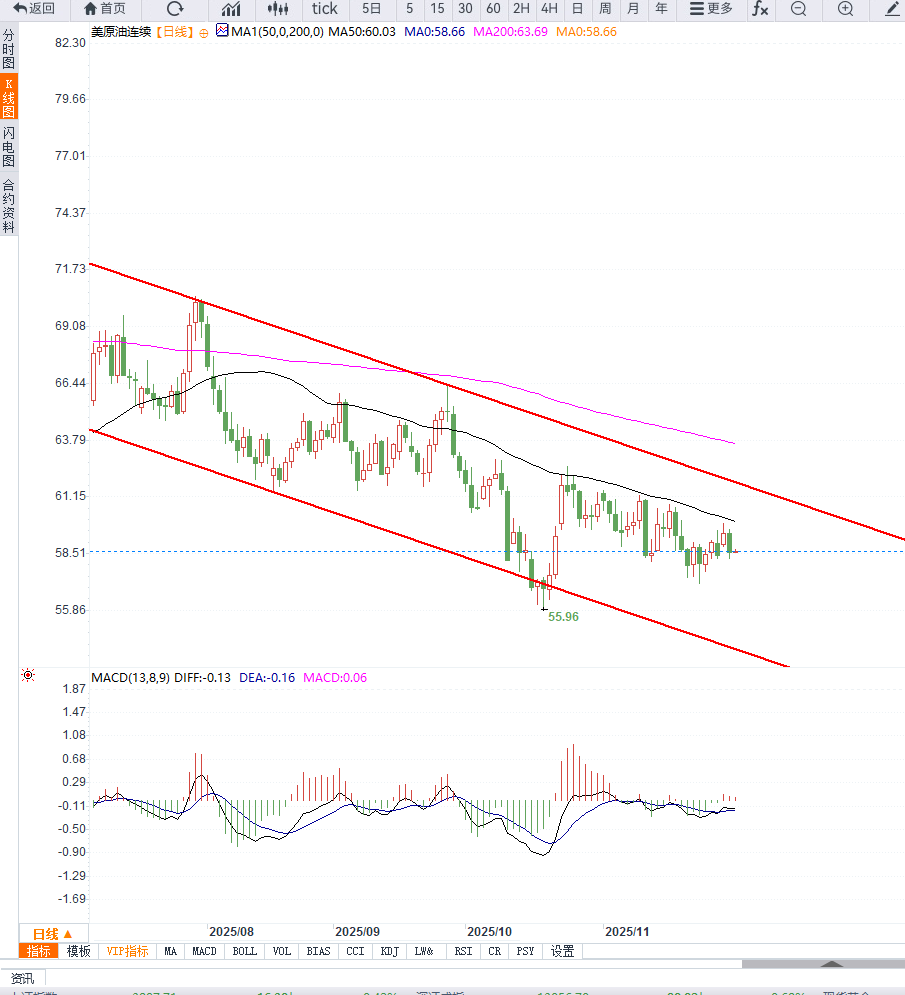
Looking at the WTI daily chart, oil prices have clearly broken through the short-term moving average support zone after falling below the $60 mark, and have touched the lower edge of the trading range that has been in place for the past month. The recent consecutive bearish candles indicate that bearish forces are dominating the market, and the MACD histogram continues to expand below the zero line, reflecting a continued weak trend.
As long as prices remain below $60, the risk of further declines to previous lows remains; however, if new geopolitical disturbances occur, a short-term technical rebound cannot be ruled out. Currently, the overall structure exhibits a weak and volatile pattern.
Editor's Note:
This round of oil price declines not only reflects expectations of a potential "large-scale supply repatriation," but is also suppressed by the reality of an unexpected increase in US inventories. If Russian oil returns to Europe, the impact on refined product and natural gas markets will be greater than on crude oil, and the subsequent effects could be amplified in a chain reaction.
Pay close attention to the progress of negotiations and the direction of sanctions, as they will determine the future supply landscape, and the core logic behind oil price fluctuations will change accordingly. Considering the combined impact of inventory data and geopolitics, oil prices may continue to fluctuate within a range in the current environment. However, if expectations of Russian supply returning to Russia strengthen further, prices may face a greater risk of structural decline.
Robert Yawger, head of energy at Mizuho, said: "Once the sanctions are lifted, Russian energy products will once again choose the route of least resistance, which is Europe."
He emphasized that if Russia fully resumes energy exports, it will have a potential impact on the crude oil, diesel, and natural gas markets, and the reallocation of supply could lead to a new round of changes in the global price system.
Nevertheless, geopolitical voices from Russia have not completely subsided. Russia has stated that it is prepared to respond to challenges from Europe should it be attacked, keeping the situation highly uncertain.
The latest U.S. inventory data shows that U.S. commercial crude oil inventories unexpectedly increased by 2.48 million barrels this week. This contrasts sharply with earlier market expectations of a decline in inventories. Increased inventories are typically seen as a signal of weak demand or oversupply, putting downward pressure on oil prices.
Therefore, even though some analysts still expect inventories to decline, this actual change has partially weakened the support for crude oil prices.
Looking at the WTI daily chart, oil prices have clearly broken through the short-term moving average support zone after falling below the $60 mark, and have touched the lower edge of the trading range that has been in place for the past month. The recent consecutive bearish candles indicate that bearish forces are dominating the market, and the MACD histogram continues to expand below the zero line, reflecting a continued weak trend.
As long as prices remain below $60, the risk of further declines to previous lows remains; however, if new geopolitical disturbances occur, a short-term technical rebound cannot be ruled out. Currently, the overall structure exhibits a weak and volatile pattern.
Editor's Note:
This round of oil price declines not only reflects expectations of a potential "large-scale supply repatriation," but is also suppressed by the reality of an unexpected increase in US inventories. If Russian oil returns to Europe, the impact on refined product and natural gas markets will be greater than on crude oil, and the subsequent effects could be amplified in a chain reaction.
Pay close attention to the progress of negotiations and the direction of sanctions, as they will determine the future supply landscape, and the core logic behind oil price fluctuations will change accordingly. Considering the combined impact of inventory data and geopolitics, oil prices may continue to fluctuate within a range in the current environment. However, if expectations of Russian supply returning to Russia strengthen further, prices may face a greater risk of structural decline.
- Risk Warning and Disclaimer
- The market involves risk, and trading may not be suitable for all investors. This article is for reference only and does not constitute personal investment advice, nor does it take into account certain users’ specific investment objectives, financial situation, or other needs. Any investment decisions made based on this information are at your own risk.