ADP employment unexpectedly declined! Gold gains momentum, US dollar index falls, will the Fed "turn around" earlier than expected next week?
2025-12-03 21:33:03
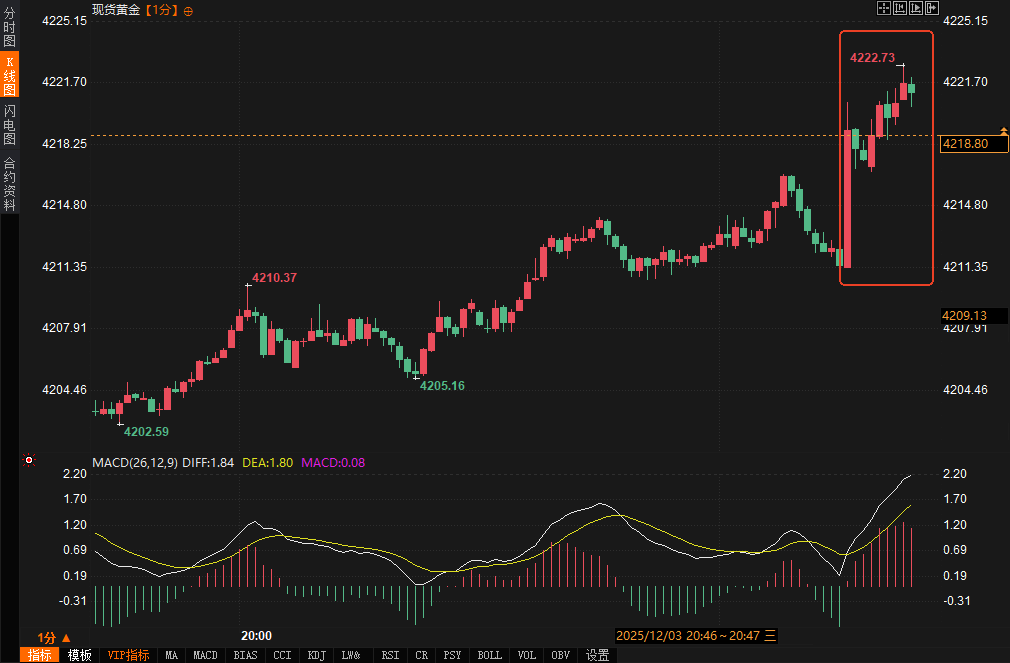
On Wednesday (December 3rd) at 21:15 Beijing time, the US ADP employment report was released, showing that the private sector added 32,000 jobs in November, far below the market expectation of a slight increase of 10,000. This is the worst monthly performance since June 2020, indicating increasing downward pressure on the labor market. After the data release, market expectations for a Federal Reserve rate cut rose significantly, and the US dollar index fell by about 8 points in the short term, hitting a low of 98.8840; spot gold rose by nearly $10 per ounce in the short term, reaching a high of $4221.25 per ounce. US stock futures saw limited volatility, but risk aversion dominated the intraday trend, and investors focused on the impact of this data on the path of macroeconomic policy.

Consumer spending became more cautious, corporate hiring slowed, and geopolitical factors continued to drive safe-haven demand. Meanwhile, the official non-farm payroll data, delayed until December 16th due to the government shutdown, highlighted the importance of the ADP report as a leading indicator. Prior to the data release, the market had lowered its expectations but still hoped for resilient employment to offset signals of declining inflation. However, the actual negative growth disrupted this balance, exacerbating concerns about a shift from a "soft landing" to a "hard landing." Compared to the revised 47,000 new jobs added in October, November saw a 175% decline, with hiring slowing across key sectors such as manufacturing, professional services, information technology, and construction, particularly noticeable in small businesses. This aligns with the ADP report's assertion that "hiring volatility stems from consumer caution and macroeconomic uncertainty," reflecting a potential turning point in economic fundamentals.
The US dollar index quickly fell from around 99.6, briefly dropping below the 99 mark, before barely holding above 98.9 at the close, indicating that traders are repricing the impact of a cooling labor market. Spot gold, however, bucked the trend, rising above $4220 per ounce, with trading volume surging by over 20%, reflecting safe-haven inflows. US stock futures edged lower, with S&P 500 futures down about 0.2%, pressured by tech stocks but without panic selling. This volatility is not isolated but a continuation of recent trends: since late November, the US dollar index has fallen by 3.5%, while gold has risen by 5%, with market focus gradually shifting from inflation to employment.

Analysts believe that negative ADP growth will significantly increase the probability of a December rate cut. Some institutions point out that slowing hiring by small businesses is often a harbinger of a weakening overall job market, consistent with the fact that half of the districts reported weakening employment demand in the Fed's Beige Book. This reinforces the logic that the Fed needs to address downside risks in advance. Before the data release, the CME FedWatch tool showed that the probability of a rate cut had risen from 37% after the October meeting to 87%, and the negative growth result further pushed this probability to nearly 90%. Although there may be disagreements within the Fed, labor market risks have taken precedence.
Retail traders reacted more emotionally. After the data release, there was a widespread belief that the Federal Reserve had "no choice" but to cut interest rates by another 25 basis points, otherwise the economy might accelerate its decline. Unlike the pre-release wait-and-see attitude that "employment may be robust, and a rate cut is still uncertain," sentiment shifted rapidly after the data release, with many believing that "gold bulls are celebrating, and dollar bears are awakening." These immediate reactions spread quickly through social media, further amplifying market volatility.
The labor market showed signs of cooling in November. Although weekly jobless claims declined, the proportion of people struggling to find employment rose in consumer surveys, and the small business employment index improved only slightly. The negative ADP growth is consistent with this trend and aligns with recent statements from Federal Reserve officials regarding "increased downside risks to employment and easing inflationary pressures." Analysts believe that despite potential internal disagreements within the Fed, a dovish stance has prevailed. Meanwhile, the recent core Producer Price Index (PPI) fell to 2.6%, lower than expected, and stabilizing inflation provides the Fed with more policy space. The market logic is clear: weak employment reinforces the Fed's mandate to support employment, while easing inflation concerns prompt funds to flow from the dollar to gold and bonds.
Short-term risk aversion has boosted gold's appeal, while a weaker dollar benefits emerging market assets and commodity currencies. Some institutions have summarized that the ADP data confirmed lackluster job growth in the second half of the year and a continued downward trend in wage growth, which will amplify the effects of the Fed's precautionary easing. Retail investors have felt the shift in sentiment more directly, moving from "expecting slight growth" before the data release to "weak data breaking through support, gold rising." Compared to similar historical situations, the current environment differs in that inflation has stabilized, avoiding exacerbated concerns about "stagflation." From a technical perspective, the downward channel on the dollar index daily chart has been confirmed, and gold technical indicators show strengthening bullish momentum. Overall, the market has shifted from "balanced wait-and-see" to "expecting easing," setting a more dovish tone for next week's Fed meeting.
The market needs to strike a balance between short-term volatility and long-term resilience. While a weakening labor market strengthens expectations of interest rate cuts, subsequent data, such as the ISM Services PMI, still need to be monitored to verify whether the economy is experiencing a broad slowdown. Friday's PCE inflation index will also be key; if core inflation continues to decline, it will solidify the easing path; conversely, it could trigger a market correction. In the long term, the US economy remains resilient: wage growth is still higher than inflation, consumer spending, while cautious, has not collapsed, and the Fed may shift to a more dovish leadership, potentially supporting a recovery in risk assets in 2026. However, in the short term, market divergence may continue: the dollar index may fluctuate between 98.8 and 100, while gold may test the $4200-$4250/ounce range, with upside potential closely tied to the dollar's performance.
While the ADP report delivered a shock, its historical correlation with official non-farm payroll data, as a leading indicator, is less than 60%, suggesting that a more complete picture requires further data verification. Overall, this data serves not only as a warning sign for the job market but also as a catalyst for policy shifts, pushing the market cautiously towards expectations of further easing.
The US economy is currently facing multiple uncertainties.
Consumer spending became more cautious, corporate hiring slowed, and geopolitical factors continued to drive safe-haven demand. Meanwhile, the official non-farm payroll data, delayed until December 16th due to the government shutdown, highlighted the importance of the ADP report as a leading indicator. Prior to the data release, the market had lowered its expectations but still hoped for resilient employment to offset signals of declining inflation. However, the actual negative growth disrupted this balance, exacerbating concerns about a shift from a "soft landing" to a "hard landing." Compared to the revised 47,000 new jobs added in October, November saw a 175% decline, with hiring slowing across key sectors such as manufacturing, professional services, information technology, and construction, particularly noticeable in small businesses. This aligns with the ADP report's assertion that "hiring volatility stems from consumer caution and macroeconomic uncertainty," reflecting a potential turning point in economic fundamentals.
The market reacted swiftly after the data was released.
The US dollar index quickly fell from around 99.6, briefly dropping below the 99 mark, before barely holding above 98.9 at the close, indicating that traders are repricing the impact of a cooling labor market. Spot gold, however, bucked the trend, rising above $4220 per ounce, with trading volume surging by over 20%, reflecting safe-haven inflows. US stock futures edged lower, with S&P 500 futures down about 0.2%, pressured by tech stocks but without panic selling. This volatility is not isolated but a continuation of recent trends: since late November, the US dollar index has fallen by 3.5%, while gold has risen by 5%, with market focus gradually shifting from inflation to employment.
Interpretation by institutions and retail investors
Analysts believe that negative ADP growth will significantly increase the probability of a December rate cut. Some institutions point out that slowing hiring by small businesses is often a harbinger of a weakening overall job market, consistent with the fact that half of the districts reported weakening employment demand in the Fed's Beige Book. This reinforces the logic that the Fed needs to address downside risks in advance. Before the data release, the CME FedWatch tool showed that the probability of a rate cut had risen from 37% after the October meeting to 87%, and the negative growth result further pushed this probability to nearly 90%. Although there may be disagreements within the Fed, labor market risks have taken precedence.
Retail traders reacted more emotionally. After the data release, there was a widespread belief that the Federal Reserve had "no choice" but to cut interest rates by another 25 basis points, otherwise the economy might accelerate its decline. Unlike the pre-release wait-and-see attitude that "employment may be robust, and a rate cut is still uncertain," sentiment shifted rapidly after the data release, with many believing that "gold bulls are celebrating, and dollar bears are awakening." These immediate reactions spread quickly through social media, further amplifying market volatility.
ADP data reinforces the case for a rate cut.
The labor market showed signs of cooling in November. Although weekly jobless claims declined, the proportion of people struggling to find employment rose in consumer surveys, and the small business employment index improved only slightly. The negative ADP growth is consistent with this trend and aligns with recent statements from Federal Reserve officials regarding "increased downside risks to employment and easing inflationary pressures." Analysts believe that despite potential internal disagreements within the Fed, a dovish stance has prevailed. Meanwhile, the recent core Producer Price Index (PPI) fell to 2.6%, lower than expected, and stabilizing inflation provides the Fed with more policy space. The market logic is clear: weak employment reinforces the Fed's mandate to support employment, while easing inflation concerns prompt funds to flow from the dollar to gold and bonds.
The impact on market trends is reflected in several aspects.
Short-term risk aversion has boosted gold's appeal, while a weaker dollar benefits emerging market assets and commodity currencies. Some institutions have summarized that the ADP data confirmed lackluster job growth in the second half of the year and a continued downward trend in wage growth, which will amplify the effects of the Fed's precautionary easing. Retail investors have felt the shift in sentiment more directly, moving from "expecting slight growth" before the data release to "weak data breaking through support, gold rising." Compared to similar historical situations, the current environment differs in that inflation has stabilized, avoiding exacerbated concerns about "stagflation." From a technical perspective, the downward channel on the dollar index daily chart has been confirmed, and gold technical indicators show strengthening bullish momentum. Overall, the market has shifted from "balanced wait-and-see" to "expecting easing," setting a more dovish tone for next week's Fed meeting.
Looking ahead
The market needs to strike a balance between short-term volatility and long-term resilience. While a weakening labor market strengthens expectations of interest rate cuts, subsequent data, such as the ISM Services PMI, still need to be monitored to verify whether the economy is experiencing a broad slowdown. Friday's PCE inflation index will also be key; if core inflation continues to decline, it will solidify the easing path; conversely, it could trigger a market correction. In the long term, the US economy remains resilient: wage growth is still higher than inflation, consumer spending, while cautious, has not collapsed, and the Fed may shift to a more dovish leadership, potentially supporting a recovery in risk assets in 2026. However, in the short term, market divergence may continue: the dollar index may fluctuate between 98.8 and 100, while gold may test the $4200-$4250/ounce range, with upside potential closely tied to the dollar's performance.
While the ADP report delivered a shock, its historical correlation with official non-farm payroll data, as a leading indicator, is less than 60%, suggesting that a more complete picture requires further data verification. Overall, this data serves not only as a warning sign for the job market but also as a catalyst for policy shifts, pushing the market cautiously towards expectations of further easing.
- Risk Warning and Disclaimer
- The market involves risk, and trading may not be suitable for all investors. This article is for reference only and does not constitute personal investment advice, nor does it take into account certain users’ specific investment objectives, financial situation, or other needs. Any investment decisions made based on this information are at your own risk.