With global central banks joining forces to "encircle and suppress" the dollar, can it stage a dramatic comeback after its sharp decline?
2025-12-03 21:57:11
On Wednesday (December 3), during the Asian and European sessions, the US dollar index fell steadily throughout the day, finally accelerating its decline towards the end of the session due to weaker-than-expected ADP data. It is currently trading at 98.93 (-0.38%), having fallen as low as 98.88 during the session.
First, the Reserve Bank of New Zealand announced a hawkish rate cut, which was seen as the rate could be lowered as far as it could go, and the New Zealand dollar rebounded significantly. Then, the Bank of England's unexpected fiscal plan and its drastic tax increase policy officially declared war on high government debt, igniting a rebound in the pound. After that, the European Central Bank repeatedly confirmed that there was no possibility of a rate cut until next year, and the euro took over the rebound. Finally, the Bank of Japan finished by announcing that it would start raising interest rates, and the US dollar index was unable to withstand the combined pressure from all sides.
Judging from the current situation of the war between Russia and Ukraine, Russia has successively gained control of key strategic areas, which has greatly improved its bargaining power in peace negotiations and also indicates that the Russia-Ukraine conflict is nearing its end. Coupled with the recent frequent peace negotiations, the demand for safe-haven assets has decreased.
Influenced by Trump's comments on Tuesday specifically naming Hassett, the probability of Kevin Hassett becoming the Federal Reserve Chairman continues to rise. As the director of the National Economic Council, Hassett has the closest ties to Donald Trump and is the leading candidate for the Fed chairmanship. According to Kalshi platform pricing, Hassett's probability of being elected has reached 82%, while Kevin Walsh and Christopher Waller's estimated probabilities are 10% and 4%, respectively.
With the dovish camp dominating the Federal Open Market Committee (FOMC), the potential risks of aggressive monetary easing are accumulating. Futures market pricing indicates a 74% probability that the federal funds rate will fall to 3.25% by the end of 2026, and a 45% probability that it will fall to 3%.
The U.S. Institute for Supply Management (ISM) Manufacturing Purchasing Managers' Index (PMI), released on Monday, fell below the 50-point threshold for the ninth consecutive month, reflecting a contraction in industry activity. This further highlights the negative impact of tariff policies on the U.S. economy. However, thanks to large-scale capital investment in artificial intelligence technology, the economic damage is less severe than market expectations.
Meanwhile, the newly released US ADP data showed that sectoral employment decreased by 32,000, significantly lower than the expected increase of 10,000. In addition, the US retroactively released September import price index data showed a month-on-month decrease of 0.1%, which was lower than expected, easing some of the pressure from imported inflation.
Europe is struggling to compete with the US in the artificial intelligence race. Electricity costs for the continental European AI industry are approximately twice that of the US, posing a significant competitive disadvantage. Only by significantly narrowing this cost gap can market expectations be fundamentally reversed, thereby boosting the confidence of EUR/USD bulls.
Summary and Conclusion: The US dollar index has recently experienced a rapid pullback due to multiple pressures. However, the US's clear competitive advantage in the AI field and crowded short-selling transactions have caused the dollar index to quickly pull back to key price levels, suggesting a one-step adjustment for the dollar.
The US dollar index has touched the long-term trading center of 98.87, which is also the intermediate breakout point of this wave of dollar index rise. The dollar index should be starting a rebound.
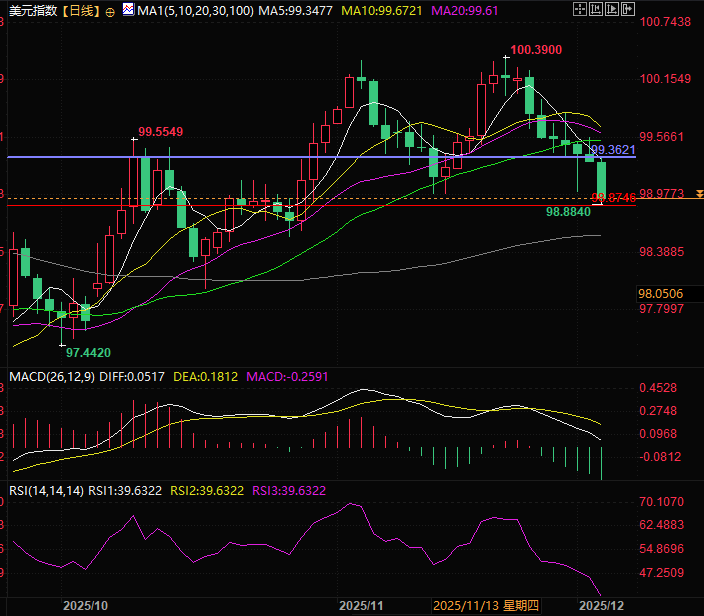
(US Dollar Index Daily Chart, Source: FX678)
At 21:56 Beijing time, the US dollar index is currently at 98.97.
Major central banks around the world collectively besiege the US dollar.
First, the Reserve Bank of New Zealand announced a hawkish rate cut, which was seen as the rate could be lowered as far as it could go, and the New Zealand dollar rebounded significantly. Then, the Bank of England's unexpected fiscal plan and its drastic tax increase policy officially declared war on high government debt, igniting a rebound in the pound. After that, the European Central Bank repeatedly confirmed that there was no possibility of a rate cut until next year, and the euro took over the rebound. Finally, the Bank of Japan finished by announcing that it would start raising interest rates, and the US dollar index was unable to withstand the combined pressure from all sides.
The easing of the Russia-Ukraine conflict has reduced demand for the US dollar as a safe haven.
Judging from the current situation of the war between Russia and Ukraine, Russia has successively gained control of key strategic areas, which has greatly improved its bargaining power in peace negotiations and also indicates that the Russia-Ukraine conflict is nearing its end. Coupled with the recent frequent peace negotiations, the demand for safe-haven assets has decreased.
Federal Reserve personnel: Hassett leads the race for chairman
Influenced by Trump's comments on Tuesday specifically naming Hassett, the probability of Kevin Hassett becoming the Federal Reserve Chairman continues to rise. As the director of the National Economic Council, Hassett has the closest ties to Donald Trump and is the leading candidate for the Fed chairmanship. According to Kalshi platform pricing, Hassett's probability of being elected has reached 82%, while Kevin Walsh and Christopher Waller's estimated probabilities are 10% and 4%, respectively.
With the dovish camp dominating the Federal Open Market Committee (FOMC), the potential risks of aggressive monetary easing are accumulating. Futures market pricing indicates a 74% probability that the federal funds rate will fall to 3.25% by the end of 2026, and a 45% probability that it will fall to 3%.
Recent weak US economic data has spurred interest rate cuts and put downward pressure on the dollar.
The U.S. Institute for Supply Management (ISM) Manufacturing Purchasing Managers' Index (PMI), released on Monday, fell below the 50-point threshold for the ninth consecutive month, reflecting a contraction in industry activity. This further highlights the negative impact of tariff policies on the U.S. economy. However, thanks to large-scale capital investment in artificial intelligence technology, the economic damage is less severe than market expectations.
Meanwhile, the newly released US ADP data showed that sectoral employment decreased by 32,000, significantly lower than the expected increase of 10,000. In addition, the US retroactively released September import price index data showed a month-on-month decrease of 0.1%, which was lower than expected, easing some of the pressure from imported inflation.
The competition in the AI field is unbalanced in Europe and the United States: Europe's electricity costs have doubled, putting it at a significant competitive disadvantage.
Europe is struggling to compete with the US in the artificial intelligence race. Electricity costs for the continental European AI industry are approximately twice that of the US, posing a significant competitive disadvantage. Only by significantly narrowing this cost gap can market expectations be fundamentally reversed, thereby boosting the confidence of EUR/USD bulls.
Summary and Conclusion: The US dollar index has recently experienced a rapid pullback due to multiple pressures. However, the US's clear competitive advantage in the AI field and crowded short-selling transactions have caused the dollar index to quickly pull back to key price levels, suggesting a one-step adjustment for the dollar.
The US dollar index has touched the long-term trading center of 98.87, which is also the intermediate breakout point of this wave of dollar index rise. The dollar index should be starting a rebound.
(US Dollar Index Daily Chart, Source: FX678)
At 21:56 Beijing time, the US dollar index is currently at 98.97.
- Risk Warning and Disclaimer
- The market involves risk, and trading may not be suitable for all investors. This article is for reference only and does not constitute personal investment advice, nor does it take into account certain users’ specific investment objectives, financial situation, or other needs. Any investment decisions made based on this information are at your own risk.