Trump publicly pressures Zelensky: "He hasn't even looked at my proposal!" The rift between the US and Ukraine deepens.
2025-12-09 08:57:50
Tensions between Trump and Ukrainian President Volodymyr Zelensky have escalated again, with the US president accusing Zelensky of not even having read the peace proposal put forward by the US.
Trump told reporters on Sunday evening (December 7) local time: "I am somewhat disappointed because President Zelensky has not yet seen the proposal, which was just a few hours ago."
Trump added, "His people like it, but he hasn't seen it." Trump said, "I think Russia would rather have the whole country, but Russia is okay with it, but I'm not sure if Zelensky would be okay with it too."
It is unclear which version of the US-backed Russia-Ukraine peace plan Trump was referring to, but the president's remarks came a day after talks between US and Ukrainian officials in Miami concluded without reaching an agreement on the latest version of the draft peace plan.
Several versions of the so-called peace plan have emerged as Russia and Ukraine have negotiated key details through US intermediaries, particularly Russia's demands for territorial concessions and security guarantees from Ukraine.
Outgoing Ukrainian envoy Keith Kellogg said on Sunday that an agreement to end the conflict is “very close,” depending on the resolution of two major outstanding issues: the future of the Donbas region in eastern Ukraine (where Russian troops have extensively occupied) and the Zaporizhia nuclear power plant in southern Ukraine, which is under Russian control.
Zelensky was more cautious in his assessment of the talks' progress, stating in a speech Sunday night that the talks in Miami were "constructive, though not easy." Zelensky said he would personally brief the negotiating team in detail, rather than by phone, and pointedly noted that "some things can only be discussed face-to-face."
Ukrainian President Volodymyr Zelenskyy traveled to London on Monday for talks. Kyiv and its European allies are taking urgent steps to ensure that Ukraine's territorial integrity and future security (as well as Europe's security) are not jeopardized by increasing pressure from the United States, which is demanding that Ukraine agree to a peace proposal initially seen as highly favorable to Russia.
Downing Street said on Sunday that Zelenskyy would hold talks with British Prime Minister Keir Starmer, French President Emmanuel Macron, and German Chancellor Friedrich Merz, "focusing on the ongoing peace negotiations and next steps." Zelenskyy will also travel to Brussels and Rome this week for further talks.
With European allies excluded from the US-led peace talks in Ukraine, European nations are eager to demonstrate their presence and participate in the decision-making process—especially given the profound impact any peace agreement would have on the overall security landscape of the continent. Britain and France have been key proponents of the "Alliance of Will," whose members may form a "security guarantee force" in postwar Ukraine to assist in maintaining its security.
Russia strongly opposes the deployment of foreign troops in Ukraine, with President Vladimir Putin warning that these forces would become “legitimate targets.” Following the Trump administration’s release of its new National Security Strategy last Friday, European leaders’ concerns have intensified that the US might be inclined to compromise with Russian demands. The document declares that Europe faces a “risk of civilizational extinction,” questions the ability of European countries to “continue as reliable allies,” and explicitly states that Washington should rebuild a strategically stable relationship with Russia. The Kremlin praised the strategy on Sunday, saying it “fundamentally aligns with Russia’s vision.”
Although both the US and Russia hope for a future easing of tensions, differences remain regarding an immediate peace agreement between Russia and Ukraine. Last week's talks between Vitkov, Kushner, and Russian officials in Moscow also failed to yield a breakthrough. Russian presidential aide Yuri Ushakov told reporters that the discussions were "very beneficial, constructive, and informative," but emphasized that "a great deal of work remains to be done."
The Kremlin also commented on Trump's criticism of Zelensky. Russian Presidential Press Secretary Dmitry Peskov told reporters on Monday, "We are not clear on the specific differences. What is important to us is that Putin did a great deal of meticulous work during and after his meeting with Vitkov and Kushner in Moscow, and Vitkov and Kushner subsequently continued to work with the Ukrainian negotiating delegation led by Umerov, based on the outcomes of the Moscow talks."
In a statement translated by NBC News, he said: “Right now we need to understand the progress of this work. Clearly, both sides now understand that this kind of work needs to proceed quietly. This kind of work cannot be done entirely openly, otherwise it would be counterproductive. Most importantly, openness would hinder progress. Therefore, we look forward to receiving relevant information. Once we have the information, the situation will become clear.”
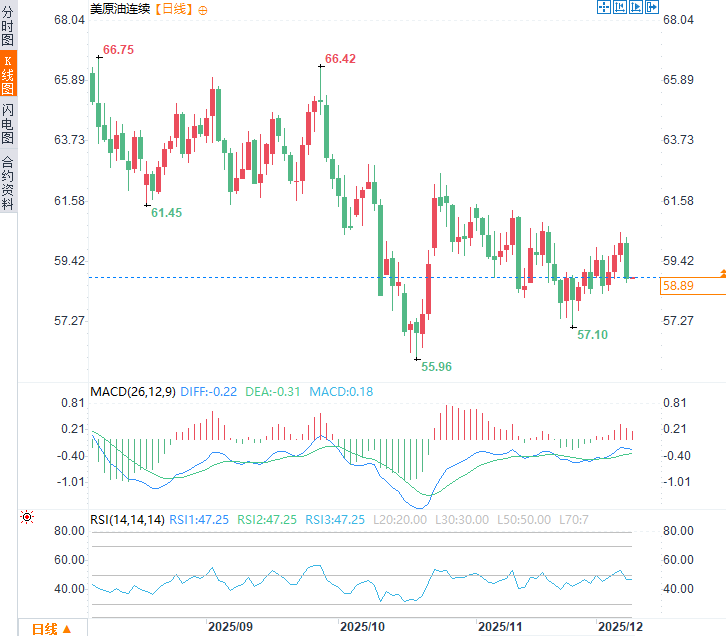
(US crude oil daily chart, source: FX678)
The Russia-Ukraine conflict has been one of the key geopolitical factors supporting high international oil prices since 2022. Any progress or setbacks in peace negotiations will directly affect oil prices by altering market expectations of global oil supply risks.
At this stage, news surrounding the Russia-Ukraine peace talks is likely to lead to a cautious sentiment in the crude oil market amid high volatility. On Tuesday, US crude oil fluctuated around $58.88 per barrel.
In the short term, oil prices may be caught in a tug-of-war between "expectations of peace" and the "reality of a stalemate." Any signs of substantial progress in negotiations will put downward pressure on oil prices; while any news of a breakdown in negotiations, widening differences, or escalation of military action will quickly push up oil prices.
Trump’s rhetoric and U.S. pressure are more about creating a narrative that “peace talks may come soon,” but resistance from Europe, Ukraine’s position, and Russia’s demands constitute solid, real obstacles.
At 8:57 AM Beijing time, US crude oil futures were trading at $58.89 per barrel.
Trump told reporters on Sunday evening (December 7) local time: "I am somewhat disappointed because President Zelensky has not yet seen the proposal, which was just a few hours ago."
Trump added, "His people like it, but he hasn't seen it." Trump said, "I think Russia would rather have the whole country, but Russia is okay with it, but I'm not sure if Zelensky would be okay with it too."
It is unclear which version of the US-backed Russia-Ukraine peace plan Trump was referring to, but the president's remarks came a day after talks between US and Ukrainian officials in Miami concluded without reaching an agreement on the latest version of the draft peace plan.
Several versions of the so-called peace plan have emerged as Russia and Ukraine have negotiated key details through US intermediaries, particularly Russia's demands for territorial concessions and security guarantees from Ukraine.
Outgoing Ukrainian envoy Keith Kellogg said on Sunday that an agreement to end the conflict is “very close,” depending on the resolution of two major outstanding issues: the future of the Donbas region in eastern Ukraine (where Russian troops have extensively occupied) and the Zaporizhia nuclear power plant in southern Ukraine, which is under Russian control.
Zelensky was more cautious in his assessment of the talks' progress, stating in a speech Sunday night that the talks in Miami were "constructive, though not easy." Zelensky said he would personally brief the negotiating team in detail, rather than by phone, and pointedly noted that "some things can only be discussed face-to-face."
The talks moved to London
Ukrainian President Volodymyr Zelenskyy traveled to London on Monday for talks. Kyiv and its European allies are taking urgent steps to ensure that Ukraine's territorial integrity and future security (as well as Europe's security) are not jeopardized by increasing pressure from the United States, which is demanding that Ukraine agree to a peace proposal initially seen as highly favorable to Russia.
Downing Street said on Sunday that Zelenskyy would hold talks with British Prime Minister Keir Starmer, French President Emmanuel Macron, and German Chancellor Friedrich Merz, "focusing on the ongoing peace negotiations and next steps." Zelenskyy will also travel to Brussels and Rome this week for further talks.
With European allies excluded from the US-led peace talks in Ukraine, European nations are eager to demonstrate their presence and participate in the decision-making process—especially given the profound impact any peace agreement would have on the overall security landscape of the continent. Britain and France have been key proponents of the "Alliance of Will," whose members may form a "security guarantee force" in postwar Ukraine to assist in maintaining its security.
Russia strongly opposes the deployment of foreign troops in Ukraine, with President Vladimir Putin warning that these forces would become “legitimate targets.” Following the Trump administration’s release of its new National Security Strategy last Friday, European leaders’ concerns have intensified that the US might be inclined to compromise with Russian demands. The document declares that Europe faces a “risk of civilizational extinction,” questions the ability of European countries to “continue as reliable allies,” and explicitly states that Washington should rebuild a strategically stable relationship with Russia. The Kremlin praised the strategy on Sunday, saying it “fundamentally aligns with Russia’s vision.”
Although both the US and Russia hope for a future easing of tensions, differences remain regarding an immediate peace agreement between Russia and Ukraine. Last week's talks between Vitkov, Kushner, and Russian officials in Moscow also failed to yield a breakthrough. Russian presidential aide Yuri Ushakov told reporters that the discussions were "very beneficial, constructive, and informative," but emphasized that "a great deal of work remains to be done."
The Kremlin also commented on Trump's criticism of Zelensky. Russian Presidential Press Secretary Dmitry Peskov told reporters on Monday, "We are not clear on the specific differences. What is important to us is that Putin did a great deal of meticulous work during and after his meeting with Vitkov and Kushner in Moscow, and Vitkov and Kushner subsequently continued to work with the Ukrainian negotiating delegation led by Umerov, based on the outcomes of the Moscow talks."
In a statement translated by NBC News, he said: “Right now we need to understand the progress of this work. Clearly, both sides now understand that this kind of work needs to proceed quietly. This kind of work cannot be done entirely openly, otherwise it would be counterproductive. Most importantly, openness would hinder progress. Therefore, we look forward to receiving relevant information. Once we have the information, the situation will become clear.”
(US crude oil daily chart, source: FX678)
The Russia-Ukraine conflict has been one of the key geopolitical factors supporting high international oil prices since 2022. Any progress or setbacks in peace negotiations will directly affect oil prices by altering market expectations of global oil supply risks.
At this stage, news surrounding the Russia-Ukraine peace talks is likely to lead to a cautious sentiment in the crude oil market amid high volatility. On Tuesday, US crude oil fluctuated around $58.88 per barrel.
In the short term, oil prices may be caught in a tug-of-war between "expectations of peace" and the "reality of a stalemate." Any signs of substantial progress in negotiations will put downward pressure on oil prices; while any news of a breakdown in negotiations, widening differences, or escalation of military action will quickly push up oil prices.
Trump’s rhetoric and U.S. pressure are more about creating a narrative that “peace talks may come soon,” but resistance from Europe, Ukraine’s position, and Russia’s demands constitute solid, real obstacles.
At 8:57 AM Beijing time, US crude oil futures were trading at $58.89 per barrel.
- Risk Warning and Disclaimer
- The market involves risk, and trading may not be suitable for all investors. This article is for reference only and does not constitute personal investment advice, nor does it take into account certain users’ specific investment objectives, financial situation, or other needs. Any investment decisions made based on this information are at your own risk.