Gold prices rose, while silver surged to a new all-time high.
2025-12-11 22:33:18
Gold prices held firm in early U.S. trading on Thursday (December 11). Silver surged, hitting a new record high overnight. Both precious metals are seeing more technical buying and benefiting from the Federal Reserve's unexpectedly dovish stance (which some analysts interpret as hawkish). February gold futures (COMEX gold futures are generally priced a dozen dollars higher than spot gold) rose $20.40 to $4,245.00 an ounce. March silver futures rose $1.446 to $62.47 an ounce.
The Federal Reserve's unexpectedly dovish stance caught the market off guard. The Federal Open Market Committee (FOMC) announced a 0.25% interest rate cut on Wednesday afternoon, entirely within market expectations, marking the third consecutive 25-basis-point rate cut at the FOMC meeting. The FOMC voted 9-3 to lower the benchmark federal funds rate by 25 basis points to a range of 3.5%-3.75%. The FOMC statement hinted at greater uncertainty regarding when the Fed would cut rates again. The Fed also surprised the market by announcing it would begin purchasing $40 billion in U.S. Treasury bills monthly starting Friday to further reduce short-term funding costs by rebuilding reserves in the financial system. In recent months, the money market has been signaling that the $12.6 trillion market is facing accumulating pressure as the Fed shrinks its balance sheet. Following the FOMC meeting and Fed Chairman Powell's press conference Wednesday afternoon, U.S. stock indices rose, U.S. Treasury yields fell, the dollar index declined, and gold and silver prices increased. In the days leading up to this week's FOMC meeting, most market observers believed that while a rate cut was expected, the Federal Reserve and Powell would adopt a slightly more hawkish tone on US monetary policy. However, the market interpreted the Fed's dovish move to purchase US Treasury bonds as overshadowing any other Fed comments that might be perceived as hawkish.
Global stock markets mostly weakened overnight. U.S. stock indices opened lower when New York's daytime trading session began.
In other news, Chinese economic policymakers have pledged supportive monetary and fiscal policies, hinting at interest rate cuts and maintaining a substantial budget deficit. An official summary released Thursday following the Central Economic Work Conference indicated that the leadership will use interest rate and reserve requirement ratio cuts "flexibly and efficiently" to ensure ample liquidity. The conference set the economic policy priorities for the coming year. The government will also continue its "moderately loose" monetary policy stance. Bloomberg reported that the summary indicated policy will focus on a "reasonable recovery in prices."
The IEA has lowered its forecast for a global oil supply glut. The International Energy Agency (IEA) has reduced its estimates for a global oil supply glut this year and next, citing stronger demand and slower production growth. World oil supply will now exceed demand by 3.815 million barrels per day in 2026, a decrease of 231,000 barrels per day from the IEA's estimate last month. This revision reflects several factors, including OPEC+'s decision to pause production increases, a slight downward revision of production forecasts for the cartel's competitors, and a stronger global oil consumption outlook.
In key external markets today, the US dollar index fell and hit a six-week low. Crude oil prices declined, trading around $57.75 per barrel. The benchmark 10-year US Treasury yield is currently at 4.14%.
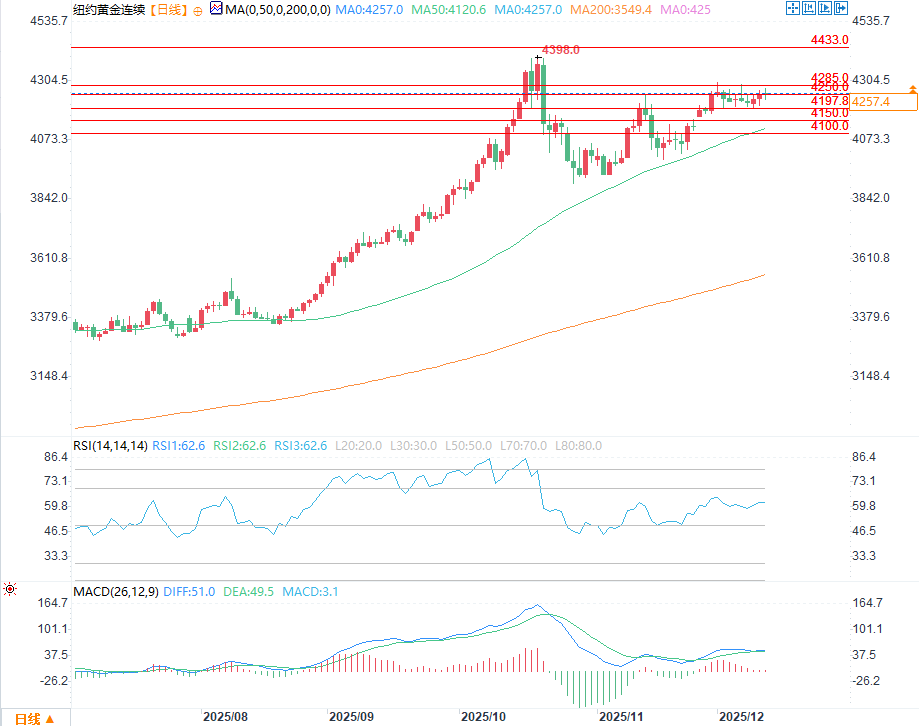
(COMEX Gold Daily Chart Source: FX678)
From a technical perspective, the next upside price target for February gold futures bulls is to close above the solid resistance level of $4,433.00, the contract/historical high. The next near-term downside price target for bears is to push futures prices below the solid technical support level of $4,100.00. Initial resistance is seen at the overnight high of $4,277.70, followed by $4,300.00. Initial support is seen at the overnight low of $4,231.20, followed by the week's low of $4,197.80.
March silver futures have broken out of a bullish flag pattern on the daily chart. The bulls' next upside target is a close above the solid technical resistance level of $70.00. The bears' next downside target is a close below the solid support level of $57.00. Initial resistance is seen at the overnight contract/all-time high of $63.25, followed by $64.00. The next support levels are seen at $61.00, followed by $60.00.
Note: The gold market operates through two main pricing mechanisms. The first is the spot market, which provides quotes for immediate purchase and delivery. The second is the futures market, which sets prices for delivery on a future date. Due to year-end position adjustments and market liquidity, the December gold futures contract is currently the most actively traded contract on the Chicago Mercantile Exchange.
The Federal Reserve's unexpectedly dovish stance caught the market off guard. The Federal Open Market Committee (FOMC) announced a 0.25% interest rate cut on Wednesday afternoon, entirely within market expectations, marking the third consecutive 25-basis-point rate cut at the FOMC meeting. The FOMC voted 9-3 to lower the benchmark federal funds rate by 25 basis points to a range of 3.5%-3.75%. The FOMC statement hinted at greater uncertainty regarding when the Fed would cut rates again. The Fed also surprised the market by announcing it would begin purchasing $40 billion in U.S. Treasury bills monthly starting Friday to further reduce short-term funding costs by rebuilding reserves in the financial system. In recent months, the money market has been signaling that the $12.6 trillion market is facing accumulating pressure as the Fed shrinks its balance sheet. Following the FOMC meeting and Fed Chairman Powell's press conference Wednesday afternoon, U.S. stock indices rose, U.S. Treasury yields fell, the dollar index declined, and gold and silver prices increased. In the days leading up to this week's FOMC meeting, most market observers believed that while a rate cut was expected, the Federal Reserve and Powell would adopt a slightly more hawkish tone on US monetary policy. However, the market interpreted the Fed's dovish move to purchase US Treasury bonds as overshadowing any other Fed comments that might be perceived as hawkish.
Global stock markets mostly weakened overnight. U.S. stock indices opened lower when New York's daytime trading session began.
In other news, Chinese economic policymakers have pledged supportive monetary and fiscal policies, hinting at interest rate cuts and maintaining a substantial budget deficit. An official summary released Thursday following the Central Economic Work Conference indicated that the leadership will use interest rate and reserve requirement ratio cuts "flexibly and efficiently" to ensure ample liquidity. The conference set the economic policy priorities for the coming year. The government will also continue its "moderately loose" monetary policy stance. Bloomberg reported that the summary indicated policy will focus on a "reasonable recovery in prices."
The IEA has lowered its forecast for a global oil supply glut. The International Energy Agency (IEA) has reduced its estimates for a global oil supply glut this year and next, citing stronger demand and slower production growth. World oil supply will now exceed demand by 3.815 million barrels per day in 2026, a decrease of 231,000 barrels per day from the IEA's estimate last month. This revision reflects several factors, including OPEC+'s decision to pause production increases, a slight downward revision of production forecasts for the cartel's competitors, and a stronger global oil consumption outlook.
In key external markets today, the US dollar index fell and hit a six-week low. Crude oil prices declined, trading around $57.75 per barrel. The benchmark 10-year US Treasury yield is currently at 4.14%.
(COMEX Gold Daily Chart Source: FX678)
From a technical perspective, the next upside price target for February gold futures bulls is to close above the solid resistance level of $4,433.00, the contract/historical high. The next near-term downside price target for bears is to push futures prices below the solid technical support level of $4,100.00. Initial resistance is seen at the overnight high of $4,277.70, followed by $4,300.00. Initial support is seen at the overnight low of $4,231.20, followed by the week's low of $4,197.80.
March silver futures have broken out of a bullish flag pattern on the daily chart. The bulls' next upside target is a close above the solid technical resistance level of $70.00. The bears' next downside target is a close below the solid support level of $57.00. Initial resistance is seen at the overnight contract/all-time high of $63.25, followed by $64.00. The next support levels are seen at $61.00, followed by $60.00.
Note: The gold market operates through two main pricing mechanisms. The first is the spot market, which provides quotes for immediate purchase and delivery. The second is the futures market, which sets prices for delivery on a future date. Due to year-end position adjustments and market liquidity, the December gold futures contract is currently the most actively traded contract on the Chicago Mercantile Exchange.
- Risk Warning and Disclaimer
- The market involves risk, and trading may not be suitable for all investors. This article is for reference only and does not constitute personal investment advice, nor does it take into account certain users’ specific investment objectives, financial situation, or other needs. Any investment decisions made based on this information are at your own risk.