US Dollar Outlook: Rate Cuts and Weak Data Trigger Expectations Reassessment, Dollar Continues to Decline
2025-12-12 01:07:22
On Thursday (December 11), during the US trading session, the US dollar index continued its downward trend, falling sharply for the second consecutive trading day after breaking below the 50-day moving average of 99.222. This decline pushed the index further into the range from September to November (96.218-100.395), and the price is currently testing a key retracement level that previously supported medium-term buying. This movement reflects the combined pressure on the dollar from the weakening of US Treasury yields following the Fed's rate cut this week and the market's repricing of expectations for Fed policy.

The dollar faced further selling pressure as Treasury yields fell across the board and a surge in weekly initial jobless claims prompted traders to reassess the U.S. economic growth outlook. The dollar index touched a low of 98.212 during the day, and its future direction will depend on the market's reaction to the 50% retracement level of 98.307.
Federal Reserve rate cuts, a weak labor market, and declining yields are putting triple pressure on the US dollar.
The Federal Reserve cut its overnight interest rate to a range of 3.5%-3.75%, a decision opposed by three committee members. This disagreement led traders to believe that the rate cut would offer limited support for future easing policies. Fed Chairman Powell emphasized that the Fed is prepared to wait for more data to corroborate its decisions before adjusting policy again. Meanwhile, the Fed's forecast of only one rate cut in 2026 further reinforced the signal of a slowdown in the pace of easing. For the dollar index, weakening yield support coupled with uncertainty surrounding the Fed's policy path is eroding its carry trade advantage.
Concerns about the labor market further exacerbated the downward pressure on the dollar. Initial jobless claims surged to 236,000, far exceeding market expectations, prompting traders to reassess short-term economic fundamentals. A weakening labor market typically increases the likelihood of further policy easing by the Federal Reserve, thus putting downward pressure on the dollar.
A weak dollar dominated the market, with foreign exchange funds flowing into the euro and the pound.
Despite a relatively light UK economic data calendar, the pound held onto its recent gains against the dollar, trading around $1.2288, influenced by weak US economic fundamentals. Even with market expectations of a Bank of England rate cut next week, the pound still benefited from dollar outflows.
Meanwhile, market expectations that the European Central Bank may raise interest rates in the second half of next year boosted the euro, with the euro-pound exchange rate rising to 0.8751. Increased cross-rate inflows into the euro, coupled with stable pound positions, jointly suppressed market demand for the dollar.
Treasury yields fell, and the dollar lost key support.
U.S. Treasury yields fell across the board on Thursday, with the 10-year Treasury yield at 4.118%, the 2-year at 3.515%, and the 30-year at 4.761%. Lower yields reduced the relative returns of U.S. assets, prompting global investors to shift to other markets, thus putting pressure on the dollar. Weak economic data coupled with the Federal Reserve's cautious policy statements boosted market risk appetite, further weakening inflows into the dollar as a safe-haven asset.
Key technical level: The 98.307-97.814 range is attracting buying attention.
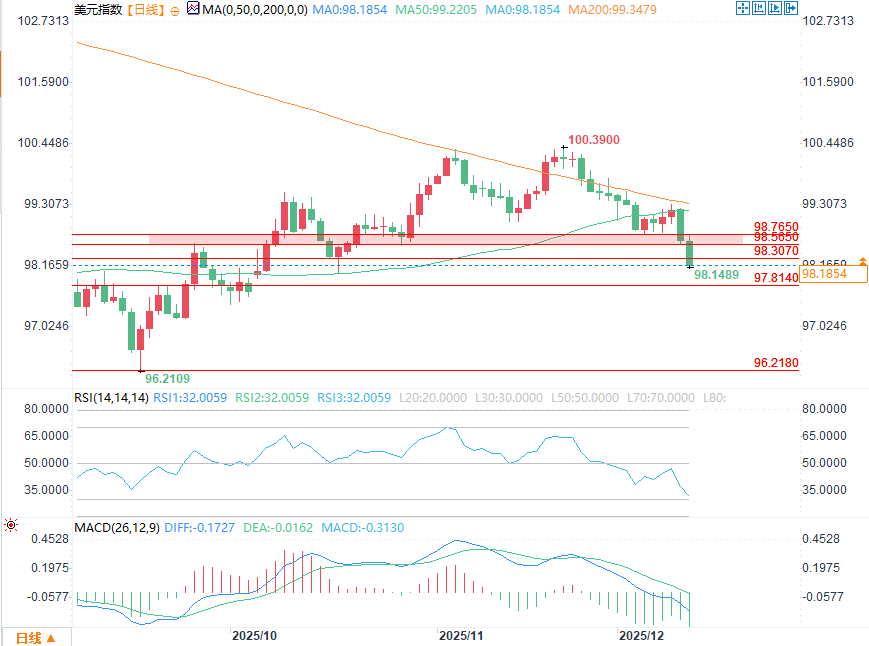
The US dollar index is currently testing the range of 98.307 (50% retracement) to 97.814 (61.8% retracement), a range considered a value area by some traders. The index touched a low of 98.212 during the day, and its short-term movement will depend on whether buying can hold the key level of 98.307. If this level can be effectively held, the dollar's downward momentum may slow; conversely, if it fails to recover this level, the index will continue to be under pressure.
Short-term outlook: Unless 98.307 holds, the bearish trend for the US dollar is unlikely to change.
Judging from factors such as declining Treasury yields, weak US economic data, and the dollar index falling below its 50-day moving average, the short-term trend of the dollar index is bearish, unless buying can regain control of 98.307.
At 01:05 Beijing time, the US dollar index was at 98.1547/1793, down 0.49%.
The dollar faced further selling pressure as Treasury yields fell across the board and a surge in weekly initial jobless claims prompted traders to reassess the U.S. economic growth outlook. The dollar index touched a low of 98.212 during the day, and its future direction will depend on the market's reaction to the 50% retracement level of 98.307.
Federal Reserve rate cuts, a weak labor market, and declining yields are putting triple pressure on the US dollar.
The Federal Reserve cut its overnight interest rate to a range of 3.5%-3.75%, a decision opposed by three committee members. This disagreement led traders to believe that the rate cut would offer limited support for future easing policies. Fed Chairman Powell emphasized that the Fed is prepared to wait for more data to corroborate its decisions before adjusting policy again. Meanwhile, the Fed's forecast of only one rate cut in 2026 further reinforced the signal of a slowdown in the pace of easing. For the dollar index, weakening yield support coupled with uncertainty surrounding the Fed's policy path is eroding its carry trade advantage.
Concerns about the labor market further exacerbated the downward pressure on the dollar. Initial jobless claims surged to 236,000, far exceeding market expectations, prompting traders to reassess short-term economic fundamentals. A weakening labor market typically increases the likelihood of further policy easing by the Federal Reserve, thus putting downward pressure on the dollar.
A weak dollar dominated the market, with foreign exchange funds flowing into the euro and the pound.
Despite a relatively light UK economic data calendar, the pound held onto its recent gains against the dollar, trading around $1.2288, influenced by weak US economic fundamentals. Even with market expectations of a Bank of England rate cut next week, the pound still benefited from dollar outflows.
Meanwhile, market expectations that the European Central Bank may raise interest rates in the second half of next year boosted the euro, with the euro-pound exchange rate rising to 0.8751. Increased cross-rate inflows into the euro, coupled with stable pound positions, jointly suppressed market demand for the dollar.
Treasury yields fell, and the dollar lost key support.
U.S. Treasury yields fell across the board on Thursday, with the 10-year Treasury yield at 4.118%, the 2-year at 3.515%, and the 30-year at 4.761%. Lower yields reduced the relative returns of U.S. assets, prompting global investors to shift to other markets, thus putting pressure on the dollar. Weak economic data coupled with the Federal Reserve's cautious policy statements boosted market risk appetite, further weakening inflows into the dollar as a safe-haven asset.
Key technical level: The 98.307-97.814 range is attracting buying attention.
The US dollar index is currently testing the range of 98.307 (50% retracement) to 97.814 (61.8% retracement), a range considered a value area by some traders. The index touched a low of 98.212 during the day, and its short-term movement will depend on whether buying can hold the key level of 98.307. If this level can be effectively held, the dollar's downward momentum may slow; conversely, if it fails to recover this level, the index will continue to be under pressure.
Short-term outlook: Unless 98.307 holds, the bearish trend for the US dollar is unlikely to change.
Judging from factors such as declining Treasury yields, weak US economic data, and the dollar index falling below its 50-day moving average, the short-term trend of the dollar index is bearish, unless buying can regain control of 98.307.
At 01:05 Beijing time, the US dollar index was at 98.1547/1793, down 0.49%.
- Risk Warning and Disclaimer
- The market involves risk, and trading may not be suitable for all investors. This article is for reference only and does not constitute personal investment advice, nor does it take into account certain users’ specific investment objectives, financial situation, or other needs. Any investment decisions made based on this information are at your own risk.