Crude oil trading alert: A slight rebound in the US dollar is putting pressure on oil prices. In the short term, continue to focus on inventory data and await a directional move.
2025-12-10 10:00:19
WTI crude oil traded around $58.40 in Asian trading on Wednesday, with market sentiment cautious under the dual pressures of a strong dollar and supply recovery. The latest US jobs data, significantly better than expected, caused a temporary rebound in the dollar, directly weakening the performance of dollar-denominated commodity prices.
According to the latest JOLTS report released by the U.S. Bureau of Labor Statistics, job openings reached 7.658 million in September and 7.67 million in October, both higher than market expectations, indicating that the U.S. labor market remains resilient.

This signal reinforced market expectations that the economy would maintain a certain level of vitality, thus supporting the dollar and putting downward pressure on oil prices. "The continued resilience of labor data not only enhanced the attractiveness of the dollar but also reinforced market expectations that corporate demand has not yet weakened significantly," noted an energy economist.
On the supply side, the resumption of production at major Iraqi oil fields has cooled global market expectations of a supply gap, putting downward pressure on oil prices. The West Qurna-2 oil field in Iraq, which had temporarily suspended production due to a pipeline leak, resumed crude oil transportation after the weekend, with crude oil flowing back to the Tuba main storage terminal.
This oil field, operated by energy company Lukoil, produces more than 460,000 barrels per day, accounting for about 0.5% of global supply and about 9% of Iraq's total production. The resumption of production has temporarily eased supply risks in the Middle East, reducing previous market concerns about supply shortages.
"The rapid recovery of high-production oil fields means that a significant supply gap in the market is unlikely in the short term." — An expert from an international energy analysis agency stated.
A significant drop in API inventories became a key support for oil prices during their decline. Despite downward pressure on oil prices, the inventory change offered the market another possibility. According to the latest API data, U.S. crude oil inventories fell by 4.8 million barrels in the week ending December 5, far exceeding the market's expectation of a 1.7 million barrel decrease, and following a 2.48 million barrel decrease the previous week.
According to Oilprice's calculations, U.S. crude oil inventories have increased by only 121,000 barrels so far this year, remaining almost at an annual equilibrium. This data suggests that end-user demand has not weakened significantly, and restocking by companies may provide support for oil prices in subsequent trading sessions.
"The continued decline in inventories suggests that demand is more resilient than the market previously anticipated, which could limit further declines in oil prices." —Analysis by an independent energy consultant
EIA data may act as a directional catalyst. The market will next focus on the official inventory report to be released by the Energy Information Administration (EIA) later. If the EIA also shows a significant reduction in inventories, oil prices may rebound in the short term; conversely, if inventories rise, oil prices may continue to be under pressure.
The current trend of WTI is seeking a balance between three forces: supply recovery, a stronger dollar, and declining inventories. A directional breakout depends on new macroeconomic or inventory data.
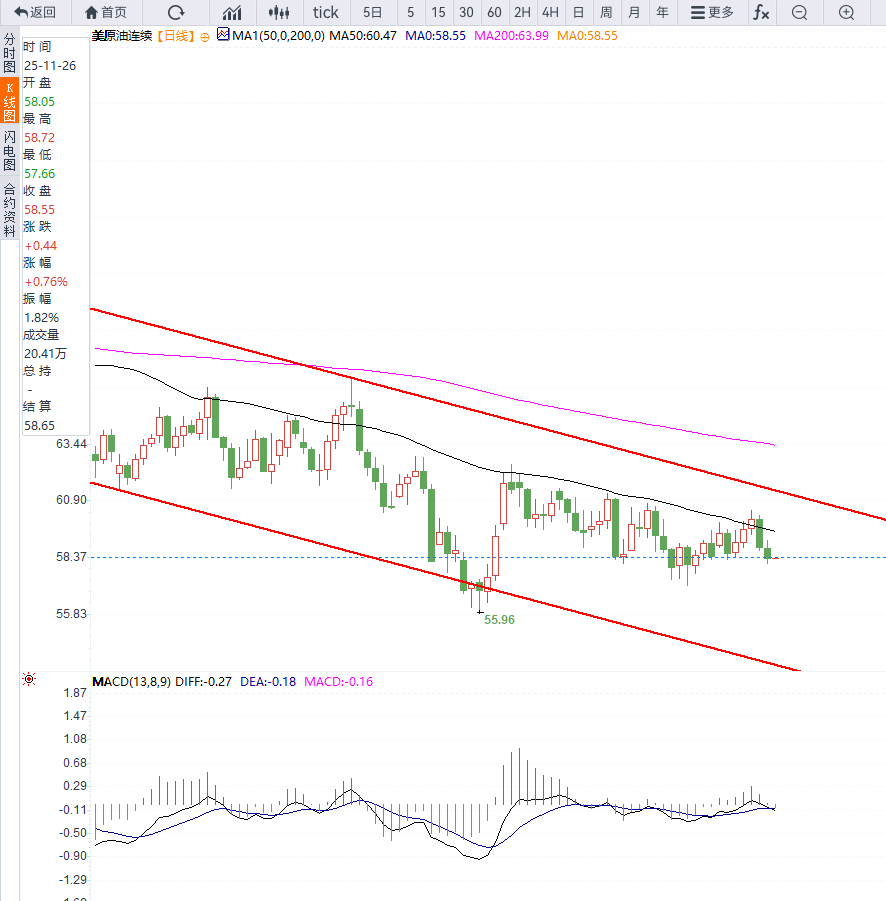
From a daily chart perspective, WTI crude oil prices have recently exhibited a "weak rebound followed by renewed downward pressure" structure, indicating that the bulls and bears are still locked in a stalemate. WTI has repeatedly encountered resistance near short-term moving averages, suggesting that selling pressure remains significant, while support mainly comes from the lower Bollinger Band area and the densely traded area at previous lows.
Although the MACD indicator histogram has shortened, indicating a weakening of bearish momentum, it remains below the zero line, suggesting the short-term trend has not yet fully reversed. Meanwhile, the consecutive long upper shadows on the candlestick charts indicate strong resistance at higher levels, and the market remains cautious about rising supply and a stronger dollar.
Without stronger fundamental positive factors emerging, WTI is likely to consolidate within a range, and a directional breakout will require new momentum from EIA inventory data or macroeconomic variables.
Editor's Note:
From a market structure perspective, short-term fluctuations in oil prices are more driven by news, but there are still two main themes in the medium term: first, whether US labor and economic data will remain strong, thereby supporting the US dollar; and second, the uncertainty caused by frequent supply-side events.
The "expectation of improvement" in inventory data may become the dominant variable in the coming weeks, and oil prices may see a corrective rebound once there is a sustained and significant reduction in inventory.
According to the latest JOLTS report released by the U.S. Bureau of Labor Statistics, job openings reached 7.658 million in September and 7.67 million in October, both higher than market expectations, indicating that the U.S. labor market remains resilient.
This signal reinforced market expectations that the economy would maintain a certain level of vitality, thus supporting the dollar and putting downward pressure on oil prices. "The continued resilience of labor data not only enhanced the attractiveness of the dollar but also reinforced market expectations that corporate demand has not yet weakened significantly," noted an energy economist.
On the supply side, the resumption of production at major Iraqi oil fields has cooled global market expectations of a supply gap, putting downward pressure on oil prices. The West Qurna-2 oil field in Iraq, which had temporarily suspended production due to a pipeline leak, resumed crude oil transportation after the weekend, with crude oil flowing back to the Tuba main storage terminal.
This oil field, operated by energy company Lukoil, produces more than 460,000 barrels per day, accounting for about 0.5% of global supply and about 9% of Iraq's total production. The resumption of production has temporarily eased supply risks in the Middle East, reducing previous market concerns about supply shortages.
"The rapid recovery of high-production oil fields means that a significant supply gap in the market is unlikely in the short term." — An expert from an international energy analysis agency stated.
A significant drop in API inventories became a key support for oil prices during their decline. Despite downward pressure on oil prices, the inventory change offered the market another possibility. According to the latest API data, U.S. crude oil inventories fell by 4.8 million barrels in the week ending December 5, far exceeding the market's expectation of a 1.7 million barrel decrease, and following a 2.48 million barrel decrease the previous week.
According to Oilprice's calculations, U.S. crude oil inventories have increased by only 121,000 barrels so far this year, remaining almost at an annual equilibrium. This data suggests that end-user demand has not weakened significantly, and restocking by companies may provide support for oil prices in subsequent trading sessions.
"The continued decline in inventories suggests that demand is more resilient than the market previously anticipated, which could limit further declines in oil prices." —Analysis by an independent energy consultant
EIA data may act as a directional catalyst. The market will next focus on the official inventory report to be released by the Energy Information Administration (EIA) later. If the EIA also shows a significant reduction in inventories, oil prices may rebound in the short term; conversely, if inventories rise, oil prices may continue to be under pressure.
The current trend of WTI is seeking a balance between three forces: supply recovery, a stronger dollar, and declining inventories. A directional breakout depends on new macroeconomic or inventory data.
From a daily chart perspective, WTI crude oil prices have recently exhibited a "weak rebound followed by renewed downward pressure" structure, indicating that the bulls and bears are still locked in a stalemate. WTI has repeatedly encountered resistance near short-term moving averages, suggesting that selling pressure remains significant, while support mainly comes from the lower Bollinger Band area and the densely traded area at previous lows.
Although the MACD indicator histogram has shortened, indicating a weakening of bearish momentum, it remains below the zero line, suggesting the short-term trend has not yet fully reversed. Meanwhile, the consecutive long upper shadows on the candlestick charts indicate strong resistance at higher levels, and the market remains cautious about rising supply and a stronger dollar.
Without stronger fundamental positive factors emerging, WTI is likely to consolidate within a range, and a directional breakout will require new momentum from EIA inventory data or macroeconomic variables.
Editor's Note:
From a market structure perspective, short-term fluctuations in oil prices are more driven by news, but there are still two main themes in the medium term: first, whether US labor and economic data will remain strong, thereby supporting the US dollar; and second, the uncertainty caused by frequent supply-side events.
The "expectation of improvement" in inventory data may become the dominant variable in the coming weeks, and oil prices may see a corrective rebound once there is a sustained and significant reduction in inventory.
- Risk Warning and Disclaimer
- The market involves risk, and trading may not be suitable for all investors. This article is for reference only and does not constitute personal investment advice, nor does it take into account certain users’ specific investment objectives, financial situation, or other needs. Any investment decisions made based on this information are at your own risk.