Gold Trading Alert: Fed Rate Cut Helps Gold Prices Reach One-Month High, Silver Hits All-Time High; Is the Next Bull Market Poised to Start?
2025-12-12 07:48:52
Amidst global economic uncertainty, gold, as a traditional safe-haven asset, has once again shone brightly. On Thursday (December 11), following the Federal Reserve's third consecutive 25 basis point interest rate cut, gold prices rebounded strongly, with spot gold rising 1.2% to a more than one-month high of $4285.75 per ounce, while silver hit a record high of $64.31 per ounce. This surge in precious metals prices stems not only from a weakening dollar and persistent inflationary pressures but also from the upcoming non-farm payroll report and global geopolitical turmoil. Investors are closely watching how these factors intertwine to influence the future trend of gold. This article will delve into the driving mechanism of this gold price increase, explore the underlying economic logic, and look ahead to potential investment opportunities and risks. Through this analysis, we can see that the gold market is at a crucial juncture; a break above the $4300 level could signal the start of a new bull market. On Friday (December 12) in early Asian trading, spot gold traded in a narrow range, currently at $4276.29 per ounce.
The Federal Reserve's monetary policy adjustment was undoubtedly the core catalyst for the recent surge in gold prices. On Wednesday, the Fed announced a 25-basis-point interest rate cut, marking the third consecutive rate reduction. Although the market had widely anticipated this, the Fed policymakers' wording and forecasts showed a dovish bias, emphasizing that they would monitor labor market trends and acknowledging that inflation "remains high." This statement led investors to interpret it as suggesting that the possibility of further rate cuts was not entirely closed, especially given that inflation had not yet fallen back to the 2% target.
Marex analyst Edward Meir points out that when interest rates fall in an inflationary environment, it is extremely beneficial for gold because it reduces the opportunity cost of holding gold.
Historically, Federal Reserve easing cycles have often been accompanied by strong rebounds in gold prices, and this time is no exception. Spot gold rose rapidly after the interest rate cut, with the February U.S. gold futures contract settling at $4,313 per ounce, a gain of 2.1%.
Meanwhile, the Federal Reserve announced it would purchase approximately $40 billion in short-term Treasury bonds starting December 12 to manage market liquidity, further expanding its balance sheet and ending the quantitative tightening process that began in 2022. This liquidity injection is beneficial to risk assets but puts pressure on safe-haven assets such as the US dollar, thereby indirectly increasing the attractiveness of gold. Overall, the Fed's dovish shift not only lowered borrowing costs but also strengthened market expectations for a soft landing of the economy, driving funds into the gold market.
The weakening US dollar index was another key driver behind gold prices hitting new highs. Following the interest rate cut, the dollar index fell to a near two-month low of 98.13, also hitting multi-month lows against the euro, Swiss franc, and pound sterling. This was primarily due to the Federal Reserve's less hawkish forecasts than some investors had anticipated, contrasting sharply with the rate hike signals from officials at the Reserve Bank of Australia and the European Central Bank.
UBS FX strategist Vassili Serebriakov analyzed that interest rate expectations outside the US are turning hawkish, highlighting the Fed's relatively dovish stance and further dragging down the dollar.
The depreciation of the US dollar directly reduces the cost of dollar-denominated gold for overseas buyers, stimulating international demand. For example, on Wednesday, India's pension regulator allowed pension funds to invest in gold and silver ETFs, which will inject more institutional funds into the gold market and drive demand expansion.
In addition, the number of initial jobless claims in the United States last week saw the largest increase in nearly four and a half years, reaching 236,000, higher than expected. Although this was attributed to seasonal factors, it still exacerbated market concerns about a weak labor market and further depressed the dollar.
In an environment of a weakening US dollar, gold's safe-haven properties have been amplified, attracting more investors to this "non-interest-bearing asset" and thus consolidating its upward momentum.
It is worth noting that silver performed particularly well in this round of market activity, with spot silver surging nearly 3% to close at $63.54 per ounce, close to the intraday record high of $64.29.
Edward Meir observed that silver appears to be driving up gold prices, while also prompting other precious metals such as platinum and palladium to follow suit. This synergistic effect stems from silver's dual nature: as an industrial metal, it is supported by expectations of a global manufacturing recovery; as a precious metal, it benefits from rising safe-haven demand.
Silver's strong performance reflects not only market concerns about inflation and economic uncertainty, but also signs of a recovery in the precious metals sector as a whole.
Compared to gold, silver is more volatile, but its historical highs have also provided upward momentum for gold, creating a complementary upward trend. Investors should note that silver has a higher proportion of industrial demand, and its gains may face the risk of correction if the global economy slows down. However, in the current environment, silver's leading role undoubtedly strengthens the bullish sentiment in the gold market.
Global geopolitical turmoil provided additional support for gold. US President Trump indicated he would assist with security matters in Ukraine and might attend related meetings, suggesting a possible turning point in the situation, though uncertainty remains. Meanwhile, Trump's tough stance on Venezuela, stating he would "soon take action on land," exacerbated regional tensions, while Venezuelan President Maduro condemned the US seizure of the oil tanker as a "crime."
In addition, Israeli Prime Minister Netanyahu convened a security cabinet meeting, expressing concerns about the resumption of military operations in Lebanon. Although these events did not directly erupt, they increased global uncertainty and drove funds into gold as a safe haven.
On the other hand, investors are focused on the November non-farm payrolls report to be released on December 16 , which will provide new clues about the Federal Reserve's policy path. Weak data could strengthen expectations of a rate cut, further boosting gold prices; conversely, strong data could limit gains. Currently, the market estimates only a 24.4% probability of a Fed rate cut in January, but any surprise could trigger volatility.
In summary, the combination of a weakening dollar triggered by the Federal Reserve's interest rate cut, persistent inflation, declining US Treasury yields, and geopolitical risks has driven gold prices to a monthly high and silver to a record high. This round of price increases is not an isolated event, but rather a concentrated reflection of the divergence in global monetary policies and economic uncertainty.
Looking ahead, with the release of non-farm payroll data and evolving geopolitical situations, the gold market may see more opportunities. However, investors should be wary of potential pullback risks, such as the Federal Reserve pausing interest rate cuts or an unexpectedly strong global economy. Overall, gold still possesses strong upward momentum, and long-term holders are advised to consider tools such as ETFs to capitalize on the wealth opportunities presented by this safe-haven trend.
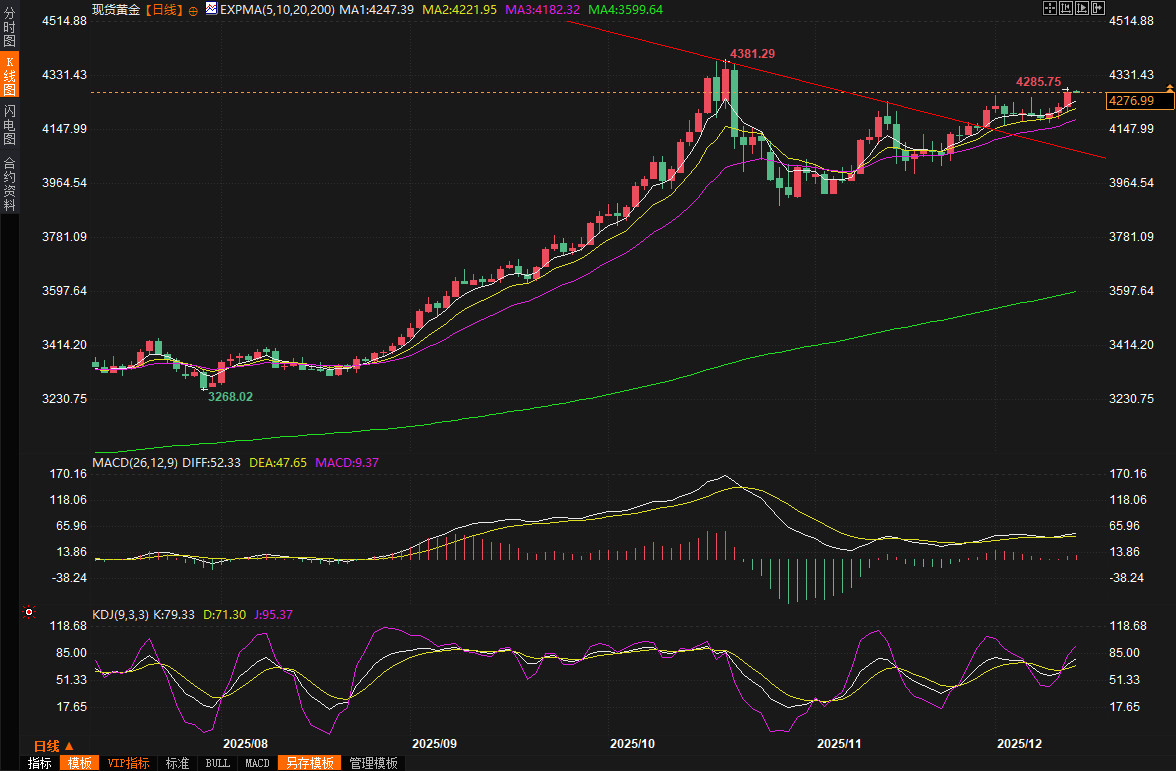
(Spot gold daily chart, source: FX678)
At 07:48 Beijing time, spot gold was trading at $4276.34 per ounce.
The Fed's dovish signals ignite the gold price engine.
The Federal Reserve's monetary policy adjustment was undoubtedly the core catalyst for the recent surge in gold prices. On Wednesday, the Fed announced a 25-basis-point interest rate cut, marking the third consecutive rate reduction. Although the market had widely anticipated this, the Fed policymakers' wording and forecasts showed a dovish bias, emphasizing that they would monitor labor market trends and acknowledging that inflation "remains high." This statement led investors to interpret it as suggesting that the possibility of further rate cuts was not entirely closed, especially given that inflation had not yet fallen back to the 2% target.
Marex analyst Edward Meir points out that when interest rates fall in an inflationary environment, it is extremely beneficial for gold because it reduces the opportunity cost of holding gold.
Historically, Federal Reserve easing cycles have often been accompanied by strong rebounds in gold prices, and this time is no exception. Spot gold rose rapidly after the interest rate cut, with the February U.S. gold futures contract settling at $4,313 per ounce, a gain of 2.1%.
Meanwhile, the Federal Reserve announced it would purchase approximately $40 billion in short-term Treasury bonds starting December 12 to manage market liquidity, further expanding its balance sheet and ending the quantitative tightening process that began in 2022. This liquidity injection is beneficial to risk assets but puts pressure on safe-haven assets such as the US dollar, thereby indirectly increasing the attractiveness of gold. Overall, the Fed's dovish shift not only lowered borrowing costs but also strengthened market expectations for a soft landing of the economy, driving funds into the gold market.
A weak dollar boosts overseas demand for gold.
The weakening US dollar index was another key driver behind gold prices hitting new highs. Following the interest rate cut, the dollar index fell to a near two-month low of 98.13, also hitting multi-month lows against the euro, Swiss franc, and pound sterling. This was primarily due to the Federal Reserve's less hawkish forecasts than some investors had anticipated, contrasting sharply with the rate hike signals from officials at the Reserve Bank of Australia and the European Central Bank.
UBS FX strategist Vassili Serebriakov analyzed that interest rate expectations outside the US are turning hawkish, highlighting the Fed's relatively dovish stance and further dragging down the dollar.
The depreciation of the US dollar directly reduces the cost of dollar-denominated gold for overseas buyers, stimulating international demand. For example, on Wednesday, India's pension regulator allowed pension funds to invest in gold and silver ETFs, which will inject more institutional funds into the gold market and drive demand expansion.
In addition, the number of initial jobless claims in the United States last week saw the largest increase in nearly four and a half years, reaching 236,000, higher than expected. Although this was attributed to seasonal factors, it still exacerbated market concerns about a weak labor market and further depressed the dollar.
In an environment of a weakening US dollar, gold's safe-haven properties have been amplified, attracting more investors to this "non-interest-bearing asset" and thus consolidating its upward momentum.
Silver strongly led the precious metals sector.
It is worth noting that silver performed particularly well in this round of market activity, with spot silver surging nearly 3% to close at $63.54 per ounce, close to the intraday record high of $64.29.
Edward Meir observed that silver appears to be driving up gold prices, while also prompting other precious metals such as platinum and palladium to follow suit. This synergistic effect stems from silver's dual nature: as an industrial metal, it is supported by expectations of a global manufacturing recovery; as a precious metal, it benefits from rising safe-haven demand.
Silver's strong performance reflects not only market concerns about inflation and economic uncertainty, but also signs of a recovery in the precious metals sector as a whole.
Compared to gold, silver is more volatile, but its historical highs have also provided upward momentum for gold, creating a complementary upward trend. Investors should note that silver has a higher proportion of industrial demand, and its gains may face the risk of correction if the global economy slows down. However, in the current environment, silver's leading role undoubtedly strengthens the bullish sentiment in the gold market.
Geopolitical risks and uncertainty surrounding employment data
Global geopolitical turmoil provided additional support for gold. US President Trump indicated he would assist with security matters in Ukraine and might attend related meetings, suggesting a possible turning point in the situation, though uncertainty remains. Meanwhile, Trump's tough stance on Venezuela, stating he would "soon take action on land," exacerbated regional tensions, while Venezuelan President Maduro condemned the US seizure of the oil tanker as a "crime."
In addition, Israeli Prime Minister Netanyahu convened a security cabinet meeting, expressing concerns about the resumption of military operations in Lebanon. Although these events did not directly erupt, they increased global uncertainty and drove funds into gold as a safe haven.
On the other hand, investors are focused on the November non-farm payrolls report to be released on December 16 , which will provide new clues about the Federal Reserve's policy path. Weak data could strengthen expectations of a rate cut, further boosting gold prices; conversely, strong data could limit gains. Currently, the market estimates only a 24.4% probability of a Fed rate cut in January, but any surprise could trigger volatility.
In summary, the combination of a weakening dollar triggered by the Federal Reserve's interest rate cut, persistent inflation, declining US Treasury yields, and geopolitical risks has driven gold prices to a monthly high and silver to a record high. This round of price increases is not an isolated event, but rather a concentrated reflection of the divergence in global monetary policies and economic uncertainty.
Looking ahead, with the release of non-farm payroll data and evolving geopolitical situations, the gold market may see more opportunities. However, investors should be wary of potential pullback risks, such as the Federal Reserve pausing interest rate cuts or an unexpectedly strong global economy. Overall, gold still possesses strong upward momentum, and long-term holders are advised to consider tools such as ETFs to capitalize on the wealth opportunities presented by this safe-haven trend.
(Spot gold daily chart, source: FX678)
At 07:48 Beijing time, spot gold was trading at $4276.34 per ounce.
- Risk Warning and Disclaimer
- The market involves risk, and trading may not be suitable for all investors. This article is for reference only and does not constitute personal investment advice, nor does it take into account certain users’ specific investment objectives, financial situation, or other needs. Any investment decisions made based on this information are at your own risk.