Behind the early appointment: Trump's covert battle with the Federal Reserve escalates, posing long-term risks to the dollar.
2025-12-12 16:31:18
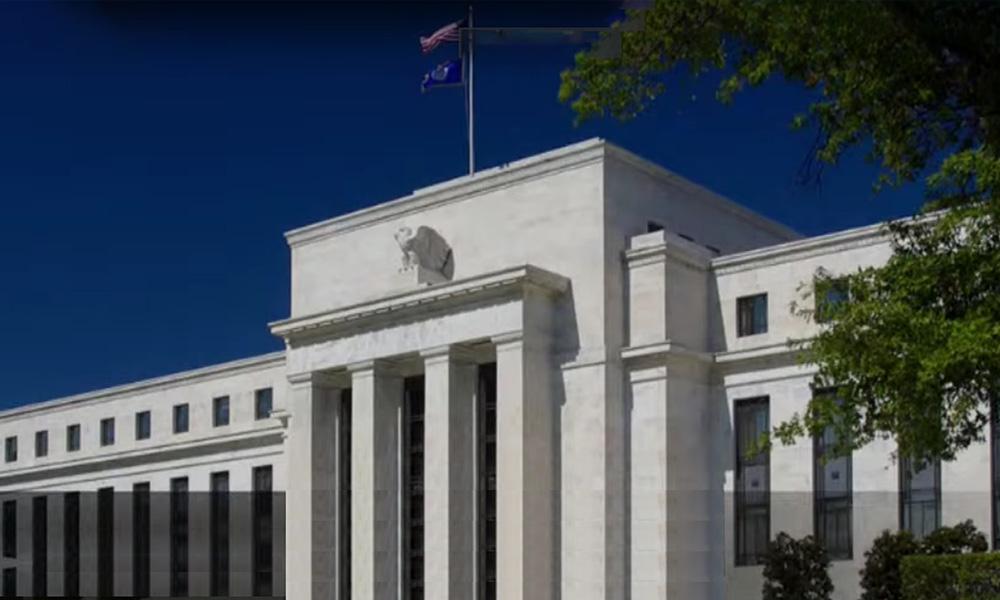
The Federal Reserve Board announced on Thursday (December 11) the reappointment of all regional Federal Reserve presidents, just days after the Trump administration began expressing its desire for significant reforms to the reappointment process. In the 12 Federal Reserve districts across the country, the regional presidents wield almost the same influence over interest rate decisions as the seven permanent members of the Federal Reserve Board confirmed by the Senate.
Treasury Secretary Scott Bessant said on December 3 that he plans to propose a new rule for appointing regional Federal Reserve presidents. Bessant stated, "I will begin advocating—for the future only, not retroactively—that regional Fed presidents must reside in their respective districts for at least three years."
He suggested that Federal Reserve Chairman Jerome Powell and the Board of Governors should have the power to explicitly state, "We will veto an appointment unless the candidate has resided in a particular district for three years." Bessant stated that he has not yet formally proposed the new rule, but the Federal Reserve can proceed with this reform on its own.
Stephen Milan, who is currently serving as a Federal Reserve governor after temporarily leaving the White House, joined Jerome Powell and other governors in voting for all reappointments. Michelle Bowman, the Fed's vice chairman for supervision appointed during Trump's first term, and Governor Christopher Waller also voted in favor.
It remains unclear how many current regional Federal Reserve presidents might be affected by Bessant's proposed new rules. Many of them previously worked on Wall Street, at large corporations, and at the New York Fed before assuming their current positions. The Fed last executed this routine re-election process in January 2021, so Thursday's announcement came earlier than expected. Normally, the re-election process must be completed by the end of February.
Kevin Hassett, director of Trump's National Economic Council, recently endorsed Bessett's proposal in an interview, suggesting it may garner more support. Trump has previously hinted that Hassett is his top choice to succeed Powell as Federal Reserve chairman next May.
The Federal Reserve issued a statement on Thursday saying that the appointment was approved "following a comprehensive review by the boards of directors of the regional reserve banks." Since returning to power in January, the Trump administration has almost continuously criticized the Federal Reserve and its chairman.
Thursday's announcement was crucial for the Federal Reserve because its interest rate-setting committee consists of governors, the president of the New York Fed, and four other regional Fed presidents (who rotate annually). The regional Fed presidents are nominated by a selection committee comprised of nonprofit organizations and business leaders from their respective districts, and appointed every five years by the Federal Reserve Board of Governors.
When Trump initially attempted to fire Federal Reserve Governor Lisa Cook this summer, he predicted he would soon gain a "majority" on the board and use that majority to ensure a rapid reduction in interest rates. Although Cook has successfully contested the dismissal, Trump's remarks have raised concerns that the government might manipulate the selection of regional Fed presidents by blocking some re-election appointments.
Trump said on August 26, "Once we get a majority, the housing market will turn around and the outlook will be very positive." The Supreme Court will hear oral arguments in Cook's case next January.
The Federal Reserve Board unanimously approved the reappointments of nearly all 12 regional Federal Reserve presidents, a group that had been under close scrutiny by the Trump administration. With the exception of Atlanta Fed President Rafael Bostic, who will step down at the end of February and whose successor has not yet been determined, the reappointments of the other 11 presidents were approved.
The regional Federal Reserve presidents all serve five-year terms, with their terms ending in 1 or 6. Their appointments are typically approved by the Federal Reserve Board of Governors. This approval process was closely watched because President Trump is seeking to strengthen his control over the Fed, which is traditionally seen as independent of day-to-day politics. The unanimous approval by the Board means that the two Fed officials appointed by Trump (Bowman and Waller) also voted for re-election.
This turmoil has significantly increased the long-term political risk premium for the US dollar, cracking its foundation as the global reserve currency. In the long run, this increases the dollar's vulnerability. The dollar index fluctuated around 98.35 on Friday, after falling for two consecutive trading days and hitting a near seven-week low of 98.13 on Thursday.
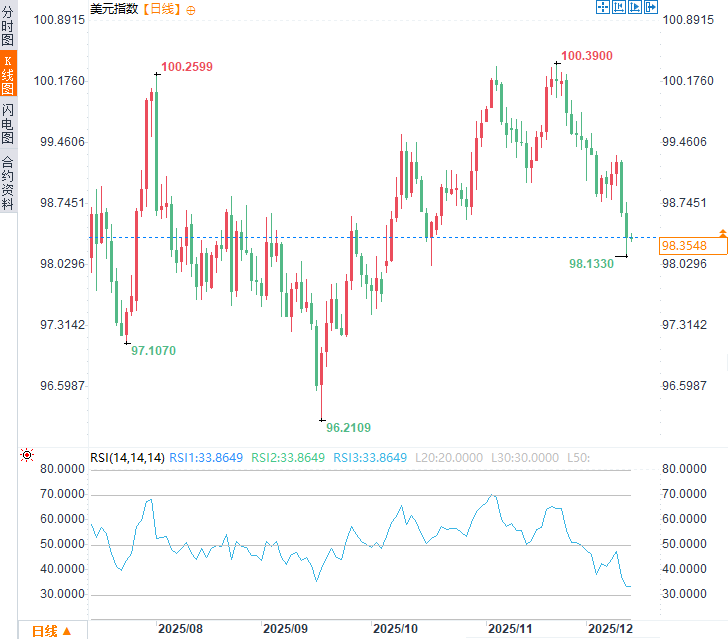
(US Dollar Index Daily Chart, Source: FX678)
At 16:25 Beijing time, the US dollar index is currently at 98.36.
The Trump administration wants to introduce new residency restrictions.
Treasury Secretary Scott Bessant said on December 3 that he plans to propose a new rule for appointing regional Federal Reserve presidents. Bessant stated, "I will begin advocating—for the future only, not retroactively—that regional Fed presidents must reside in their respective districts for at least three years."
He suggested that Federal Reserve Chairman Jerome Powell and the Board of Governors should have the power to explicitly state, "We will veto an appointment unless the candidate has resided in a particular district for three years." Bessant stated that he has not yet formally proposed the new rule, but the Federal Reserve can proceed with this reform on its own.
Stephen Milan, who is currently serving as a Federal Reserve governor after temporarily leaving the White House, joined Jerome Powell and other governors in voting for all reappointments. Michelle Bowman, the Fed's vice chairman for supervision appointed during Trump's first term, and Governor Christopher Waller also voted in favor.
It remains unclear how many current regional Federal Reserve presidents might be affected by Bessant's proposed new rules. Many of them previously worked on Wall Street, at large corporations, and at the New York Fed before assuming their current positions. The Fed last executed this routine re-election process in January 2021, so Thursday's announcement came earlier than expected. Normally, the re-election process must be completed by the end of February.
The tug-of-war between the White House and the Federal Reserve over independence continues.
Kevin Hassett, director of Trump's National Economic Council, recently endorsed Bessett's proposal in an interview, suggesting it may garner more support. Trump has previously hinted that Hassett is his top choice to succeed Powell as Federal Reserve chairman next May.
The Federal Reserve issued a statement on Thursday saying that the appointment was approved "following a comprehensive review by the boards of directors of the regional reserve banks." Since returning to power in January, the Trump administration has almost continuously criticized the Federal Reserve and its chairman.
Thursday's announcement was crucial for the Federal Reserve because its interest rate-setting committee consists of governors, the president of the New York Fed, and four other regional Fed presidents (who rotate annually). The regional Fed presidents are nominated by a selection committee comprised of nonprofit organizations and business leaders from their respective districts, and appointed every five years by the Federal Reserve Board of Governors.
When Trump initially attempted to fire Federal Reserve Governor Lisa Cook this summer, he predicted he would soon gain a "majority" on the board and use that majority to ensure a rapid reduction in interest rates. Although Cook has successfully contested the dismissal, Trump's remarks have raised concerns that the government might manipulate the selection of regional Fed presidents by blocking some re-election appointments.
Trump said on August 26, "Once we get a majority, the housing market will turn around and the outlook will be very positive." The Supreme Court will hear oral arguments in Cook's case next January.
The Federal Reserve unanimously approved the reappointment of regional reserve presidents.
The Federal Reserve Board unanimously approved the reappointments of nearly all 12 regional Federal Reserve presidents, a group that had been under close scrutiny by the Trump administration. With the exception of Atlanta Fed President Rafael Bostic, who will step down at the end of February and whose successor has not yet been determined, the reappointments of the other 11 presidents were approved.
The regional Federal Reserve presidents all serve five-year terms, with their terms ending in 1 or 6. Their appointments are typically approved by the Federal Reserve Board of Governors. This approval process was closely watched because President Trump is seeking to strengthen his control over the Fed, which is traditionally seen as independent of day-to-day politics. The unanimous approval by the Board means that the two Fed officials appointed by Trump (Bowman and Waller) also voted for re-election.
This turmoil has significantly increased the long-term political risk premium for the US dollar, cracking its foundation as the global reserve currency. In the long run, this increases the dollar's vulnerability. The dollar index fluctuated around 98.35 on Friday, after falling for two consecutive trading days and hitting a near seven-week low of 98.13 on Thursday.
(US Dollar Index Daily Chart, Source: FX678)
At 16:25 Beijing time, the US dollar index is currently at 98.36.
- Risk Warning and Disclaimer
- The market involves risk, and trading may not be suitable for all investors. This article is for reference only and does not constitute personal investment advice, nor does it take into account certain users’ specific investment objectives, financial situation, or other needs. Any investment decisions made based on this information are at your own risk.