Oil prices experienced a "geopolitical scare" in a single day, with a 4% weekly drop revealing the main battleground for short sellers.
2025-12-13 13:15:01
During the trading week from December 8th to 12th, 2025, the international crude oil market was once again dominated by pessimistic expectations of oversupply. Despite frequent geopolitical events, these failed to reverse the downward trend in oil prices. Both major benchmark oil prices fluctuated downwards throughout the week, recording significant declines of over 4%, continuing the recent weak trend. NYMEX WTI crude oil futures closed at $57.92 per barrel, down 4.34% for the week; ICE Brent crude oil futures closed at $61.56 per barrel, down 4.04% for the week. Market focus quickly shifted from geopolitical risks back to fundamentals, with the reality of ample global oil supply becoming the core force suppressing prices.

At the start of the week, oil prices attempted to find support after opening relatively low, but market sentiment was generally bearish. Mid-week, news of the US seizure of a sanctioned oil tanker off the coast of Venezuela briefly fueled supply concerns and drove a short-term rebound in prices. However, this geopolitical premium was short-lived, and traders quickly turned their attention to the broader supply and demand picture. The International Energy Agency's (IEA) pessimistic forecast released on Thursday proved to be the final straw, causing oil prices to plummet and continue their decline on Friday, ultimately closing near the week's lows.
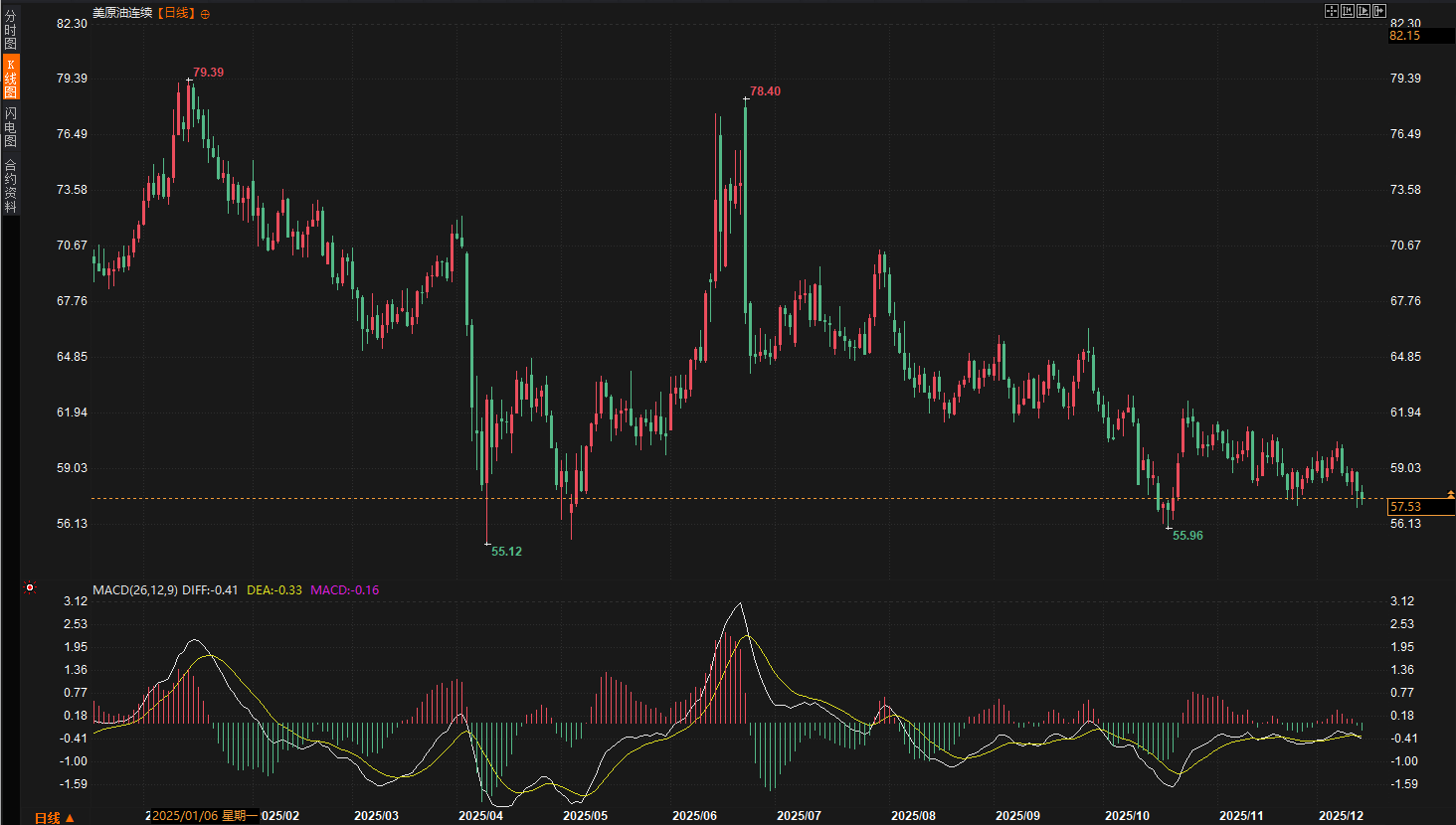
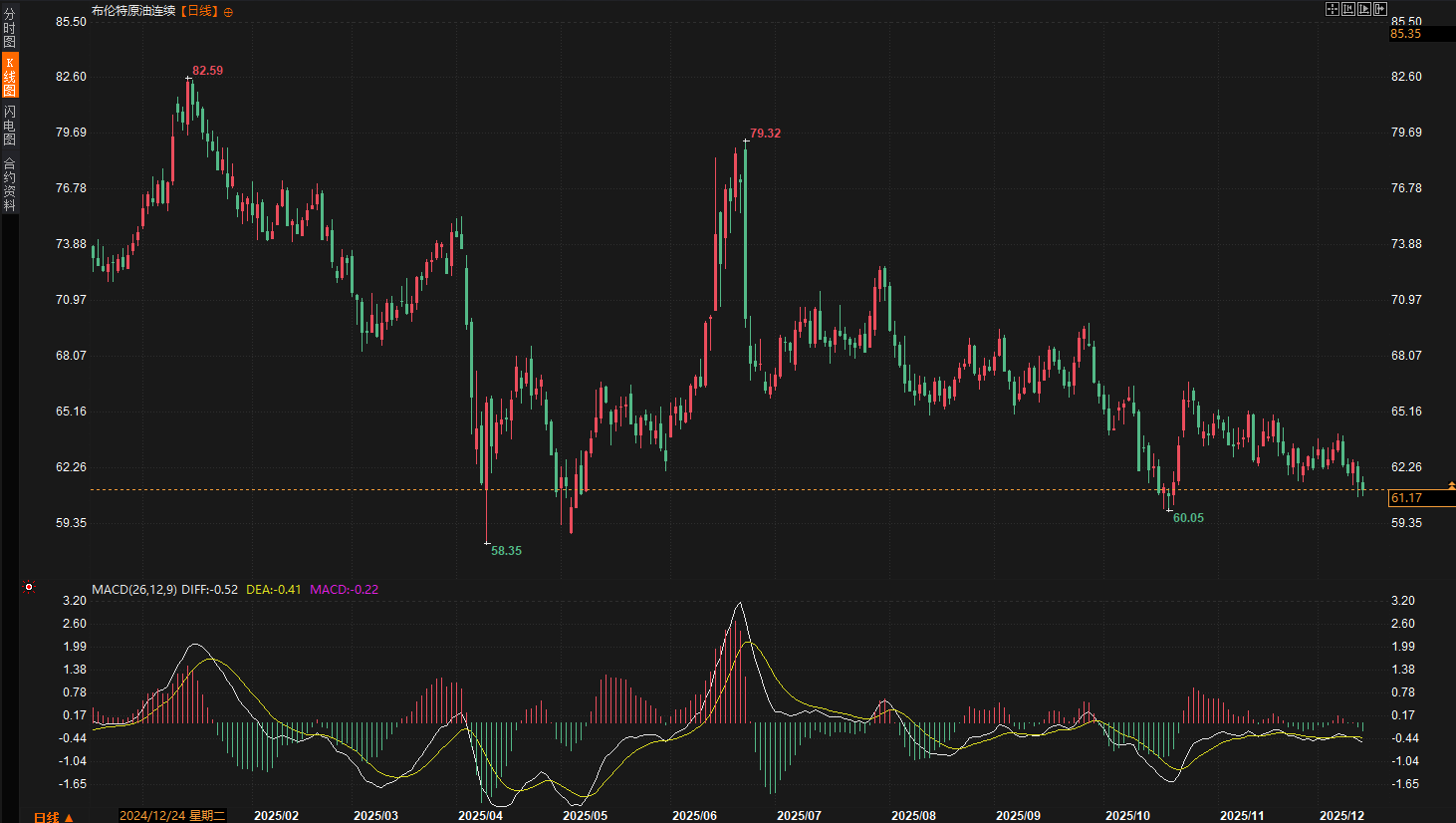
The week's trading exhibited a typical pattern of "event-driven rallies and fundamental-driven declines." Markets viewed volatility caused by geopolitical events as short-term noise, while institutional reports revealing a supply glut were interpreted as a long-term trend. This difference in perception determined the ultimate direction of oil prices.
The most important fundamental information this week came from the International Energy Agency's (IEA) monthly report released on Thursday. The agency predicts that global oil supply will exceed demand by 3.84 million barrels per day in 2026, a surplus equivalent to almost 4% of global daily demand. This significant oversupply expectation directly reinforces market expectations of continued downward pressure on oil prices in the medium to long term.
In contrast, a report released on the same day by the Organization of the Petroleum Exporting Countries (OPEC) indicated that global oil supply will be close to matching demand in 2026. This discrepancy between the forecasts of the two authoritative institutions reflects the current market uncertainty regarding the long-term balance, but traders clearly tend to believe the IEA's pessimistic scenario.
1. Tensions escalate between the United States and Venezuela
US President Trump announced on Wednesday that the US had seized a sanctioned oil tanker off the coast of Venezuela. Subsequently, six sources revealed on Thursday that following the initial action this week, the US is preparing to intercept more ships carrying Venezuelan oil. This series of actions signifies a significant strengthening of US enforcement of sanctions against Venezuela.
However, the market reacted tepidly. Most traders and analysts believe that current global oil supplies are ample, and the potential disruption to Venezuelan crude oil exports will not have a substantial impact on the overall balance. Andrew Lipow, president of Lipow Oil Associates, noted, "The market continues to be pressured by the crude oil supply situation... On the other hand, the oil market is ignoring the tensions between the United States and Venezuela."
2. Updates on the Russia-Ukraine conflict
A Ukrainian drone strike on a Russian oil rig in the Caspian Sea could have triggered supply concerns. However, industry data showed that Russia's seaborne petroleum product exports in November fell only slightly by 0.8% compared to October, with refinery maintenance work offsetting the decline in exports via the southern shipping route. The market viewed this as a localized disturbance and did not price it in significantly.
Furthermore, the market continues to focus on progress toward a potential peace agreement between Russia and Ukraine. Any signal that might reduce the risk of escalation is seen as a factor reducing uncertainty in the global energy market, thus putting slight downward pressure on oil prices.
The global trade environment remains complex, with the US's unilateral imposition of tariffs continuing to fuel market concerns about global economic growth and oil demand. While some countries have taken measures to protect their own interests, from a market sentiment perspective, escalating trade frictions could dampen business investment and consumer confidence, thereby impacting energy consumption growth. This risk aversion has suppressed the performance of risk assets at times this week, and crude oil, as a commodity, has not been immune.
Andrew Lipow, President of Lipow Oil Associates:
The market continues to be pressured by crude oil supply conditions, with the oil market ignoring tensions between the US and Venezuela. The current focus is entirely on the reality of a fundamental oversupply.
Rystad Energy analyst Janiv Shah:
Despite some factors supporting prices, including escalating tensions between the United States and Venezuela and the Ukrainian drone attack on Russian oil facilities, these geopolitical risk premiums were overshadowed by the macroeconomic backdrop of oversupply.
Opinions from multiple traders:
Most traders downplayed concerns about the impact of the US seizure of the Venezuelan oil tanker, generally pointing out that market supply was ample and that localized geopolitical events were unlikely to alter the overall supply and demand dynamics.
Industry data interpretation and insights:
Russian export data shows that its oil supply remains resilient. Despite geopolitical challenges, exports have remained stable by adjusting transportation routes and refinery production, further reinforcing market perceptions of ample supply.
Looking ahead to the trading week of December 15-20, the crude oil market will face multiple challenges:
1. A flurry of macroeconomic data releases:
The US will release delayed data for October and November, including non-farm payrolls, retail sales, and CPI. These figures will provide a more complete picture of the US economy. If the data shows signs of an economic slowdown, it could exacerbate concerns about the outlook for oil demand. Manufacturing PMIs and consumer confidence data from various countries will also influence global growth expectations.
2. Central bank policy decisions are concentrated:
The Bank of England, the European Central Bank, and the Bank of Japan will announce their interest rate decisions soon. The market expects the UK to cut rates, Japan to raise rates, and the ECB to hold rates steady. This divergence in monetary policy will affect exchange rate fluctuations, which will then impact the dollar-denominated oil market.
3. Technical and financial factors:
NYMEX crude oil futures for January delivery will roll over on December 20th. Changes in liquidity during this period may cause short-term price fluctuations. Investors should pay attention to position adjustments made during the contract rollover process.
4. Geopolitical risks remain:
Tensions between the United States and Venezuela could escalate further, and any unexpected escalation could provide a temporary boost to oil prices. Furthermore, trade policy developments among major global economies require close monitoring, as any escalation of unilateral protectionist measures could trigger risk aversion in the market.
Looking back at the week of December 8th to 12th, the crude oil market experienced a typical scenario where fundamentals outweighed geopolitical risks. Despite the US's assertive actions off the Venezuelan coast and events related to the Russia-Ukraine conflict generating headlines, traders remained focused on the severe oversupply outlook revealed in the IEA report. This market logic of "macroeconomics over microeconomics, and trends over events" led to a one-sided decline in oil prices throughout the week, and the geopolitical premium quickly dissipated.
The market is recalibrating its expectations for the 2026 supply-demand balance, and this process is clearly biased towards pessimism. Against a backdrop of ample inventories, increasing non-OPEC supply, and an uncertain demand outlook, any geopolitical risk pricing becomes short-lived and limited. For traders, the current environment demands more rigorous fundamental supply-demand analysis and the ability to identify "signals and noise" in geopolitical events.
Looking ahead to the coming week, oil prices will find direction amid a confluence of macroeconomic data, central bank policies, and geopolitical events. However, unless there is a disruptive supply disruption or a demand surprise, the shadow of oversupply is likely to continue looming over the market, limiting the upside potential for oil prices. Investors need to remain vigilant in this complex environment and be flexible in responding to potential volatility and turning points.
Weekly Market Review
At the start of the week, oil prices attempted to find support after opening relatively low, but market sentiment was generally bearish. Mid-week, news of the US seizure of a sanctioned oil tanker off the coast of Venezuela briefly fueled supply concerns and drove a short-term rebound in prices. However, this geopolitical premium was short-lived, and traders quickly turned their attention to the broader supply and demand picture. The International Energy Agency's (IEA) pessimistic forecast released on Thursday proved to be the final straw, causing oil prices to plummet and continue their decline on Friday, ultimately closing near the week's lows.
The week's trading exhibited a typical pattern of "event-driven rallies and fundamental-driven declines." Markets viewed volatility caused by geopolitical events as short-term noise, while institutional reports revealing a supply glut were interpreted as a long-term trend. This difference in perception determined the ultimate direction of oil prices.
Oversupply has become the dominant theme in the market.
The most important fundamental information this week came from the International Energy Agency's (IEA) monthly report released on Thursday. The agency predicts that global oil supply will exceed demand by 3.84 million barrels per day in 2026, a surplus equivalent to almost 4% of global daily demand. This significant oversupply expectation directly reinforces market expectations of continued downward pressure on oil prices in the medium to long term.
In contrast, a report released on the same day by the Organization of the Petroleum Exporting Countries (OPEC) indicated that global oil supply will be close to matching demand in 2026. This discrepancy between the forecasts of the two authoritative institutions reflects the current market uncertainty regarding the long-term balance, but traders clearly tend to believe the IEA's pessimistic scenario.
Geopolitical events failed to reverse market sentiment.
1. Tensions escalate between the United States and Venezuela
US President Trump announced on Wednesday that the US had seized a sanctioned oil tanker off the coast of Venezuela. Subsequently, six sources revealed on Thursday that following the initial action this week, the US is preparing to intercept more ships carrying Venezuelan oil. This series of actions signifies a significant strengthening of US enforcement of sanctions against Venezuela.
However, the market reacted tepidly. Most traders and analysts believe that current global oil supplies are ample, and the potential disruption to Venezuelan crude oil exports will not have a substantial impact on the overall balance. Andrew Lipow, president of Lipow Oil Associates, noted, "The market continues to be pressured by the crude oil supply situation... On the other hand, the oil market is ignoring the tensions between the United States and Venezuela."
2. Updates on the Russia-Ukraine conflict
A Ukrainian drone strike on a Russian oil rig in the Caspian Sea could have triggered supply concerns. However, industry data showed that Russia's seaborne petroleum product exports in November fell only slightly by 0.8% compared to October, with refinery maintenance work offsetting the decline in exports via the southern shipping route. The market viewed this as a localized disturbance and did not price it in significantly.
Furthermore, the market continues to focus on progress toward a potential peace agreement between Russia and Ukraine. Any signal that might reduce the risk of escalation is seen as a factor reducing uncertainty in the global energy market, thus putting slight downward pressure on oil prices.
Uncertainty in the trade environment
The global trade environment remains complex, with the US's unilateral imposition of tariffs continuing to fuel market concerns about global economic growth and oil demand. While some countries have taken measures to protect their own interests, from a market sentiment perspective, escalating trade frictions could dampen business investment and consumer confidence, thereby impacting energy consumption growth. This risk aversion has suppressed the performance of risk assets at times this week, and crude oil, as a commodity, has not been immune.
Summary of institutional and analyst opinions
Andrew Lipow, President of Lipow Oil Associates:
The market continues to be pressured by crude oil supply conditions, with the oil market ignoring tensions between the US and Venezuela. The current focus is entirely on the reality of a fundamental oversupply.
Rystad Energy analyst Janiv Shah:
Despite some factors supporting prices, including escalating tensions between the United States and Venezuela and the Ukrainian drone attack on Russian oil facilities, these geopolitical risk premiums were overshadowed by the macroeconomic backdrop of oversupply.
Opinions from multiple traders:
Most traders downplayed concerns about the impact of the US seizure of the Venezuelan oil tanker, generally pointing out that market supply was ample and that localized geopolitical events were unlikely to alter the overall supply and demand dynamics.
Industry data interpretation and insights:
Russian export data shows that its oil supply remains resilient. Despite geopolitical challenges, exports have remained stable by adjusting transportation routes and refinery production, further reinforcing market perceptions of ample supply.
Market Outlook and Risk Warnings for Next Week
Looking ahead to the trading week of December 15-20, the crude oil market will face multiple challenges:
1. A flurry of macroeconomic data releases:
The US will release delayed data for October and November, including non-farm payrolls, retail sales, and CPI. These figures will provide a more complete picture of the US economy. If the data shows signs of an economic slowdown, it could exacerbate concerns about the outlook for oil demand. Manufacturing PMIs and consumer confidence data from various countries will also influence global growth expectations.
2. Central bank policy decisions are concentrated:
The Bank of England, the European Central Bank, and the Bank of Japan will announce their interest rate decisions soon. The market expects the UK to cut rates, Japan to raise rates, and the ECB to hold rates steady. This divergence in monetary policy will affect exchange rate fluctuations, which will then impact the dollar-denominated oil market.
3. Technical and financial factors:
NYMEX crude oil futures for January delivery will roll over on December 20th. Changes in liquidity during this period may cause short-term price fluctuations. Investors should pay attention to position adjustments made during the contract rollover process.
4. Geopolitical risks remain:
Tensions between the United States and Venezuela could escalate further, and any unexpected escalation could provide a temporary boost to oil prices. Furthermore, trade policy developments among major global economies require close monitoring, as any escalation of unilateral protectionist measures could trigger risk aversion in the market.
This week's summary and next week's outlook
Looking back at the week of December 8th to 12th, the crude oil market experienced a typical scenario where fundamentals outweighed geopolitical risks. Despite the US's assertive actions off the Venezuelan coast and events related to the Russia-Ukraine conflict generating headlines, traders remained focused on the severe oversupply outlook revealed in the IEA report. This market logic of "macroeconomics over microeconomics, and trends over events" led to a one-sided decline in oil prices throughout the week, and the geopolitical premium quickly dissipated.
The market is recalibrating its expectations for the 2026 supply-demand balance, and this process is clearly biased towards pessimism. Against a backdrop of ample inventories, increasing non-OPEC supply, and an uncertain demand outlook, any geopolitical risk pricing becomes short-lived and limited. For traders, the current environment demands more rigorous fundamental supply-demand analysis and the ability to identify "signals and noise" in geopolitical events.
Looking ahead to the coming week, oil prices will find direction amid a confluence of macroeconomic data, central bank policies, and geopolitical events. However, unless there is a disruptive supply disruption or a demand surprise, the shadow of oversupply is likely to continue looming over the market, limiting the upside potential for oil prices. Investors need to remain vigilant in this complex environment and be flexible in responding to potential volatility and turning points.
- Risk Warning and Disclaimer
- The market involves risk, and trading may not be suitable for all investors. This article is for reference only and does not constitute personal investment advice, nor does it take into account certain users’ specific investment objectives, financial situation, or other needs. Any investment decisions made based on this information are at your own risk.