Is the US dollar "hanging in mid-air"? A data storm is approaching.
2025-12-16 19:39:49
The Federal Reserve cut interest rates by 25 basis points as expected, but the dollar weakened due to uncertainty about the policy outlook and market concerns about the economic outlook. Powell's cautious remarks emphasizing "data reliance" exacerbated market divergence, resulting in a lack of clear direction for the dollar. The upcoming key employment report (December 16th, 21:30) is a crucial variable, its outcome influencing market expectations regarding the path of rate cuts. Currently, the dollar is in a dilemma: rate cuts weaken its interest rate advantage, while uncertainty surrounding economic data inhibits capital inflows. Analysts believe that the dollar is more likely to remain volatile until the trend becomes clearer, with its true direction potentially only becoming clear after the employment data is released.

The Federal Reserve cut interest rates by 25 basis points as expected, adjusting the policy rate target range to 3.50% to 3.75%. This seemingly stable move, however, caused the dollar to weaken. This was not unexpected, as the market had already priced in the rate cut. What truly determines the dollar's trajectory is not what has already happened, but what will happen next.
Powell's post-meeting remarks were unusually cautious, neither explicitly promising further rate cuts nor strongly hinting at a pause, instead leaving the statement that he would "make decisions based on data." This ambiguous wording has left traders in a tug-of-war—should they hold off on rates in January, or will another round of easing arrive soon? Once this divergence emerges, the dollar struggles to build upward momentum. After all, when the direction is unclear, funds are more inclined to trade within a range rather than betting on a one-sided trend.
Analysts point out that the weakness of the US dollar does not necessarily stem from an economic collapse; sometimes it is simply a loss of certainty. The core logic supporting a strong dollar in the past was "higher US interest rates and better growth," but this story has become blurred. Interest rate cuts have weakened the interest rate differential advantage, while uncertainty about the policy outlook makes traders hesitant to chase higher prices. As a result, even short-term rebounds are quickly seen as selling opportunities by the market, creating a "sell on rallies" trading pattern.
What's truly making the market nervous is the upcoming major jobs report. Due to the delay in data collection caused by the US government shutdown, this report will include data from both October and November, essentially releasing two months' worth of information at once. Market forecasts vary widely: expectations for new jobs range from +150,000 to -20,000, with a median of around +50,000, significantly lower than September's 119,000. This means that regardless of the outcome, it could lead to significant volatility.
More importantly, this data shouldn't just be viewed from the numbers themselves, but also from the signals they convey. If new job creation is indeed negative, even if it's just a temporary phenomenon, it will immediately trigger market concerns that the economy has "turned from cooling to deteriorating." Interest rate futures will quickly price in the possibility of a March rate cut, Treasury yields are likely to decline, and the US dollar will face further pressure.
The unemployment rate is also a key focus. The market generally expects it to remain at 4.4%, while the Federal Reserve's own forecast is around 4.5%. If the actual figure exceeds 4.5%, it will be seen as a significant deviation, reinforcing the narrative that the economy is weakening. Conversely, if the employment data is weak but not out of control—for example, with around 50,000 new jobs and a stable unemployment rate—the market may accept a "wait-and-see" approach, and the dollar may experience a technical rebound. However, analysts caution that this rebound is more of a corrective measure than a trend reversal, because the dollar is unlikely to truly regain its upward momentum until the expectation of further interest rate cuts is broken.
The current trajectory of the US dollar resembles a fierce tug-of-war. On one side, interest rate cuts have reduced the attractiveness of yields; on the other, there is the potential for safe-haven demand supported by the relative resilience of the US economy. The problem is, neither side has truly gained the upper hand yet.
First, the interest rate cut has already occurred, leading to a decline in short-term interest rates and lower returns on dollar-denominated assets, naturally reducing their attractiveness to international capital. Simultaneously, anxiety has begun to emerge in the bond market. Treasury yields lack a clear direction, and traders are reassessing the credibility of the Federal Reserve's policies and the long-term interest rate path. When the bond market becomes hesitant, the currency market often follows suit, manifesting as a weak upward move and a smooth decline in the dollar.
Secondly, fluctuations in the employment sector have amplified the uncertainty of the overall macroeconomic narrative. Last week's sudden jump in initial jobless claims, while potentially including seasonal factors, is being amplified and interpreted at this sensitive juncture. The market is beginning to debate: is this merely random noise, or the beginning of a genuine easing in the labor market?
Furthermore, global funds are now more inclined to "wait for confirmation" rather than make premature bets. The price action of the past week has illustrated this: the dollar initially fell after the rate cut, then rebounded slightly due to some stabilizing data, but consistently failed to break through key resistance levels. Each rebound was accompanied by heavy selling, indicating market skepticism about the trend's sustainability.
The key now remains whether the data can clarify the narrative. What the market is truly betting on is the pace of interest rate cuts next year. If employment data is significantly weak, traders may increase their bets on a March rate cut—currently, the market is pricing in nearly a 50/50 chance, implying a bias of approximately -13 basis points; while the probability of another 25 basis point rate cut in April is almost fully priced in.
This expectation of "earlier and more" easing has dealt a double blow to the US dollar: first, the decline in short-term interest rates directly compresses the interest rate differential advantage, reducing the attractiveness of the dollar; second, the yield curve becomes more dependent on data verification, and increased volatility will deter trend traders, further suppressing the formation of one-sided market trends.
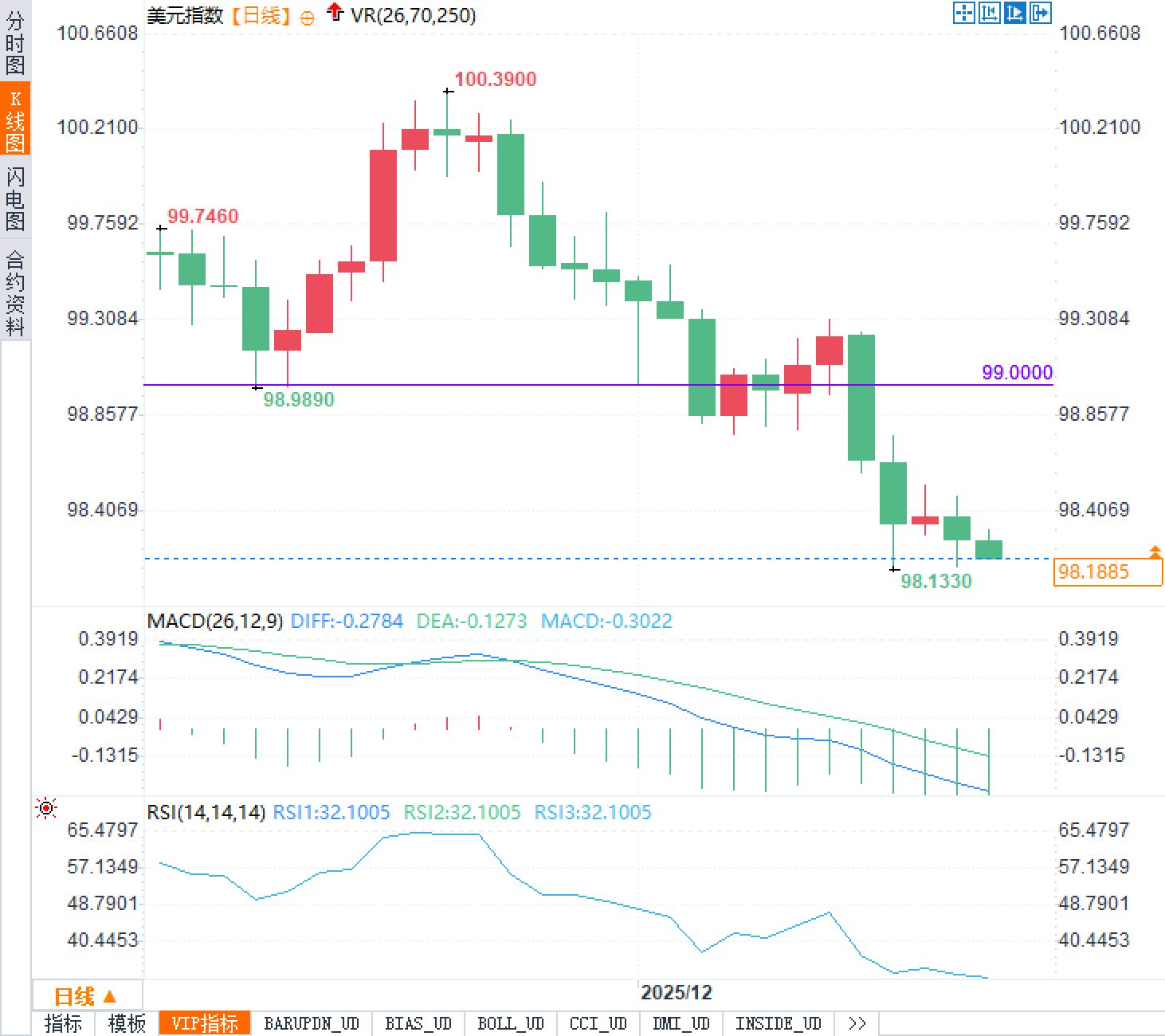
Analysts believe that at this stage, rather than chasing individual fluctuations, it's more important to understand the fundamental changes in the US dollar—it has transformed from a "strongly trending, clearly directional" asset into a trading tool "highly sensitive to interest rate paths." When the policy path is clear, trends tend to extend; when the path is uncertain, rebounds are often short-lived, while pullbacks are more pronounced. Therefore, the most rational strategy at present might be to control the pace and wait for confirmation. For those closely watching the dollar's trajectory, the real answer may lie in the upcoming jobs report.
With the interest rate cut implemented, the US dollar began to retreat.
The Federal Reserve cut interest rates by 25 basis points as expected, adjusting the policy rate target range to 3.50% to 3.75%. This seemingly stable move, however, caused the dollar to weaken. This was not unexpected, as the market had already priced in the rate cut. What truly determines the dollar's trajectory is not what has already happened, but what will happen next.
Powell's post-meeting remarks were unusually cautious, neither explicitly promising further rate cuts nor strongly hinting at a pause, instead leaving the statement that he would "make decisions based on data." This ambiguous wording has left traders in a tug-of-war—should they hold off on rates in January, or will another round of easing arrive soon? Once this divergence emerges, the dollar struggles to build upward momentum. After all, when the direction is unclear, funds are more inclined to trade within a range rather than betting on a one-sided trend.
Analysts point out that the weakness of the US dollar does not necessarily stem from an economic collapse; sometimes it is simply a loss of certainty. The core logic supporting a strong dollar in the past was "higher US interest rates and better growth," but this story has become blurred. Interest rate cuts have weakened the interest rate differential advantage, while uncertainty about the policy outlook makes traders hesitant to chase higher prices. As a result, even short-term rebounds are quickly seen as selling opportunities by the market, creating a "sell on rallies" trading pattern.
Employment data stirs emotions, market plunges into a vortex of speculation.
What's truly making the market nervous is the upcoming major jobs report. Due to the delay in data collection caused by the US government shutdown, this report will include data from both October and November, essentially releasing two months' worth of information at once. Market forecasts vary widely: expectations for new jobs range from +150,000 to -20,000, with a median of around +50,000, significantly lower than September's 119,000. This means that regardless of the outcome, it could lead to significant volatility.
More importantly, this data shouldn't just be viewed from the numbers themselves, but also from the signals they convey. If new job creation is indeed negative, even if it's just a temporary phenomenon, it will immediately trigger market concerns that the economy has "turned from cooling to deteriorating." Interest rate futures will quickly price in the possibility of a March rate cut, Treasury yields are likely to decline, and the US dollar will face further pressure.
The unemployment rate is also a key focus. The market generally expects it to remain at 4.4%, while the Federal Reserve's own forecast is around 4.5%. If the actual figure exceeds 4.5%, it will be seen as a significant deviation, reinforcing the narrative that the economy is weakening. Conversely, if the employment data is weak but not out of control—for example, with around 50,000 new jobs and a stable unemployment rate—the market may accept a "wait-and-see" approach, and the dollar may experience a technical rebound. However, analysts caution that this rebound is more of a corrective measure than a trend reversal, because the dollar is unlikely to truly regain its upward momentum until the expectation of further interest rate cuts is broken.
The market is in a tug-of-war, and the US dollar is caught in a dilemma.
The current trajectory of the US dollar resembles a fierce tug-of-war. On one side, interest rate cuts have reduced the attractiveness of yields; on the other, there is the potential for safe-haven demand supported by the relative resilience of the US economy. The problem is, neither side has truly gained the upper hand yet.
First, the interest rate cut has already occurred, leading to a decline in short-term interest rates and lower returns on dollar-denominated assets, naturally reducing their attractiveness to international capital. Simultaneously, anxiety has begun to emerge in the bond market. Treasury yields lack a clear direction, and traders are reassessing the credibility of the Federal Reserve's policies and the long-term interest rate path. When the bond market becomes hesitant, the currency market often follows suit, manifesting as a weak upward move and a smooth decline in the dollar.
Secondly, fluctuations in the employment sector have amplified the uncertainty of the overall macroeconomic narrative. Last week's sudden jump in initial jobless claims, while potentially including seasonal factors, is being amplified and interpreted at this sensitive juncture. The market is beginning to debate: is this merely random noise, or the beginning of a genuine easing in the labor market?
Furthermore, global funds are now more inclined to "wait for confirmation" rather than make premature bets. The price action of the past week has illustrated this: the dollar initially fell after the rate cut, then rebounded slightly due to some stabilizing data, but consistently failed to break through key resistance levels. Each rebound was accompanied by heavy selling, indicating market skepticism about the trend's sustainability.
The real variables are yet to come; the market is holding its breath.
The key now remains whether the data can clarify the narrative. What the market is truly betting on is the pace of interest rate cuts next year. If employment data is significantly weak, traders may increase their bets on a March rate cut—currently, the market is pricing in nearly a 50/50 chance, implying a bias of approximately -13 basis points; while the probability of another 25 basis point rate cut in April is almost fully priced in.
This expectation of "earlier and more" easing has dealt a double blow to the US dollar: first, the decline in short-term interest rates directly compresses the interest rate differential advantage, reducing the attractiveness of the dollar; second, the yield curve becomes more dependent on data verification, and increased volatility will deter trend traders, further suppressing the formation of one-sided market trends.
Analysts believe that at this stage, rather than chasing individual fluctuations, it's more important to understand the fundamental changes in the US dollar—it has transformed from a "strongly trending, clearly directional" asset into a trading tool "highly sensitive to interest rate paths." When the policy path is clear, trends tend to extend; when the path is uncertain, rebounds are often short-lived, while pullbacks are more pronounced. Therefore, the most rational strategy at present might be to control the pace and wait for confirmation. For those closely watching the dollar's trajectory, the real answer may lie in the upcoming jobs report.
- Risk Warning and Disclaimer
- The market involves risk, and trading may not be suitable for all investors. This article is for reference only and does not constitute personal investment advice, nor does it take into account certain users’ specific investment objectives, financial situation, or other needs. Any investment decisions made based on this information are at your own risk.