The US dollar index rose slightly ahead of the release of the November consumer price index report.
2025-12-18 01:17:13
On Wednesday (December 17), during the US trading session, the US dollar index's 200-day moving average was around 99.2407, approaching a bearish crossover with the 50-day moving average at 99.2240. Traders are on high alert, bracing for potential market volatility following Thursday's release of the November Consumer Price Index (CPI).

Although the US dollar index has recently stabilized near its lows in early October, it has still fallen by about 9.5% year-to-date, potentially marking its biggest annual drop since 2017.
Non-farm payroll data was mixed, and the Federal Reserve held rates steady.
The November non-farm payroll report cast a shadow over monetary policy decisions. U.S. non-farm payrolls increased by 64,000, exceeding the market consensus of 45,000, but the October figure was significantly revised downwards, ultimately recording a decrease of 105,000. August's non-farm payrolls were revised down by 22,000 to a decrease of 26,000; September's increase was also revised down by 11,000 to 108,000.
More worryingly, the unemployment rate climbed to 4.6% from 4.4% in September, a four-year high. Jeff Schultz, head of economics and market strategy at Invesco Great Wall Investment Company, pointed out that this data "sets a moderately accommodative tone for U.S. monetary policy in 2026," adding that the rising unemployment rate "will continue to fuel market expectations of another Fed rate cut in the first quarter of next year, as signs of slack in the labor market are gradually emerging."
Federal Reserve Chairman Jerome Powell previously stated that non-farm payroll data may have been overestimated by as much as 60,000 jobs per month since April, implying that the underlying weakness in the US job market may be far greater than the surface data suggests. Federal funds rate futures currently indicate that the market sees only a 22% probability of a Fed rate cut in January; meanwhile, although the Fed predicts only one rate cut in 2026, the market expects two rate cuts throughout the year.
Retail sales data highlight a disconnect between consumption and employment.
The complex trends in other economic data also supported the dollar, driving a moderate rebound. Among them, retail sales in the control group rose 0.8% month-on-month, marking the largest increase since June.
Analysts at Mitsubishi Financial Group say there is a clear disconnect between the weak labor market and consumer spending, a phenomenon that reflects a “K-shaped” polarization among consumer groups: low-income groups are significantly impacted by rising living costs and benefit far less from the strong stock market performance than high-income groups; meanwhile, concerns about the impact of artificial intelligence technology have exacerbated employment instability among low-income groups, further weakening their consumer confidence.
Inflation report faces data challenges
The Consumer Price Index (CPI) report released on Thursday faces unique circumstances. Barclays economist Puja Sriram warned that due to the 43-day U.S. government shutdown, the Bureau of Labor Statistics was unable to release the October inflation breakdown data, making the November report "unlikely to be considered a 'precise reference' for measuring inflation." The market has been forced to turn to the month-on-month changes from September to November to assess inflation trends.
Sriram predicts that during this period, the overall consumer price index (CPI) will rise by 0.5% cumulatively, driven by rising energy prices, with a year-on-year increase of 3.1%; the core consumer price index (excluding food and energy prices) is expected to rise by 0.6% cumulatively, with a year-on-year increase of 3.1%.
Competition intensifies for Federal Reserve Chair
The recent decrease in dollar selling reflects, to some extent, a shift in the race for the Federal Reserve Chair: Kevin Hassett is no longer the frontrunner, while Kevin Warsh and Christopher Waller have re-emerged as strong contenders, making the competition more intense than before. However, Hassett is still considered the most likely candidate, suggesting that the recent dollar rebound may be unsustainable.
US Treasury yields rose slightly ahead of key data release.
On Wednesday, the daily chart of the U.S. 10-year Treasury note showed that investors were positioning themselves in advance for inflation data releases, pushing U.S. Treasury yields slightly higher. The benchmark 10-year Treasury yield rose less than 2 basis points to 4.165%; the 2-year Treasury yield rose to 3.495%; and the 30-year Treasury yield climbed to 4.835%.
Short-term outlook: Cautiously bearish
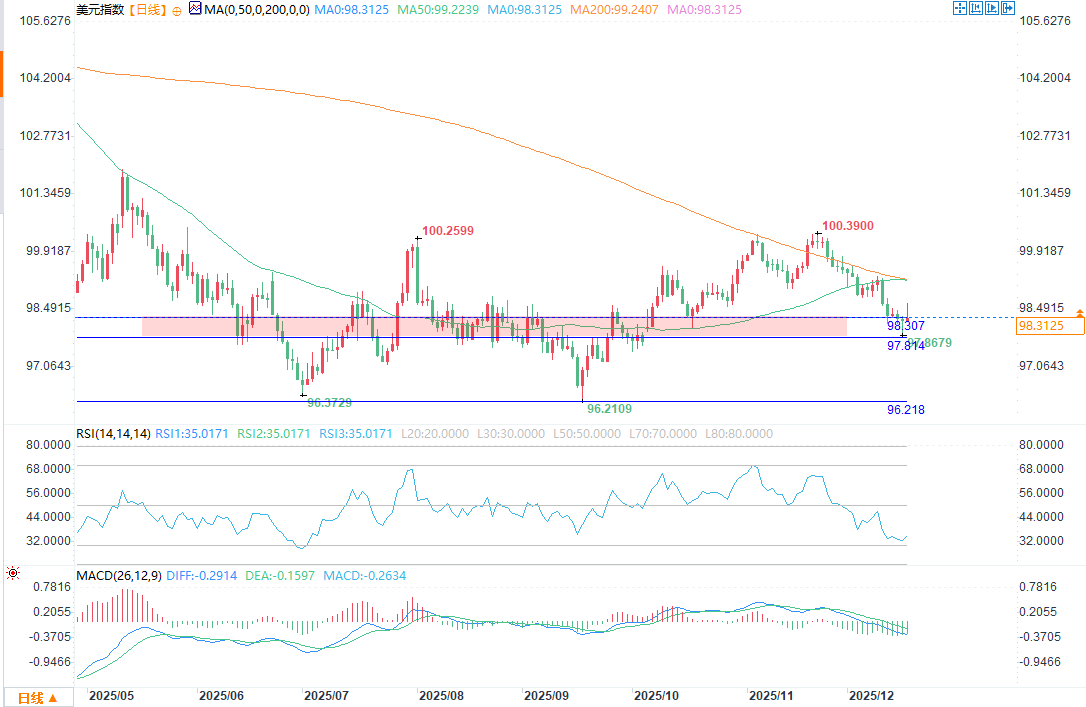
(US Dollar Index Daily Chart Source: FX678)
The continued weakening of the labor market and the possibility that the Federal Reserve may shift to an accommodative monetary policy in early 2026 are putting pressure on the US dollar. If the dollar index falls below the key retracement range of 98.307-97.814, it could trigger a sell-off, pushing the index down to 96.218.
However, if Thursday's Consumer Price Index (CPI) data unexpectedly exceeds expectations, the dollar may experience a technical rebound. Until the inflation situation becomes clearer, the dollar's downward trend will likely continue, and market confidence in its sustained recovery remains limited.
Although the US dollar index has recently stabilized near its lows in early October, it has still fallen by about 9.5% year-to-date, potentially marking its biggest annual drop since 2017.
Non-farm payroll data was mixed, and the Federal Reserve held rates steady.
The November non-farm payroll report cast a shadow over monetary policy decisions. U.S. non-farm payrolls increased by 64,000, exceeding the market consensus of 45,000, but the October figure was significantly revised downwards, ultimately recording a decrease of 105,000. August's non-farm payrolls were revised down by 22,000 to a decrease of 26,000; September's increase was also revised down by 11,000 to 108,000.
More worryingly, the unemployment rate climbed to 4.6% from 4.4% in September, a four-year high. Jeff Schultz, head of economics and market strategy at Invesco Great Wall Investment Company, pointed out that this data "sets a moderately accommodative tone for U.S. monetary policy in 2026," adding that the rising unemployment rate "will continue to fuel market expectations of another Fed rate cut in the first quarter of next year, as signs of slack in the labor market are gradually emerging."
Federal Reserve Chairman Jerome Powell previously stated that non-farm payroll data may have been overestimated by as much as 60,000 jobs per month since April, implying that the underlying weakness in the US job market may be far greater than the surface data suggests. Federal funds rate futures currently indicate that the market sees only a 22% probability of a Fed rate cut in January; meanwhile, although the Fed predicts only one rate cut in 2026, the market expects two rate cuts throughout the year.
Retail sales data highlight a disconnect between consumption and employment.
The complex trends in other economic data also supported the dollar, driving a moderate rebound. Among them, retail sales in the control group rose 0.8% month-on-month, marking the largest increase since June.
Analysts at Mitsubishi Financial Group say there is a clear disconnect between the weak labor market and consumer spending, a phenomenon that reflects a “K-shaped” polarization among consumer groups: low-income groups are significantly impacted by rising living costs and benefit far less from the strong stock market performance than high-income groups; meanwhile, concerns about the impact of artificial intelligence technology have exacerbated employment instability among low-income groups, further weakening their consumer confidence.
Inflation report faces data challenges
The Consumer Price Index (CPI) report released on Thursday faces unique circumstances. Barclays economist Puja Sriram warned that due to the 43-day U.S. government shutdown, the Bureau of Labor Statistics was unable to release the October inflation breakdown data, making the November report "unlikely to be considered a 'precise reference' for measuring inflation." The market has been forced to turn to the month-on-month changes from September to November to assess inflation trends.
Sriram predicts that during this period, the overall consumer price index (CPI) will rise by 0.5% cumulatively, driven by rising energy prices, with a year-on-year increase of 3.1%; the core consumer price index (excluding food and energy prices) is expected to rise by 0.6% cumulatively, with a year-on-year increase of 3.1%.
Competition intensifies for Federal Reserve Chair
The recent decrease in dollar selling reflects, to some extent, a shift in the race for the Federal Reserve Chair: Kevin Hassett is no longer the frontrunner, while Kevin Warsh and Christopher Waller have re-emerged as strong contenders, making the competition more intense than before. However, Hassett is still considered the most likely candidate, suggesting that the recent dollar rebound may be unsustainable.
US Treasury yields rose slightly ahead of key data release.
On Wednesday, the daily chart of the U.S. 10-year Treasury note showed that investors were positioning themselves in advance for inflation data releases, pushing U.S. Treasury yields slightly higher. The benchmark 10-year Treasury yield rose less than 2 basis points to 4.165%; the 2-year Treasury yield rose to 3.495%; and the 30-year Treasury yield climbed to 4.835%.
Short-term outlook: Cautiously bearish
(US Dollar Index Daily Chart Source: FX678)
The continued weakening of the labor market and the possibility that the Federal Reserve may shift to an accommodative monetary policy in early 2026 are putting pressure on the US dollar. If the dollar index falls below the key retracement range of 98.307-97.814, it could trigger a sell-off, pushing the index down to 96.218.
However, if Thursday's Consumer Price Index (CPI) data unexpectedly exceeds expectations, the dollar may experience a technical rebound. Until the inflation situation becomes clearer, the dollar's downward trend will likely continue, and market confidence in its sustained recovery remains limited.
- Risk Warning and Disclaimer
- The market involves risk, and trading may not be suitable for all investors. This article is for reference only and does not constitute personal investment advice, nor does it take into account certain users’ specific investment objectives, financial situation, or other needs. Any investment decisions made based on this information are at your own risk.