The countdown to the collapse of the "fake rise" in Japanese bonds has begun: Everyone is betting on interest rate hikes, so why are long-term bonds plummeting and the yen hesitant to move?
2025-12-18 18:52:54
On Thursday (December 18), global financial markets focused on the Bank of Japan's monetary policy decision to be announced the following day. The market widely expects the Bank of Japan to raise interest rates by 25 basis points for the first time in several months, a highly consistent expectation that dominated short-term movements in the Japanese bond and foreign exchange markets. The Japanese bond market showed technical stabilization, with the 10-year JGB yield falling slightly from its high to around 1.964%, down 0.41% from the previous trading day. Meanwhile, the USD/JPY exchange rate fluctuated narrowly above 155.90, rising slightly by 0.20% on the day, indicating that both bulls and bears remained cautious ahead of this key risk event.

The Japanese bond market's performance on Thursday clearly reflected the "buy the rumor, sell the fact" trading logic. Although the market had almost fully priced in the prospect of a 25 basis point rate hike by the Bank of Japan, the bond market did not continue the previous day's across-the-board decline. Instead, it saw some stabilization and rebound, especially in short- and medium-term bonds.
From a fundamental perspective, the core issue in the market has shifted from "whether to raise interest rates" to "the policy path and communication after the rate hike." According to a report by the well-known institution IFR, overnight index swap (OIS) market data shows that the market expects a 96.5% probability of a 25 basis point rate hike tomorrow. A survey conducted by a major Japanese currency broker also shows that 99% of the 146 respondents expect the central bank to take action. This near-certain expectation has led some traders to adjust their positions ahead of the decision, closing out some short positions to take profits, thus providing short-term support for the bond market. This explains the slight pullback in 10-year yields from recent highs.
However, the structural divergence within the bond market warrants attention. While there was buying interest in 10-year and shorter-term bonds, ultra-long-term bonds (such as 20-, 30-, and 40-year bonds) continued to face pressure. This "bearish steepening of the yield curve" (i.e., the rise in long-term interest rates exceeding that of short-term rates) reflects deep market concerns about Japan's long-term inflation outlook and fiscal sustainability. Institutional investors, such as life insurance companies, continued to engage in portfolio rebalancing, selling older, low-coupon bonds and buying newer, higher-coupon bonds to enhance their portfolios' resilience against rising interest rates. This structural selling pressure limited the upside potential for long-term bonds.
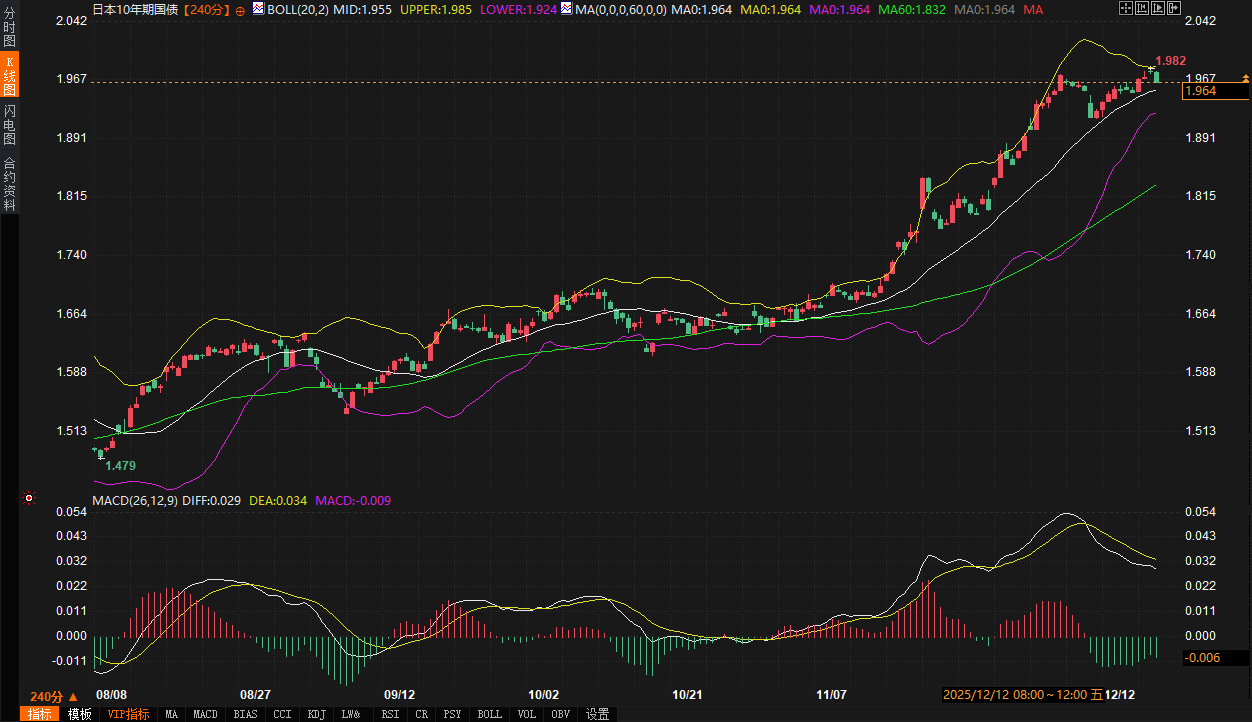
From a technical perspective, the 240-minute chart of the 10-year Japanese government bond yield shows that the current price of 1.964% is at a crucial technical level. The Bollinger Band middle line (1.955%) provides initial support, while the upper line (1.985%) and the psychological level of 2.00% together form a strong resistance zone above. In the MACD indicator, the DIFF line and DEA line are close to converging above the zero axis, and the red histogram momentum is contracting, indicating that the short-term upward momentum has weakened, and the market is in a consolidation phase before a directional decision. Intraday, close attention should be paid to the struggle between the yield and the Bollinger Band middle line. If it breaks down effectively, it may test the lower line at 1.924%; conversely, if the post-decision statement is hawkish, a break above 1.985% could open up space towards the 2.02%-2.05% range.
The USD/JPY exchange rate is currently in a delicate balance. On one hand, even if the Bank of Japan raises interest rates tomorrow, the significant yield spread between Japanese and US government bonds (for example, the spread over 300 basis points for 10-year bonds) remains a core fundamental factor supporting the USD/JPY exchange rate. This ensures that buying pressure remains present during pullbacks. On the other hand, the market remains highly vigilant about potential intervention by Japanese authorities in the foreign exchange market, limiting any disorderly upward movement of the exchange rate.
From a fundamental perspective, besides interest rate differentials, the market is paying closer attention to the Bank of Japan governor's wording at the press conference. Currently, there's a prevailing view that the Ministry of Finance might intervene if the yen depreciates sharply due to the central bank's "dovish rate hike" (i.e., raising rates but hinting at a slow pace of follow-up). This expectation creates psychological resistance for USD/JPY bulls. In other words, exchange rate movements depend not only on the interest rate action itself, but also on the signals conveyed afterward regarding the speed and determination of monetary policy normalization.
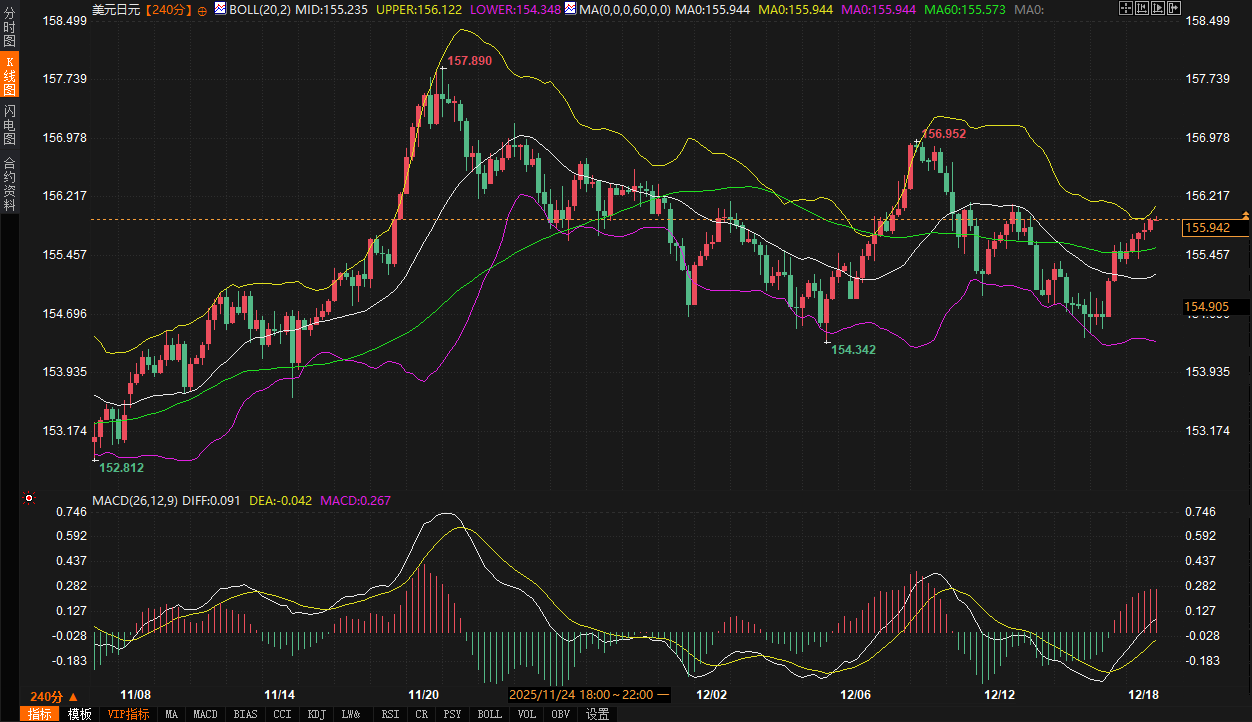
From a technical perspective, the USD/JPY 240-minute chart shows a high-level consolidation pattern. The current exchange rate of 155.942 is closely trading near the upper Bollinger Band (156.122), indicating short-term strength. However, while the MACD indicator shows the DIFF line (0.091) crossing above the DEA line (-0.042), forming a preliminary golden cross, the absolute value of the momentum bars is not large, suggesting that the upward momentum is not very strong. The middle Bollinger Band at 155.235 is the recent key level and primary support, while the lower band at 154.348 is a more crucial support area. The first resistance level to watch is the 156.10-156.30 range, which is both the upper Bollinger Band and close to recent highs, making a breakout difficult. If the Bank of Japan adopts an unexpectedly hawkish stance, pushing the yen stronger, the exchange rate may test the 155.00-154.80 support zone. Traders should closely monitor the surge in volatility immediately following the Bank of Japan's decision announcement, as well as the exchange rate's reaction to the aforementioned key technical range.
As a major global creditor nation and issuer of safe-haven currencies, Japan's government bond market fluctuations have spillover effects. The Bank of Japan's decision tomorrow will have an impact beyond yen-denominated assets. A key transmission path to watch is: changes in Japanese government bond yields → global bond market sentiment → demand for safe-haven assets.
If the Bank of Japan raises interest rates with an unexpectedly hawkish stance or provides clear guidance on the future tightening path, it could lead to a further rise in Japanese government bond yields. This could exacerbate selling pressure in global bond markets, as it weakens the attractiveness of Japanese bonds as a source of low-yield "funding currency" globally and could trigger cross-market capital reallocation. Against the backdrop of uncertainty surrounding global economic growth prospects and geopolitical risks (such as the Russia-Ukraine situation and Trump's tariff rhetoric), sharp fluctuations in the bond market are likely to trigger risk aversion.
At this juncture, the appeal of gold, a traditional safe-haven asset, may increase. Although gold prices are primarily driven by real US dollar interest rates and typically negatively correlated with US Treasury yields, this negative correlation may temporarily dissipate under a "safe-haven-driven" model rife with market panic and uncertainty. If a surge in Japanese bond yields triggers widespread concerns in global financial markets about tightening liquidity and asset price revaluation, funds may partially flow into gold to hedge against risk. Therefore, tomorrow's traders should not only focus on the US dollar and the Japanese yen but also observe the联动反应 (linkage/reaction) of US and German bond yields, and whether gold breaks free from its simple negative correlation with the US dollar, exhibiting independent safe-haven characteristics.
In conclusion, the Bank of Japan's December monetary policy decision is not the end of the market trend, but rather the beginning of a new phase. For the Japanese bond market, after the interest rate hike, the focus will quickly shift to the central bank's economic outlook report, potential adjustments to the yield curve control (YCC) policy (if any), and the possible timing of further interest rate hikes. Whether the 10-year yield remains below 2.0% or establishes a new, higher trading range will depend on these details.
For USD/JPY, the post-decision exchange rate movement will be the result of a struggle between "interest rate differential reality" and "policy expectations." If the central bank demonstrates a firm tightening sequence, the yen may be boosted, and USD/JPY may test key support levels. Conversely, any signal interpreted as hesitation or dovishness could cause the exchange rate to resume its upward trend, challenge multi-year highs, and retest the Japanese Ministry of Finance's resolve to intervene. In this process, economic data from the United States (such as inflation and employment) and the Federal Reserve's policy direction will continue to play another key role in influencing trans-Pacific interest rate differentials.
Overall, the market is expected to experience high volatility over the next 24-48 hours. Traders should manage their position risk carefully, focusing on price breakouts or confirmations of key technical ranges, and scrutinizing subtle shifts in policy logic within central bank statements. This will be crucial for predicting the market's main theme in the next phase.
Japanese bonds: Technical repairs and structural adjustments before expectations are realized.
The Japanese bond market's performance on Thursday clearly reflected the "buy the rumor, sell the fact" trading logic. Although the market had almost fully priced in the prospect of a 25 basis point rate hike by the Bank of Japan, the bond market did not continue the previous day's across-the-board decline. Instead, it saw some stabilization and rebound, especially in short- and medium-term bonds.
From a fundamental perspective, the core issue in the market has shifted from "whether to raise interest rates" to "the policy path and communication after the rate hike." According to a report by the well-known institution IFR, overnight index swap (OIS) market data shows that the market expects a 96.5% probability of a 25 basis point rate hike tomorrow. A survey conducted by a major Japanese currency broker also shows that 99% of the 146 respondents expect the central bank to take action. This near-certain expectation has led some traders to adjust their positions ahead of the decision, closing out some short positions to take profits, thus providing short-term support for the bond market. This explains the slight pullback in 10-year yields from recent highs.
However, the structural divergence within the bond market warrants attention. While there was buying interest in 10-year and shorter-term bonds, ultra-long-term bonds (such as 20-, 30-, and 40-year bonds) continued to face pressure. This "bearish steepening of the yield curve" (i.e., the rise in long-term interest rates exceeding that of short-term rates) reflects deep market concerns about Japan's long-term inflation outlook and fiscal sustainability. Institutional investors, such as life insurance companies, continued to engage in portfolio rebalancing, selling older, low-coupon bonds and buying newer, higher-coupon bonds to enhance their portfolios' resilience against rising interest rates. This structural selling pressure limited the upside potential for long-term bonds.
From a technical perspective, the 240-minute chart of the 10-year Japanese government bond yield shows that the current price of 1.964% is at a crucial technical level. The Bollinger Band middle line (1.955%) provides initial support, while the upper line (1.985%) and the psychological level of 2.00% together form a strong resistance zone above. In the MACD indicator, the DIFF line and DEA line are close to converging above the zero axis, and the red histogram momentum is contracting, indicating that the short-term upward momentum has weakened, and the market is in a consolidation phase before a directional decision. Intraday, close attention should be paid to the struggle between the yield and the Bollinger Band middle line. If it breaks down effectively, it may test the lower line at 1.924%; conversely, if the post-decision statement is hawkish, a break above 1.985% could open up space towards the 2.02%-2.05% range.
USD/JPY: A Cautious Balance Amid Interest Rate Differentiation Logic and Doubts of Intervention
The USD/JPY exchange rate is currently in a delicate balance. On one hand, even if the Bank of Japan raises interest rates tomorrow, the significant yield spread between Japanese and US government bonds (for example, the spread over 300 basis points for 10-year bonds) remains a core fundamental factor supporting the USD/JPY exchange rate. This ensures that buying pressure remains present during pullbacks. On the other hand, the market remains highly vigilant about potential intervention by Japanese authorities in the foreign exchange market, limiting any disorderly upward movement of the exchange rate.
From a fundamental perspective, besides interest rate differentials, the market is paying closer attention to the Bank of Japan governor's wording at the press conference. Currently, there's a prevailing view that the Ministry of Finance might intervene if the yen depreciates sharply due to the central bank's "dovish rate hike" (i.e., raising rates but hinting at a slow pace of follow-up). This expectation creates psychological resistance for USD/JPY bulls. In other words, exchange rate movements depend not only on the interest rate action itself, but also on the signals conveyed afterward regarding the speed and determination of monetary policy normalization.
From a technical perspective, the USD/JPY 240-minute chart shows a high-level consolidation pattern. The current exchange rate of 155.942 is closely trading near the upper Bollinger Band (156.122), indicating short-term strength. However, while the MACD indicator shows the DIFF line (0.091) crossing above the DEA line (-0.042), forming a preliminary golden cross, the absolute value of the momentum bars is not large, suggesting that the upward momentum is not very strong. The middle Bollinger Band at 155.235 is the recent key level and primary support, while the lower band at 154.348 is a more crucial support area. The first resistance level to watch is the 156.10-156.30 range, which is both the upper Bollinger Band and close to recent highs, making a breakout difficult. If the Bank of Japan adopts an unexpectedly hawkish stance, pushing the yen stronger, the exchange rate may test the 155.00-154.80 support zone. Traders should closely monitor the surge in volatility immediately following the Bank of Japan's decision announcement, as well as the exchange rate's reaction to the aforementioned key technical range.
Market Linkage: The Potential Transmission from Bond Market Volatility to Risk Aversion
As a major global creditor nation and issuer of safe-haven currencies, Japan's government bond market fluctuations have spillover effects. The Bank of Japan's decision tomorrow will have an impact beyond yen-denominated assets. A key transmission path to watch is: changes in Japanese government bond yields → global bond market sentiment → demand for safe-haven assets.
If the Bank of Japan raises interest rates with an unexpectedly hawkish stance or provides clear guidance on the future tightening path, it could lead to a further rise in Japanese government bond yields. This could exacerbate selling pressure in global bond markets, as it weakens the attractiveness of Japanese bonds as a source of low-yield "funding currency" globally and could trigger cross-market capital reallocation. Against the backdrop of uncertainty surrounding global economic growth prospects and geopolitical risks (such as the Russia-Ukraine situation and Trump's tariff rhetoric), sharp fluctuations in the bond market are likely to trigger risk aversion.
At this juncture, the appeal of gold, a traditional safe-haven asset, may increase. Although gold prices are primarily driven by real US dollar interest rates and typically negatively correlated with US Treasury yields, this negative correlation may temporarily dissipate under a "safe-haven-driven" model rife with market panic and uncertainty. If a surge in Japanese bond yields triggers widespread concerns in global financial markets about tightening liquidity and asset price revaluation, funds may partially flow into gold to hedge against risk. Therefore, tomorrow's traders should not only focus on the US dollar and the Japanese yen but also observe the联动反应 (linkage/reaction) of US and German bond yields, and whether gold breaks free from its simple negative correlation with the US dollar, exhibiting independent safe-haven characteristics.
Future Outlook: The resolution's implementation is just the beginning; the game of policy paths has commenced.
In conclusion, the Bank of Japan's December monetary policy decision is not the end of the market trend, but rather the beginning of a new phase. For the Japanese bond market, after the interest rate hike, the focus will quickly shift to the central bank's economic outlook report, potential adjustments to the yield curve control (YCC) policy (if any), and the possible timing of further interest rate hikes. Whether the 10-year yield remains below 2.0% or establishes a new, higher trading range will depend on these details.
For USD/JPY, the post-decision exchange rate movement will be the result of a struggle between "interest rate differential reality" and "policy expectations." If the central bank demonstrates a firm tightening sequence, the yen may be boosted, and USD/JPY may test key support levels. Conversely, any signal interpreted as hesitation or dovishness could cause the exchange rate to resume its upward trend, challenge multi-year highs, and retest the Japanese Ministry of Finance's resolve to intervene. In this process, economic data from the United States (such as inflation and employment) and the Federal Reserve's policy direction will continue to play another key role in influencing trans-Pacific interest rate differentials.
Overall, the market is expected to experience high volatility over the next 24-48 hours. Traders should manage their position risk carefully, focusing on price breakouts or confirmations of key technical ranges, and scrutinizing subtle shifts in policy logic within central bank statements. This will be crucial for predicting the market's main theme in the next phase.
- Risk Warning and Disclaimer
- The market involves risk, and trading may not be suitable for all investors. This article is for reference only and does not constitute personal investment advice, nor does it take into account certain users’ specific investment objectives, financial situation, or other needs. Any investment decisions made based on this information are at your own risk.