Why did the pound rise 47 points after the Bank of England cut interest rates? The hawkish undertones behind the decision and the new market logic.
2025-12-18 20:22:00
On Thursday (December 18), the Bank of England announced its highly anticipated December monetary policy decision. The Monetary Policy Committee (MPC) voted by a narrow margin of 5 to 4 to cut the benchmark interest rate by 25 basis points to 3.75%. This is the sixth consecutive rate cut since the rate-cutting cycle began in August 2024, with a cumulative reduction of 150 basis points. The policy statement indicated that although inflation remains above the 2% target, the recent pace of decline has accelerated, and economic weakness and increased labor market slack provide room for further policy easing. However, the near-half-splitting division within the committee and the cautious wording regarding the "details of future policy easing will depend on the evolution of the inflation outlook" cast a shadow of uncertainty over this rate cut.

Following the announcement of the decision, financial markets reacted swiftly, with the overall interpretation leaning towards a "hawkish rate cut"—meaning that despite the action taken, the central bank's cautious attitude and internal divisions suggest that the future easing path will be fraught with difficulties and may slow down.
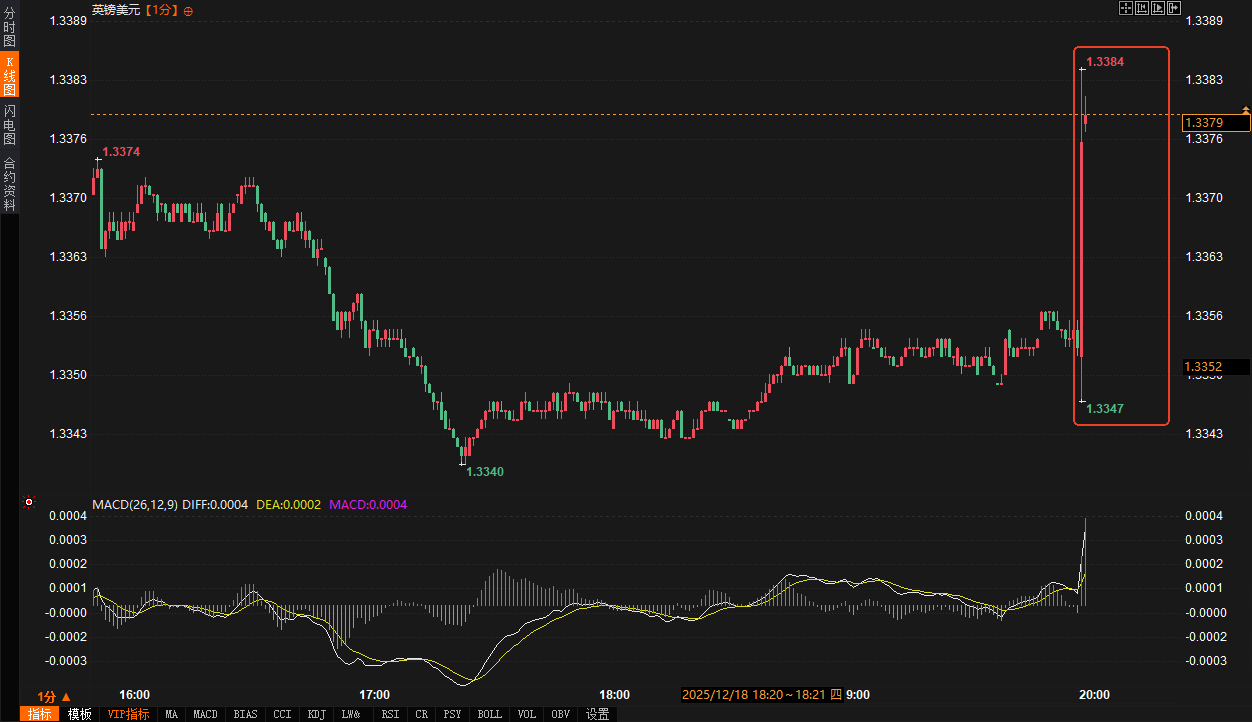
In the foreign exchange market, the pound sterling against the dollar exhibited a classic "buy the rumor, sell the fact" pattern. Prior to the rate cut announcement, the market had largely priced it in, with the pound trading around 1.3355 against the dollar. Immediately after the announcement, the pound surged approximately 47 points, reaching a high of 1.3394. This sharp rise reflected that the 5-4 vote was more closely contested than some market participants had anticipated, and the statement in the policy statement that "judgments will become more nuanced" was interpreted as hawkish. However, the rally was short-lived, and the pound subsequently retreated slightly. This indicates that after initially digesting the details of the decision, the market realized that inflation risks had not been completely eliminated, and that future rate cuts might be very gradual, limiting the pound's potential for further declines. As of this writing, the pound sterling against the dollar has consolidated within the 1.3370-1.3380 range.
The bond market reacted more directly and dramatically. Traders quickly lowered their bets on the extent of future interest rate cuts by the Bank of England. According to interest rate futures market pricing, the market expects the Bank of England to cut rates by only about 39 basis points throughout next year, meaning that after this rate cut, there may only be one or two more 25 basis point cuts left in 2026. Influenced by this expectation, UK government bond yields rose across the board. The yield on the 2-year UK government bond, which is sensitive to policy rates, successfully reversed its earlier decline, rising 2 basis points to 3.74%. Meanwhile, the yield on the 10-year UK government bond, a bellwether for the long-term economic outlook, rose 2.5 basis points to 4.50%. This change in the yield curve (both short and long-term yields rose simultaneously, with the long-term rise slightly larger) clearly indicates that the market believes the central bank is finding it more difficult to balance curbing inflation with supporting the economy, long-term inflation expectations have risen slightly, and the final interest rate level for monetary easing may be higher than previously expected.
Following the announcement of the resolution, institutional analysts and retail traders engaged in heated discussions, with the core focus on the significant disagreements surrounding the MPC, the subtle shifts in the inflation outlook, and guidance for the future policy path.
Institutional opinions generally emphasize "caution" and "reliance on data." Several prominent analysts pointed out that although the Bank of England chose to cut interest rates, the message it conveyed was far from dovish. One analyst wrote, "The 5-4 vote itself is a strong signal that concerns about the persistence of inflation remain deeply ingrained within the committee. In particular, the four members who supported keeping rates unchanged emphasized that inflation, wage growth, and inflation expectations remain above target levels, setting a high bar for future rate-cutting cycles." Another institution noted the new phrase in the policy statement that "judgments will become more nuanced," believing this essentially foreshadows a slowdown or even a pause in the rate-cutting cycle, especially given that the benchmark interest rate is gradually approaching a neutral level.
Retail traders' sentiment was divided. Some technically-oriented traders cheered the pound's short-term rebound, believing that after the negative news had been fully priced in, the pound had room for technical correction. However, more fundamental traders expressed concerns about future uncertainty. One user pointed out: "The drop in inflation to 3.2% and the short-term deflationary effect of the budget are good things, but look at those forward-looking wage surveys (such as the policymakers' panel and the central bank's agent survey), next year's wage growth is still expected to be 3.5%-3.8%. How can this be sustainably compatible with the 2% inflation target?" This view reflects the market's continued vigilance regarding the stubbornness of "last-mile" inflation. In addition, descriptions of the resilience of the global economy, especially the statement that "tariff rhetoric and trade policy uncertainty have dragged down the global economy less than expected" and the claim of worsening deflation in Chinese exports, have also sparked discussions about the complexity of the global inflation environment.
The actual outcome was more complex than the dovish rate cut widely anticipated by the market before the decision was announced. Previously, the market had primarily priced in the rate cut itself, but was unprepared for the "hawkish" tone of the statement, which emphasized risk balancing, highlighted significant internal divisions, and explicitly hinted at increased difficulty in future decision-making. This is the core reason for the short-term rebound in the pound and the compression of rate cut expectations.
This analysis examines the short-term technical outlook for the British pound against the US dollar (GBP/USD) in light of fundamental changes. The post-decision surge followed by a pullback indicates significant upward pressure.
Key resistance zone: 1.3400 - 1.3420. This is not only a psychological level above the intraday high of 1.3394, but also close to a technical resistance area that has repeatedly suppressed price increases recently. If the exchange rate can effectively break through this zone, it may open a channel to test 1.3450-1.3480, but this requires a significant improvement in market risk sentiment or a broad weakening of the US dollar.
Key support zone: 1.3330 - 1.3350. This area served as a consolidation platform before the policy decision announcement and is a crucial dividing line between bullish and bearish sentiment in the short term. If subsequent UK economic data proves weak, or if market expectations for further easing by the Bank of England resurface, the exchange rate may fall back to test this support zone. A break below this level could lead to further declines towards the 1.3280-1.3300 range.
The key focus during the trading session is how the market will weigh two factors: on the one hand, the pressure for further interest rate cuts due to economic slowdown and a loose labor market; on the other hand, the constraints on policy from wage stickiness, service inflation, and hawkish voices within the economy. Unexpected changes in any of these data sources (such as the labor market report, PMI data, or wage growth data) could trigger a breakout in the exchange rate within the aforementioned range.
Looking ahead, the Bank of England's monetary policy path, as stated in its announcement, will be a "more nuanced judgment." This decision clearly outlines the policy framework and risk landscape for the coming period.
In the short term, the inflation path is the core focus. The central bank expects inflation to fall to around 3% in the first quarter of 2026, with a possible temporary rebound in December 2025 due to factors such as a tobacco tax increase. The most critical timeframe is April 2026, when a series of direct measures in the budget (such as a one-off cut to energy bill regulatory costs) are expected to reduce CPI inflation by about 0.5 percentage points, bringing it closer to the 2% target. This will be a key observation window for assessing whether inflation can sustainably return to the target. If inflation falls sharply as expected at that time, and wage growth slows in tandem, it will provide a justification for further interest rate cuts.
In the medium term, the balance of risks will determine the pace of policy. The Bank of England has clearly identified two major risks: firstly, past high inflation may continue to influence wage and price setting through structural factors, and inflation expectations remain high, posing an upside risk; secondly, households and businesses may remain cautious, and the labor market may weaken significantly further, leading to medium-term inflation falling below the target. There are significant disagreements among MPC members regarding the weighting of these risks, meaning that every future meeting is likely to face intense debate, and the pace of policy adjustments is likely to be inconsistent and data-dependent.
In terms of market impact, this highly uncertain and data-dependent environment may mean that volatility in the pound and UK government bond yields will remain high. The pound's performance will be influenced not only by the Bank of England's relatively dovish or hawkish stance, but also by the differences in monetary policy between the pound and major economies such as the US. Meanwhile, global economic resilience, geopolitical situations (such as the development of the Russia-Ukraine conflict), and trade policy moves by major economies (such as US tariff rhetoric) will all indirectly affect UK market pricing by influencing global growth and inflation expectations.
Overall, the Bank of England's December decision ushered in a new policy phase: the easing cycle is not over, but it has entered a more challenging phase. Every step will be taken with extreme caution, requiring a delicate balance between ensuring a sustained return of inflation to the target and avoiding undue damage to the economy. For market participants, understanding and tracking economic data, especially subtle changes in wage and service inflation, will be more crucial than ever.
Market reaction: The pound sterling surged and then retreated, and the UK bond yield curve steepened.
Following the announcement of the decision, financial markets reacted swiftly, with the overall interpretation leaning towards a "hawkish rate cut"—meaning that despite the action taken, the central bank's cautious attitude and internal divisions suggest that the future easing path will be fraught with difficulties and may slow down.
In the foreign exchange market, the pound sterling against the dollar exhibited a classic "buy the rumor, sell the fact" pattern. Prior to the rate cut announcement, the market had largely priced it in, with the pound trading around 1.3355 against the dollar. Immediately after the announcement, the pound surged approximately 47 points, reaching a high of 1.3394. This sharp rise reflected that the 5-4 vote was more closely contested than some market participants had anticipated, and the statement in the policy statement that "judgments will become more nuanced" was interpreted as hawkish. However, the rally was short-lived, and the pound subsequently retreated slightly. This indicates that after initially digesting the details of the decision, the market realized that inflation risks had not been completely eliminated, and that future rate cuts might be very gradual, limiting the pound's potential for further declines. As of this writing, the pound sterling against the dollar has consolidated within the 1.3370-1.3380 range.
The bond market reacted more directly and dramatically. Traders quickly lowered their bets on the extent of future interest rate cuts by the Bank of England. According to interest rate futures market pricing, the market expects the Bank of England to cut rates by only about 39 basis points throughout next year, meaning that after this rate cut, there may only be one or two more 25 basis point cuts left in 2026. Influenced by this expectation, UK government bond yields rose across the board. The yield on the 2-year UK government bond, which is sensitive to policy rates, successfully reversed its earlier decline, rising 2 basis points to 3.74%. Meanwhile, the yield on the 10-year UK government bond, a bellwether for the long-term economic outlook, rose 2.5 basis points to 4.50%. This change in the yield curve (both short and long-term yields rose simultaneously, with the long-term rise slightly larger) clearly indicates that the market believes the central bank is finding it more difficult to balance curbing inflation with supporting the economy, long-term inflation expectations have risen slightly, and the final interest rate level for monetary easing may be higher than previously expected.
Market Sentiment and Institutional Interpretation: Finding Direction Amidst Divergence
Following the announcement of the resolution, institutional analysts and retail traders engaged in heated discussions, with the core focus on the significant disagreements surrounding the MPC, the subtle shifts in the inflation outlook, and guidance for the future policy path.
Institutional opinions generally emphasize "caution" and "reliance on data." Several prominent analysts pointed out that although the Bank of England chose to cut interest rates, the message it conveyed was far from dovish. One analyst wrote, "The 5-4 vote itself is a strong signal that concerns about the persistence of inflation remain deeply ingrained within the committee. In particular, the four members who supported keeping rates unchanged emphasized that inflation, wage growth, and inflation expectations remain above target levels, setting a high bar for future rate-cutting cycles." Another institution noted the new phrase in the policy statement that "judgments will become more nuanced," believing this essentially foreshadows a slowdown or even a pause in the rate-cutting cycle, especially given that the benchmark interest rate is gradually approaching a neutral level.
Retail traders' sentiment was divided. Some technically-oriented traders cheered the pound's short-term rebound, believing that after the negative news had been fully priced in, the pound had room for technical correction. However, more fundamental traders expressed concerns about future uncertainty. One user pointed out: "The drop in inflation to 3.2% and the short-term deflationary effect of the budget are good things, but look at those forward-looking wage surveys (such as the policymakers' panel and the central bank's agent survey), next year's wage growth is still expected to be 3.5%-3.8%. How can this be sustainably compatible with the 2% inflation target?" This view reflects the market's continued vigilance regarding the stubbornness of "last-mile" inflation. In addition, descriptions of the resilience of the global economy, especially the statement that "tariff rhetoric and trade policy uncertainty have dragged down the global economy less than expected" and the claim of worsening deflation in Chinese exports, have also sparked discussions about the complexity of the global inflation environment.
The actual outcome was more complex than the dovish rate cut widely anticipated by the market before the decision was announced. Previously, the market had primarily priced in the rate cut itself, but was unprepared for the "hawkish" tone of the statement, which emphasized risk balancing, highlighted significant internal divisions, and explicitly hinted at increased difficulty in future decision-making. This is the core reason for the short-term rebound in the pound and the compression of rate cut expectations.
Technical Analysis and Key Ranges: Support and Resistance for GBP/USD
This analysis examines the short-term technical outlook for the British pound against the US dollar (GBP/USD) in light of fundamental changes. The post-decision surge followed by a pullback indicates significant upward pressure.
Key resistance zone: 1.3400 - 1.3420. This is not only a psychological level above the intraday high of 1.3394, but also close to a technical resistance area that has repeatedly suppressed price increases recently. If the exchange rate can effectively break through this zone, it may open a channel to test 1.3450-1.3480, but this requires a significant improvement in market risk sentiment or a broad weakening of the US dollar.
Key support zone: 1.3330 - 1.3350. This area served as a consolidation platform before the policy decision announcement and is a crucial dividing line between bullish and bearish sentiment in the short term. If subsequent UK economic data proves weak, or if market expectations for further easing by the Bank of England resurface, the exchange rate may fall back to test this support zone. A break below this level could lead to further declines towards the 1.3280-1.3300 range.
The key focus during the trading session is how the market will weigh two factors: on the one hand, the pressure for further interest rate cuts due to economic slowdown and a loose labor market; on the other hand, the constraints on policy from wage stickiness, service inflation, and hawkish voices within the economy. Unexpected changes in any of these data sources (such as the labor market report, PMI data, or wage growth data) could trigger a breakout in the exchange rate within the aforementioned range.
Future Trends Outlook: Moving Forward in a "Delicate Balance"
Looking ahead, the Bank of England's monetary policy path, as stated in its announcement, will be a "more nuanced judgment." This decision clearly outlines the policy framework and risk landscape for the coming period.
In the short term, the inflation path is the core focus. The central bank expects inflation to fall to around 3% in the first quarter of 2026, with a possible temporary rebound in December 2025 due to factors such as a tobacco tax increase. The most critical timeframe is April 2026, when a series of direct measures in the budget (such as a one-off cut to energy bill regulatory costs) are expected to reduce CPI inflation by about 0.5 percentage points, bringing it closer to the 2% target. This will be a key observation window for assessing whether inflation can sustainably return to the target. If inflation falls sharply as expected at that time, and wage growth slows in tandem, it will provide a justification for further interest rate cuts.
In the medium term, the balance of risks will determine the pace of policy. The Bank of England has clearly identified two major risks: firstly, past high inflation may continue to influence wage and price setting through structural factors, and inflation expectations remain high, posing an upside risk; secondly, households and businesses may remain cautious, and the labor market may weaken significantly further, leading to medium-term inflation falling below the target. There are significant disagreements among MPC members regarding the weighting of these risks, meaning that every future meeting is likely to face intense debate, and the pace of policy adjustments is likely to be inconsistent and data-dependent.
In terms of market impact, this highly uncertain and data-dependent environment may mean that volatility in the pound and UK government bond yields will remain high. The pound's performance will be influenced not only by the Bank of England's relatively dovish or hawkish stance, but also by the differences in monetary policy between the pound and major economies such as the US. Meanwhile, global economic resilience, geopolitical situations (such as the development of the Russia-Ukraine conflict), and trade policy moves by major economies (such as US tariff rhetoric) will all indirectly affect UK market pricing by influencing global growth and inflation expectations.
Overall, the Bank of England's December decision ushered in a new policy phase: the easing cycle is not over, but it has entered a more challenging phase. Every step will be taken with extreme caution, requiring a delicate balance between ensuring a sustained return of inflation to the target and avoiding undue damage to the economy. For market participants, understanding and tracking economic data, especially subtle changes in wage and service inflation, will be more crucial than ever.
- Risk Warning and Disclaimer
- The market involves risk, and trading may not be suitable for all investors. This article is for reference only and does not constitute personal investment advice, nor does it take into account certain users’ specific investment objectives, financial situation, or other needs. Any investment decisions made based on this information are at your own risk.